When I turned thirty-six, the village had already written my future in whispers. Still no wife? they said, shaking their heads like my life was a broken tool. I didn’t argue. I watered my small garden, fed my chickens and ducks, and let quietness be my companion. Peace was never loud, but it was honest—and for a long time, I believed that was enough.
One late-winter afternoon at the market, I saw her sitting near the roadside where the wind cut through people’s sleeves. Her clothes were thin and patched, her hands held out—not demanding, just asking the world to remember she existed. Yet it wasn’t the rags that held me there. It was her eyes: clear and gentle, like a pond that had learned to stay calm while a storm lived underneath. I bought rice cakes and a bottle of water and placed them in her palms. “Thank you,” she murmured, head bowed, voice barely carrying over the market noise.
That night, her face followed me home like a shadow I couldn’t shake. Days later, I found her again at another corner, the same quiet suffering wrapped around her shoulders. I sat beside her on the cold stone and spoke as if we were old friends. Her name was Hạnh. No family, no home—years spent moving from street to street, surviving on what kindness could be spared. She didn’t tell the story with tears; she told it like someone who had already cried everything out.
I don’t know what took hold of my tongue, but words rose before I could measure them. “If you agree,” I said, “I will marry you. I’m not rich, but I can give you food… and a roof.” The market around us seemed to tilt. People stared like I’d announced I’d marry the rain. Hạnh looked at me as if I was a mirage—something beautiful that couldn’t possibly be real. For three days she disappeared, and I told myself I’d been foolish. On the fourth day, she returned and gave a small nod that somehow felt heavier than a vow.
Our wedding was no grand parade—just a few tables, simple dishes, and faces trained to look for disaster. “Khải married a beggar,” they muttered, as if saying it twice could make it true in my bones. I watched Hạnh’s hands tremble when she held the teacup, watched her shoulders tighten when someone laughed too loudly. I wanted to shield her from every cruel thought, but marriage doesn’t come with walls tall enough to block other people’s tongues.
Life didn’t soften just because we signed our names. Hạnh couldn’t cook well at first, and farm work bruised her palms until they split. There were nights she sat by the stove staring at the flame, silent as if she was listening for someone who would never return. But she woke before dawn, tried again, learned slowly, stubbornly—like someone paying a debt she never owed. And one day, our home began to smell of fresh rice and warm soup instead of damp loneliness. Laughter replaced the empty air. I realized the village had been wrong about one thing: peace could grow bigger when shared.
A year later, our son arrived with a cry that sounded like a door opening. Two years after that, our daughter followed, small fists clenched like she was already ready to fight the world. When they called “Papa” and “Mama,” my chest filled with something I’d never harvested from any garden—proof. Not proof for the neighbors, but proof for myself that my life had meaning beyond their opinions.
Still, there were things Hạnh never said. She avoided the market when it got crowded. She never spoke about her past except in careful fragments. Sometimes, when the children slept, I would find her standing outside under the moonlight as if guarding a memory. I asked once, gently, if there was anything she was afraid of. She smiled too quickly. “Nothing,” she lied, and I let it go because love is not interrogation. I thought patience could heal anything.
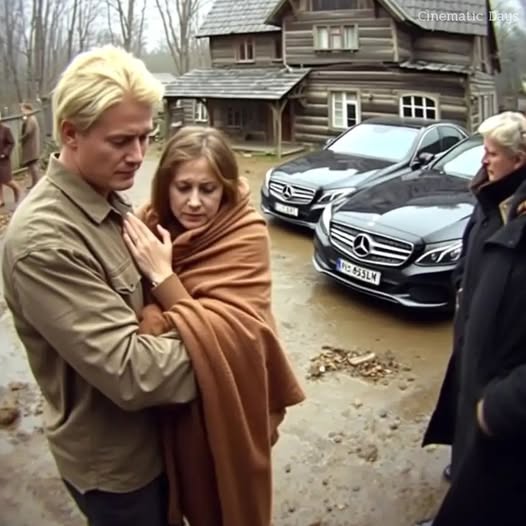
Then came the day the village stopped whispering and started shouting. It was just after dawn when the sound of engines broke the usual morning hush. Three luxury cars rolled down our dirt road like they didn’t know how to be humble—black paint gleaming, windows tinted, tires clean enough to insult the dust. Chickens scattered. Neighbors poured out of their houses like ants from a shaken hill. I stepped into the yard, heart pounding, feeling suddenly small in my worn shirt and muddy sandals.
The first car door opened, and a man in a crisp suit stepped out, followed by another, and another—people who moved like the world made room for them. One of them held a folder. Another carried a bouquet too expensive for our small yard. Then the back door of the middle car opened and an elderly woman descended, her hair silver, her eyes sharp with the kind of authority that doesn’t need to raise its voice. She looked past everyone—past me, past the neighbors—straight to Hạnh, who had come out holding our daughter’s hand.
“Hạnh,” the elderly woman said, and the name landed like thunder. My wife’s face drained of color. For the first time since I’d met her, those gentle eyes became a battlefield. She pulled our daughter closer and whispered, “Stay behind me.” I understood then: she hadn’t been hiding from hunger. She had been hiding from someone.
The men bowed slightly, and the one with the folder spoke. “Madam Hạnh Lê,” he announced, “the rightful heir.” The village gasped as if the air itself had been stolen. Papers were unfolded—legal documents, family seals, photographs of Hạnh in a world of chandeliers and silk. The truth, ugly and dazzling, spilled into our yard: Hạnh was not a beggar by birth. She had once belonged to wealth—a family so powerful that when conflict and greed erupted, she was pushed out, erased, hunted by people who wanted her name to disappear. Begging wasn’t her identity; it was her camouflage.
My knees felt weak. All the nights she stared into the stove, all the times she flinched at footsteps, all the silence—suddenly they had sharp edges. Rage and sorrow tangled inside me. Not because she had been rich, but because she had carried fear alone while I believed love could solve everything without truth. I looked at her, waiting for the denial I wished for, the excuse that would keep our life simple. Hạnh’s lips trembled.
“I wanted to be ordinary,” she said, voice breaking. “I wanted to be safe. I wanted… to be loved without my name following me.” Her gaze found mine, wet and honest now. “When you offered me a roof, you didn’t ask what I could give you. You didn’t ask who I was. You only saw me. For the first time, I felt like I could breathe.” She turned to the suited men and the elderly woman. “But I won’t leave like a thief in the night. This is my husband. These are my children. If you came for me, you must come through the truth.”
The elderly woman’s expression cracked—just slightly, like stone showing a hidden vein. “We have searched for you for years,” she said, softer now. “Your father died. Your mother… never stopped waiting.” She glanced at me, measuring me with eyes that had measured a thousand people. “And you,” she added, “you married her when she had nothing.”
I expected the village to turn cruel again, to decide I had been tricked. Instead, something unexpected happened: the same neighbors who once mocked us stood still, embarrassed by their own past words. Some lowered their heads. One woman whispered, “She was never a beggar… we were the beggars—begging for gossip.” The luxury cars didn’t just reveal Hạnh’s identity. They revealed our village’s hunger for judgment.
That night, after the officials left and the yard returned to silence, Hạnh sat with me on the floor near the sleeping children. “I’m sorry,” she said, tears finally falling like they’d been waiting years for permission. “I was afraid you’d leave if you knew.”
I held her hands—those same hands that had learned to cook, to plant, to rock babies to sleep. “You didn’t marry me with money,” I said. “You married me with effort. With courage. With love.” My throat tightened. “But from now on, we carry fear together, not alone.”
In the weeks that followed, Hạnh chose to face her past—not because wealth called her, but because her children deserved a future without running. We did not move into a palace and forget the smell of soil. We brought our village values with us: honest work, simple meals, quiet gratitude. And when people asked how a “beggar” became a lady, Hạnh would answer, “I became myself again—because someone loved me when I was invisible.”
The lesson didn’t belong to the luxury cars or the shocking reveal. It belonged to the choice made at a roadside in winter: to treat a human being as worthy before knowing their story. Because the truth is, status can be taken, names can be erased, and riches can vanish overnight—but character is what remains when everything else is stripped away. And love, real love, doesn’t ask, What are you? It asks, Are you hungry? Are you safe? Come home.