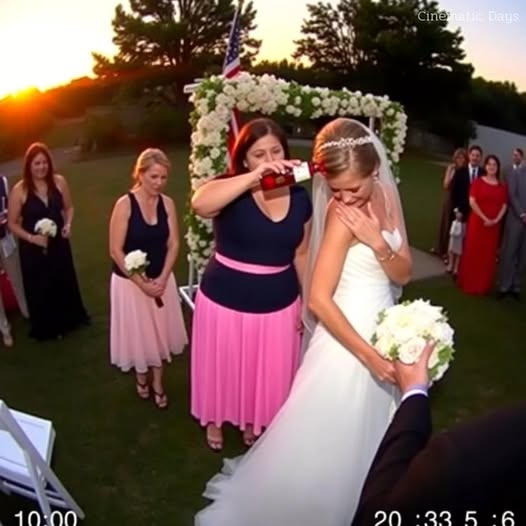
The ruin of my wedding dress happened in slow motion, a cold, golden arc of vintage champagne splashing against the pristine white silk. It wasn’t an accident; it was a declaration. My sister, Bethany, stood amidst the wreckage of the reception hall, a half-empty flute in one hand and a manic gleam in her eyes, screaming that this was what I deserved for acting like I was “better” than everyone else. Behind her, the wedding cake lay in a tragic heap of smashed fondant and sugar flowers, the victim of her sudden, violent tantrum. The music had died, replaced by the collective gasp of two hundred guests. I stood frozen, feeling the sticky liquid seep into the fabric, watching mascara run down Bethany’s face like black rivers of spite. She looked less like a sister and more like a demolition crew in a bridesmaid’s dress.
My mother’s reaction was almost more painful than the humiliation itself. She rushed not to me, but to Bethany, wrapping her arms around the perpetrator. “She just needed to vent,” my mother told the silent room, her voice trembling with that familiar, enabling plea she had used for decades. “She’s been under so much pressure. Everyone, please, just give her a moment.” She looked at me, pleading with her eyes to smooth things over, to be the bigger person, to absorb the chaos as I always did. In that moment, the hierarchy of our family was laid bare: Bethany was the fragile storm that needed protecting, and I was the sturdy wall built to endure the battering.
I did not scream. I did not cry. I simply nodded, wiped a glob of frosting from my skirt, and thanked the stunned catering staff. But beneath the silence, I was doing something I hadn’t done in years: I was counting. I wasn’t counting to ten to calm down; I was counting the ledger. I calculated the years I had paid Bethany’s tuition deposits because she “forgot” the deadlines. I tallied the months I co-signed her luxury apartment lease so she could “focus on her art.” I added up the “emergency” car repairs that were actually designer handbags, and the late-night Venmo requests that came with subtle emotional blackmail. For years, I had been the family safety net woven from silk and patience, but as I looked at my ruined dress, I realized the net had finally snapped.
The reception continued awkwardly, but I was mentally absent. I went through the motions of the first dance, smiled for the photos, and accepted apologies from guests who were more embarrassed than my own family. My new husband squeezed my hand, his eyes asking if I wanted to leave, but I shook my head. Leaving would be a reaction. Staying was a strategy. I needed them to believe that the dynamic held, that I would wake up tomorrow and write a check to fix Bethany’s guilt and my mother’s anxiety. They relied on my predictability. They banked on the fact that I defined love as a financial transaction where I was the only one paying.
That night, while my husband slept, I sat in the glow of my laptop in our honeymoon suite. The anger had evaporated, replaced by a cold, clinical clarity. I didn’t write a long, emotional letter. I didn’t post a vague status on social media. I simply opened a few tabs. First, the university housing portal. With a few clicks, I withdrew the tuition deposit for the upcoming semester. Next, the leasing office for Bethany’s apartment. I sent the formal notification that I was removing myself as the guarantor, effective immediately, citing a breach of contract due to personal damages. finally, I cancelled the standing transfer order for her “allowance.” It took twelve minutes to dismantle the life I had subsidized for a decade.
I fell asleep instantly. It was the deepest sleep I had experienced in months, the kind of rest that comes only when a fever finally breaks. There was no guilt, only the immense relief of dropping a heavy backpack after a long hike. I had spent my life trying to buy their affection and purchase peace for the family, thinking that if I just gave enough, they would eventually respect me. But the champagne on the dress proved that my generosity hadn’t bought respect; it had only purchased their entitlement. I realized that by shielding Bethany from consequences, I had robbed her of reality, and by saving my mother from conflict, I had allowed her to weaponize her passivity.
The reckoning arrived at exactly 8:40 a.m. My phone, which I had placed face down on the nightstand, began to vibrate so intensely it sounded like an angry insect. It started with a singular notification, then blossomed into a relentless stream. I made a cup of tea, watching the steam rise in the morning sun, and finally turned the screen over. The group chat was lit up like a billboard on fire. Bethany: “Why is the housing portal saying my funding is withdrawn? Is this a glitch?” Then, moments later: “The landlord just emailed me. He says the guarantor pulled out? Call me NOW.” And finally, my mother: “The applicant sent an email about ‘withdrawing funding’—fix it. You’re scaring your sister. This isn’t funny.”
I took a sip of tea, the Earl Grey tasting particularly sweet. Peace, I discovered, is incredibly noisy when you are used to panic. They were waiting for me to jump in, to apologize, to say it was a banking error or a rash decision I regretted. They wanted the sequel to last night’s scene, where I would play the savior again to smooth over the rough edges of Bethany’s life. But I was done reading from that script. I didn’t block them; I wanted them to see that I was online, reading their messages, and choosing not to respond. My silence was no longer a sign of weakness; it was the loudest thing I had ever said.
Eventually, I sent one single message before turning off my phone for the rest of the honeymoon. “The champagne ruined the dress, but it clarified the budget. I’m using the tuition money to pay for the damages to the venue and the cleaning of my gown. The rest is going into my savings. You said last night that I act like I’m better. I realized I need to be better—better at taking care of myself. Good luck.” I handed the phone to my husband, who put it in the hotel safe. We walked out onto the balcony, leaving the digital chaos behind. I had lost a sister and strained a relationship with my mother, but I had regained my dignity.
I realized then that I hadn’t just pulled the plug on their finances; I had pulled the plug on a version of myself that was no longer viable. For years, I thought love meant setting myself on fire to keep them warm. I learned the hard way that you cannot save people who are addicted to the chaos they create, especially when they expect you to pay for the matches. I walked into my marriage not as a wallet with a heartbeat, but as a whole person, free of the debt I never actually owed.
Moral of the Story: Generosity without boundaries is not love; it is merely a subscription fee for being used. True family supports your growth, they do not punish your success or demand compensation for it. Sometimes, the most loving thing you can do for toxic family members is to let them face the consequences of their own actions, and the most loving thing you can do for yourself is to walk away from the people who only value you for what you can provide.