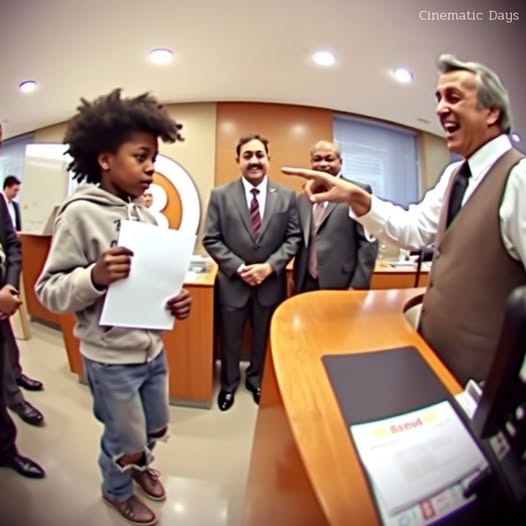
Wesley Brooks stepped onto the cold marble floor of First National Heritage Bank like it was a church he wasn’t sure he belonged in. He was ten, too small for the thrift-store jacket that hung from his shoulders, and his shoes—once black—had faded into a tired gray, their soles split like mouths that had run out of prayers. He clutched a brown envelope with both hands, because Grandma Eleanor had told him: “Hold tight to what’s yours. Not with anger. With dignity.”
At the counter, he cleared his throat. “Excuse me, sir. I’d like to check my account balance, please.” The bank manager, Bradley Whitmore, turned slowly, his polished cufflinks catching the light. He looked Wesley up and down with a smile that didn’t reach his eyes—then laughed, loud enough for the lobby to hear. “Your balance?” he repeated, as if the words themselves were a joke. People glanced over their shoulders. A couple of suits smirked like they’d been handed free entertainment.
“This is First National Heritage,” Bradley said, leaning in close, cologne sharp as a warning. “Not a place for—” he paused, letting his disgust do the speaking, “kids who wander in off the street. We serve real customers here.” The security guard shifted nearer, hand drifting toward his baton. A woman in pearls hissed from behind, “Get him out. He’s making the place look… cheap.” Cruel laughter rippled through the lobby, and Wesley felt every sound land on him like a small stone.
But Wesley didn’t run. Grandma Eleanor had raised him on two rules: tell the truth, and don’t bow your head to someone else’s shame. His voice shook, but it didn’t break. “I have an account,” he said. “My grandmother opened it for me. She passed away two months ago. She left me this.” He lifted the envelope as if it weighed more than paper—as if it held her last breath inside.
Bradley snatched it from him with the careless confidence of a man used to taking. He pulled out the documents, scanned them, and scoffed theatrically toward the watching crowd. “Your grandmother,” he echoed, rolling the words around like something sticky. “Let me guess—she also left you a mansion and a private jet.” More laughter. Chelsea Morrison, the senior teller, leaned forward with a curled lip. “Sir, I can call the police,” she offered brightly, like she was volunteering for a charity.
Then Bradley’s eyes landed on the card. Not the usual plastic. A matte-black premium tier card, heavy and sleek, the kind most people only saw in movies. For half a second his face flickered—confusion, then the faintest tremor of doubt. But prejudice is a stubborn fog; it tells you the truth can’t possibly wear worn-out shoes. Bradley straightened, finding his cruelty again like a familiar coat. “Where did you steal this?” he barked, holding it up as if it were proof of a crime. “You expect me to believe this is yours?”
Wesley’s fingers clenched, nails pressing crescents into his palms. “It is mine,” he whispered. “My grandma—” Bradley cut him off with a sharp wave. “Enough. I’m tired of scams.” He turned to Chelsea. “Run it. Prove it’s fake.” Chelsea slid the card through the reader with a smug little sigh, tapping keys like she already knew the ending. The screen blinked once, twice—then froze, as if the computer itself had to steady its hands.
Chelsea’s face drained of color. “Mr. Whitmore…” her voice cracked. Bradley leaned over, impatient. The number on the screen wasn’t a balance, it was a skyline—so tall it didn’t look real. Bradley’s laugh died mid-breath. Around them, the lobby went strangely silent, as if everyone had suddenly remembered they had hearts. “That can’t be right,” Bradley muttered. He refreshed it. Same number. He refreshed again. Same number. His lips parted, and for the first time, he looked at Wesley like a person.
A quiet voice came from the doorway. “It’s right.” An older attorney stepped in, holding a file thick enough to be a weapon. Behind him was a woman in a simple navy coat—bank compliance, the kind of person Bradley usually greeted with practiced charm. The attorney continued, calm and clear. “Eleanor Brooks was not ‘nobody.’ She was the first Black account holder this bank tried to deny in 1978. She sued. She won. And she invested the settlement—and every dividend, every interest payment—right here, in this institution that once humiliated her.” He nodded toward Wesley. “And two months before she died, she updated her trust. Today was the scheduled verification. We’ve been watching.”
Bradley’s throat worked like it was trying to swallow his own words back. “I—I didn’t know,” he stammered, suddenly softer, suddenly human. “Kid, I’m sorry. We can fix—” But Wesley stepped back, not with fear, with choice. He pulled Grandma’s letter from his pocket—creases softened by the warmth of his skin. “She told me you’d try to smile only after you saw the numbers,” Wesley said quietly. “She said some people can’t respect a person until money explains them.” He looked around the lobby at the faces that had laughed. “But I’m still the same boy. The shoes didn’t change. Your eyes did.”
The compliance officer asked Bradley to surrender his badge. The security guard lowered his hand. Chelsea’s mouth opened and closed with nothing coming out. Bradley tried one last time, voice breaking into something like pleading. “Please… don’t ruin me.” Wesley held Grandma’s letter tighter and answered with the kind of mercy that takes strength. “I’m not here to ruin you,” he said. “I’m here to know what she left me—and to be who she wanted me to be.” Later, Wesley requested one thing in writing: a fund in Eleanor Brooks’ name to support children turned away from “places for real customers.” And when he walked out, the marble floor didn’t feel like a church anymore. It felt like ground that finally knew his name.
Moral: People will judge your worth by what they can see—your clothes, your skin, your silence—until life forces them to read what they should’ve respected all along: your humanity. True dignity isn’t proven by a balance; it’s proven by how you treat someone before you know their story.