A millionaire was abandoned by everyone… until the housekeeper’s little girl did something no one expected.
Rain poured over Chicago as if it wanted to wash the whole city clean. From the hospital window, Nathaniel “Nate” Caldwell watched the lights along Lake Shore Drive blur across the wet pavement. What he refused to see—what he still couldn’t accept—was his own reflection: a thirty-five-year-old CEO, flawless even in a hospital gown, trapped in a body that no longer responded.
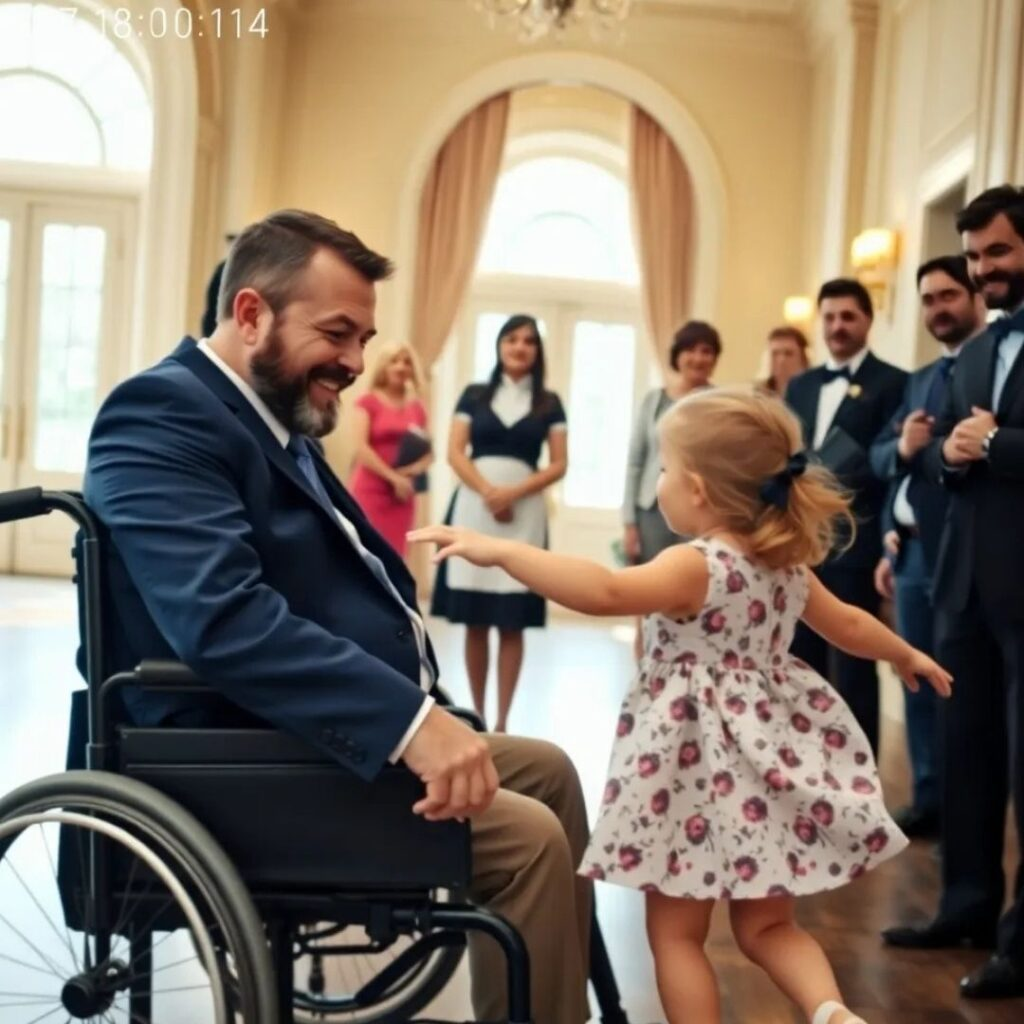
When he heard his fiancée whisper, his fingers trembled.
“I can’t do this…” Brianna Cole said softly, eyes fixed on the floor.
The silence that followed crushed him harder than the crash ever had. He tried to lift his arm toward her, but it barely twitched.
“Brianna…” Her name felt foreign in his mouth.
Tears shimmered in her eyes, but they weren’t love. They were escape.
“I tried, Nate. I really did. But I can’t live like this.”
Like this. As if he were an object. A burden.
She slid the engagement ring onto the bedside table. The diamond clicked against metal with chilling precision.
“You’re leaving? After seven years?” he asked weakly.
“The doctors said you’ll never walk again,” she whispered. “I’m still young. I have a life.”
The monitors beeped wildly as his heart raced. He wanted to scream that his mind still worked, that he was still him. But Brianna had already grabbed the designer purse he’d gifted her and walked out without turning back.
After she left, the room felt enormous. He felt microscopic.
The weeks that followed were filled with fading sympathy. Friends brought flowers, awkward hugs, empty encouragement. Then fewer came. Then just texts: “Stay strong, man.” “You’ll bounce back.” As if paralysis were a minor inconvenience.
Only Ryan “Ry” Bennett stayed. Business partner. Best friend.
When Nate was discharged, Ry pushed his expensive new wheelchair down the hospital corridor.
“It’ll be okay,” Ry said, though his voice cracked.
“Don’t lie,” Nate muttered. “They’re all gone, right?”
Ry paused. “Not all. I’m here.”
“Because you care… or because you feel sorry for me?”
Ry didn’t answer. And that silence said enough.
The mansion in Lincoln Park felt hollow. Nate hired caregivers and fired them just as quickly—one treated him like a child, another sighed constantly, the third looked at him with barely disguised disgust.
“You need someone to manage the house,” Ry insisted. “Just someone steady.”
“As long as they don’t pity me,” Nate replied. “And they don’t talk too much.”
That’s how Maria Torres arrived.
She showed up one cold morning—plain clothes, hair tied back, steady eyes. No pity. Just professionalism.
“Are you Mr. Caldwell?” she asked calmly.
“You clean. You leave. No questions. No staring,” Nate said sharply. “Understood?”
“I understand,” she replied, meeting his gaze without flinching.
For weeks, that was enough. She came early, left quietly. Nate barely noticed her.
What he didn’t know was that Maria had a five-year-old daughter.
Emma.
Her daycare had temporarily shut down. Maria had no one else to watch her and couldn’t afford to lose this job.
“You stay quiet, okay?” Maria whispered that first morning. “Color your books. Don’t wander.”
“Is he scary?” Emma asked.
“He’s not scary,” Maria said softly. “He’s hurting.”
For several days, Emma stayed hidden in the small service room. But curiosity is stronger than instructions.
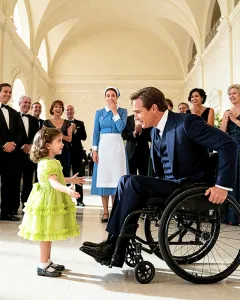
One afternoon, she slipped into the hallway and found the library.
Nate was struggling to reach a book on a high shelf, frustration tightening his jaw as his fingers brushed but couldn’t grasp it.
“Do you want help?” a small voice asked.
He spun around. “Who are you?”
“I’m Emma. I came with my mom.”
Anger flared. “Your mother brought a child into my house?”
“The school’s closed,” she said quickly. “I promised to be quiet.”
He nearly ordered her out. Instead, he heard how absurd he sounded arguing with a child.
“Which book?” she asked.
He pointed.
Emma climbed onto a chair, grabbed the blue book, and handed it to him like a prize.
Her small fingers brushed his hand—warm, unafraid.
“Why do you use that chair?” she asked bluntly.
Adults avoided the question. Emma didn’t.
“My legs were hurt in an accident,” he said stiffly. “They don’t work.”
She considered that seriously. Then she placed her tiny hand on his knee.
“When I fall down, my mom rubs it and it helps. Want me to try?”
The innocence disarmed him completely.
Maria rushed in moments later, pale. “Emma! I’m so sorry—”
“She can stay,” Nate interrupted. “Just… teach her not to make a big deal about the chair.”
From that day, something shifted. Emma wasn’t afraid of him. She didn’t treat him like glass. She asked questions. She laughed. She sat beside him while he worked.
Until the day everything exploded.
“Get out!” Nate shouted.
Maria rushed downstairs to find Emma crying, holding a crumpled drawing.
“She went through my desk!” Nate fumed.
It was a child’s drawing: Nate standing upright, smiling beside a woman. Taped above it was an old photo of him and Brianna from their engagement. The photo he couldn’t throw away.
“I wanted you to be happy,” Emma sobbed. “In my picture you’re standing.”
But anger, still raw inside him, won.
“Leave.”
Maria walked out with Emma in her arms. The door slammed.
Later, alone, Nate picked up the drawing. On the back, in crooked letters: “For Mr. Nate so he smiles again.”
And the man who had built a billion-dollar company broke down in tears.
Two days later, Ry carried Nate up the narrow stairs of Maria’s small apartment building.
Maria opened the door cautiously. Emma hid behind her.
“I’m sorry,” Nate said quietly. “I shouldn’t have yelled.”
Emma peered at him. “Are you gonna be mad again?”
“No,” he said. “Your drawing… it reminded me who I used to be. Thank you.”
She walked forward and handed him her stuffed bunny.
“I forgive you.”
Those words felt like oxygen.
“I want you both back,” he said. “And I want you to come with me somewhere important.”
Two weeks later, at a charity gala downtown, cameras flashed and whispers swirled.
“Who’s the woman?” “He brought a kid?”
Then Brianna appeared—perfect as ever, on the arm of a wealthy investor.
“Nate,” she said sweetly. “I didn’t think you’d show.”
“I’m here,” he replied calmly.
She glanced at Maria and Emma with thinly veiled disdain. “Is this your new arrangement?”
Before Maria could respond, Emma stepped forward.
“Don’t talk to him like that,” she said bravely. “He’s nice.”
Brianna scoffed—and then slapped Nate.
Gasps echoed across the room.
Emma threw herself in front of him. “Don’t hit my friend!”
Nate gently placed a hand on her shoulder. “It’s okay,” he whispered. “She can’t hurt me anymore.”
When his name was called for an award, he rolled onto the stage.
“I didn’t ‘overcome,’” he said into the microphone. “I broke. I became bitter. And then a little girl gave me a drawing where I was standing—not with my legs, but with my spirit.”
He looked at Emma and Maria.
“I learned that dignity isn’t about walking. It’s about who stays. So today, I’m launching the Caldwell Center for Inclusion—to make sure no one feels disposable because of a disability.”
The audience rose to its feet.
A year later, the center was thriving. Maria was no longer “the maid”—she was program director. Emma ran through the halls holding a sign that read: “Respect has no barriers.”
At the anniversary celebration, Nate looked down at a new drawing Emma held up: three figures holding hands. A man in a wheelchair, a woman, and a little girl.
Underneath, in wobbly letters:
“My heart family.”
“Family isn’t just blood,” Emma declared proudly. “It’s who takes care of you.”
Nate smiled, genuine and bright.
“Then yes,” he said, voice thick with emotion. “We’re family.”
He never walked again.
But he stood taller than ever.
The gala had been Nate’s re-entry into the world, but the weeks that followed were his re-entry into a life worth living. However, the shadow of Nate’s past hadn’t completely vanished. Brianna’s slap at the gala hadn’t just been a burst of temper—it had been a desperate attempt to maintain her social standing by making him look like the “unstable” one.
Part 3: The Architecture of the Heart.
In the wake of the Caldwell Center’s launch, the media wasn’t just interested in the charity; they were obsessed with the “Fall of Brianna Cole.” The video of her striking Nate at the gala went viral, and the public, once enamored by her beauty, turned on her overnight.
Threatened with the loss of her social circles and lucrative sponsorships, Brianna tried one final, desperate move. She filed a lawsuit, claiming Nate had been “emotionally abusive” and that he had coerced her into an engagement, seeking a massive settlement for “pain and suffering.”
“She’s trying to drain the foundation before it even gets its first roof,” Ry growled, tossing the legal papers onto Nate’s desk. “She’s claiming you’ve been ‘manipulating’ Maria and using Emma as a PR stunt.”
Nate didn’t look up from the blueprints of the new center. “She wants a fight, Ry. She thinks I’m still the man who hides in the library because he’s ashamed of his wheels.”
“And?”
“And I’m not that man anymore,” Nate said, a cold, focused fire in his eyes.
The meeting took place in a sterile conference room. Brianna sat across from him, smelling of expensive perfume, flanked by high-priced lawyers. She looked at Nate with a pitying smirk, her eyes darting to Maria, who sat quietly behind him.
“Let’s be real, Nate,” Brianna said, her voice dripping with artificial sweetness. “You were always controlling. This ‘inclusion’ act is just you trying to buy back the dignity you lost in that car crash. You’re using that poor woman and her child to look like a saint.”
The room was silent. Maria shifted in her seat, her face pale.
Nate leaned forward. “Brianna, do you remember the night you left? You didn’t leave because I was controlling. You left because you couldn’t stand the sight of someone who wasn’t perfect. You didn’t want a partner; you wanted an accessory.”
“I have rights!” she snapped.
“You have a ring,” Nate countered. He pulled a small digital recorder from his pocket. It played a recording from the night of the accident—his own voice, weak and gasping, and Brianna’s voice, loud and clear: ‘I can’t let my brand be tied to a cripple, Nate. Think of the press. Just sign the severance agreement and let me go quietly.’
Brianna’s lawyers froze. The recording was a death knell for her lawsuit. She had been so caught up in her own narrative that she forgot Nate was a man of business—he had recorded their final argument not for revenge, but for the same reason he did everything: to protect himself.
“The lawsuit is dropped today,” Nate said firmly. “Or this goes to every news outlet in Chicago. You don’t get a penny of the Caldwell legacy. You already took seven years of my life. You don’t get a minute more.”
Brianna gathered her things, her face twisted in rage, and fled the room. She was gone for good this time.
Six months later, the Caldwell Center for Inclusion held its first ribbon-cutting ceremony. It wasn’t just a building; it was a sanctuary. It featured accessible housing, a world-class rehabilitation gym, and an early-childhood wing named “Emma’s Room.”
As Nate prepared to speak, he felt a small tug on his sleeve. Emma stood there, wearing a dress that matched Maria’s, her eyes wide with excitement.
“Nate, look!” she whispered, pointing at the entrance.
Carved into the stone above the door was the image from her original drawing—three figures holding hands.
“I told you,” Emma grinned. “In the stone, you’re standing.”
Nate looked at Maria. They hadn’t rushed into a romance; they had built something far sturdier: a foundation of mutual respect and shared healing. She wasn’t his “help,” and he wasn’t her “project.” They were partners in a way he and Brianna never could have been.
“I have a gift for you,” Maria said softly, handing him a small box.
Inside was a key. It wasn’t to a mansion or a car. It was a key to a small cabin in the woods—the one he had mentioned wanting to visit before the accident, thinking he’d never be able to go because of the terrain.
“I had it retrofitted,” Maria said. “Ramps, widened doors, a deck that overlooks the lake. We’re going this weekend. Just us.”
The Epilogue: Standing Tall
The weekend at the cabin was filled with the sounds of the forest and Emma’s laughter as she chased frogs by the shore.
On their final evening, Nate sat on the deck, watching the sunset bleed into the water. Maria sat beside him, her head resting on his shoulder. Emma was fast asleep on a lounge chair nearby, clutching the stuffed bunny she had once given Nate as a sign of forgiveness.
Nate looked down at his legs. They were still still, still silent. But the crushing weight of “why me?” had finally lifted.
“What are you thinking about?” Maria asked.
“I was thinking about the drawing,” Nate replied. “I spent so long trying to get back to the person I was before the rain. I didn’t realize that the person I was then… he would have never appreciated this moment. He would have been too busy checking his watch or worrying about his image.”
He reached out and took Maria’s hand.
“I’m not standing, Maria. But for the first time in my life, I’m not falling either.”
In the quiet of the woods, far from the skyscrapers of Chicago and the ghosts of the past, Nate Caldwell realized that his wheelchair wasn’t a prison. It was a throne. He had lost his ability to walk, but he had found his path.
And as the stars began to reflect in the lake, Nate didn’t look at the sky. He looked at the family he had built—the one that had seen a man in the shadows and decided to stay until the sun came up.