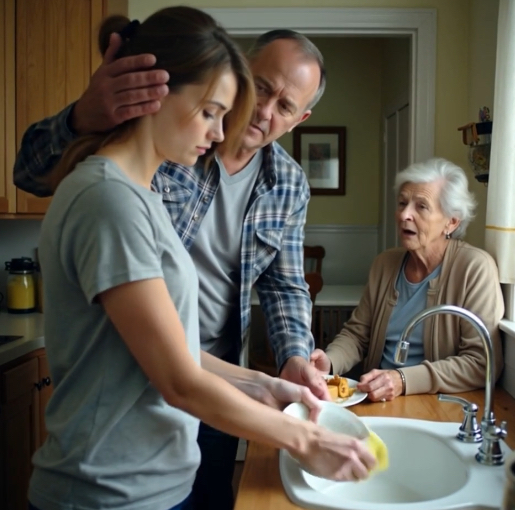
The knock on the door echoed through the room like a pivotal drumbeat, an unexpected pause in the mundane chaos. It was as if the sound held the promise of change, the potential to break through the oppressive atmosphere that seemed to suffocate Laura.
Daniel pushed back his chair, irritation flitting across his face. “Who could that be?” he muttered, more to himself than anyone else. He stood, and without a glance toward the kitchen, he ambled toward the door. Margaret, oblivious or perhaps indifferent, continued eating, her focus solely on the food in front of her.
Laura paused, her eyes flickering toward the hallway with a flicker of hope, then quickly back to the task at hand. It was as though she feared drawing too much attention to herself.
When Daniel opened the door, his casual demeanor shifted abruptly. Standing there was not just one person, but two—a police officer and a social worker, both appearing resolute and purposeful. Their presence filled the doorway, signaling the gravity of the moment.
“Good afternoon,” the officer began, his voice calm but authoritative. “We received a call expressing concern for the welfare of someone at this address.”
Daniel’s initial surprise quickly morphed into a practiced indifference. “There must be some mistake,” he replied smoothly. “Everything’s fine here.”
The social worker, a woman with kind eyes and an unwavering gaze, stepped forward slightly. “We’d like to speak to everyone in the household, if you don’t mind.”
Margaret, only now paying attention, frowned, her fork suspended mid-air. “Is this necessary?” she asked, her tone tinged with annoyance.
I stepped forward then, from the shadows of the hallway into the light of the room. “It’s necessary,” I said, my voice steady in contrast to the turmoil within.
Laura turned, her eyes meeting mine, wide and filled with a mix of relief and anxiety. The sight of her, so vulnerable yet so strong, reinforced my resolve.
The officer and the social worker crossed the threshold, their presence a protective barrier against the insidious normalcy that Daniel and Margaret tried to project. They spoke to Laura gently, coaxing her into sharing her story, allowing her the space and support she desperately needed.
As Laura began to speak, her voice halting but growing stronger with each word, it was as if she was shedding a weight she’d carried for too long. She recounted the cold indifference, the belittling comments, and the isolation she felt within her own home. The mark on her wrist told its own silent story, one that needed no embellishment.
Margaret’s façade of control crumbled, her protests dissolving under the scrutiny of those who knew how to look beyond the surface. Daniel, too, faltered, the confidence he wore like armor cracking as the truth bled through.
In those moments, the sterile chill of the house seemed to lift, replaced by an air of possibility—of freedom. Laura was no longer unseen, her voice no longer drowned out. The grip of fear and control was loosening, breaking apart with each passing second.
As the social worker assured Laura that help was available, that she could reclaim her life, I felt a profound gratitude for the instinct that had led me there that day. I knew, as did Laura, that the path ahead would not be easy. But it would be hers to walk, with dignity, support, and love.
The door to her future had been forced open, and nothing would ever be the same again—but that was precisely as it should be.