The Toolbelt
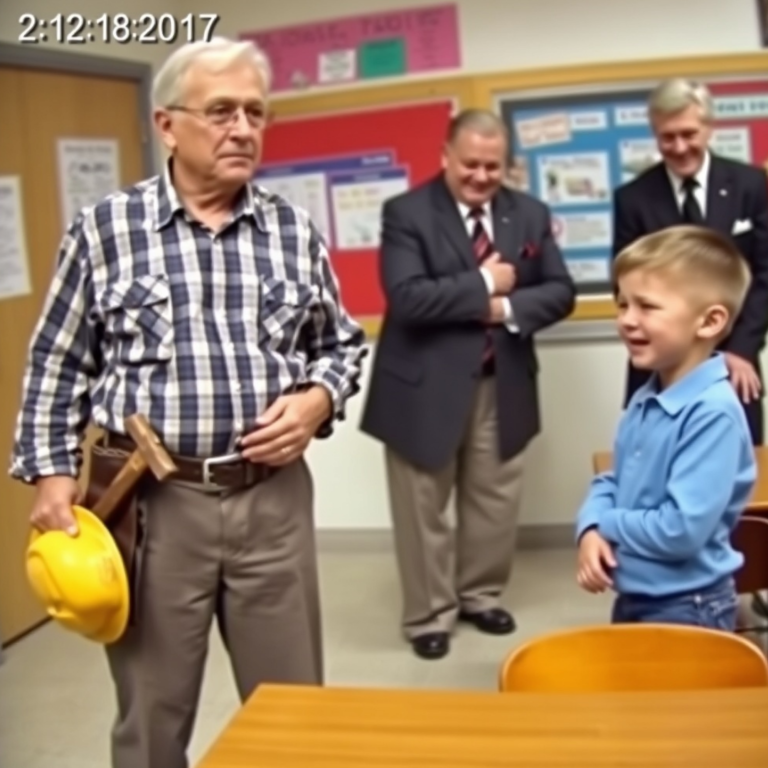
They were already smiling the kind of smile that isn’t kind. Not cruel enough to be called out. Just dismissive enough to be felt.
I heard it before I even reached the front of the classroom.
“Is he facilities staff?” one woman whispered behind perfectly manicured fingers.
The man beside her gave a polite half-smile — the kind people use when they don’t want to agree… but don’t want to disagree either.
I heard it.
You spend forty-two winters climbing frozen transmission towers in sleet that cuts through denim and bone, you learn to hear the tones that matter. What she said wasn’t loud.
But it carried.
I didn’t react.
Reacting confirms the story people already wrote about you.
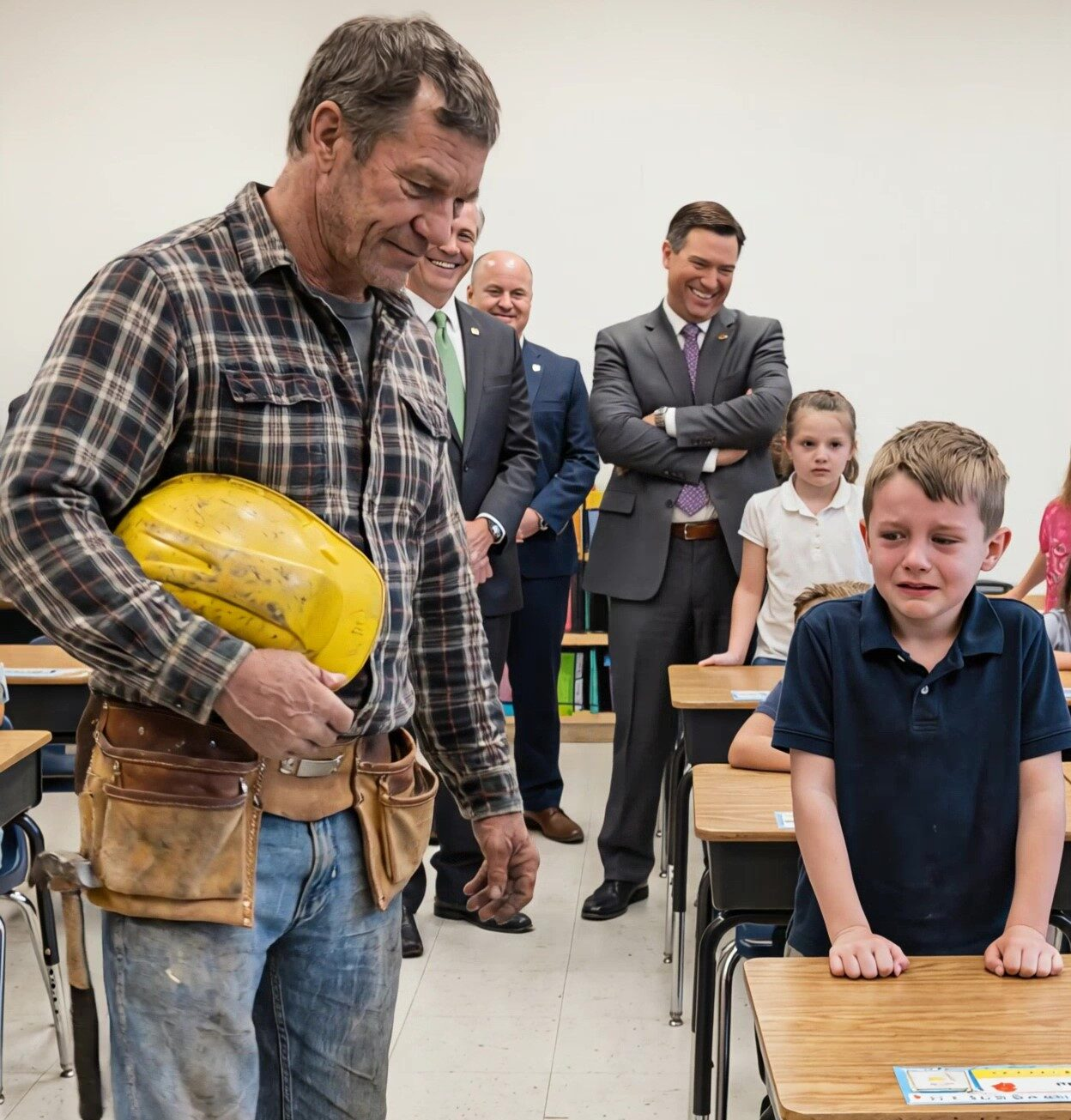
Instead, I walked to the teacher’s desk and set down my old yellow hard hat. The plastic was dulled by decades of sun and rain. I unbuckled my toolbelt — worn leather, stained dark from years of work — and laid it gently on the polished surface.
Pliers. Insulated cutters. Voltage tester. A crescent wrench I’d held more times than I could count.
The belt left a faint circle of dust.
A couple of kids in the front row wrinkled their noses.
Like the smell of real work didn’t belong in a room that smelled of catered coffee and dry-erase markers.
It was Career Day at my grandson’s middle school.
Eighth grade.
The kind of neighborhood where lawns are trimmed by landscaping companies and mailboxes cost more than my first pickup truck.
Caleb sat by the windows.
He prefers “Caleb” now instead of “Cal,” like he’s already rehearsing adulthood.
His shoulders were slightly hunched.
Not ashamed.
Just… hoping.
Hoping I wouldn’t embarrass him in front of classmates whose parents wore blazers and carried laser pointers.
The room had been filled with polished success all morning.
Venture capital analysts. Corporate attorneys. Software architects.
People with slides that moved smoothly and bar graphs that climbed obediently upward.
Applause had been steady and approving — the kind that says: This is what success looks like.
Then there was me.
Faded flannel. Work boots with dried mud still clinging from a storm repair the night before. Hands etched with thin white scars that don’t wash away.
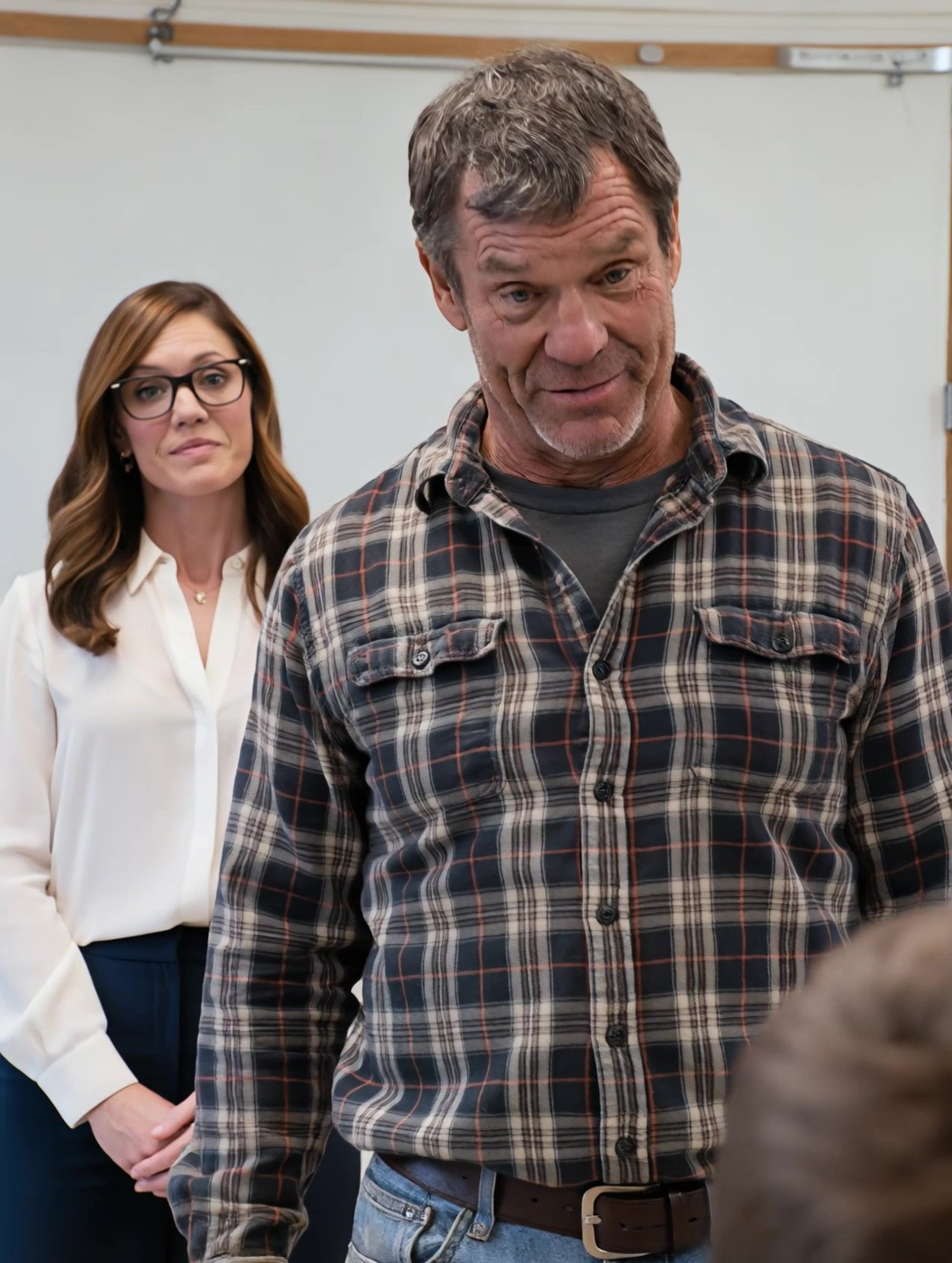
When Ms. Donovan introduced me, she hesitated slightly.
“He works… in electrical infrastructure.”
The pause was small. But deliberate.
I stood.
Didn’t bring slides. Didn’t bring charts. Just brought truth.
The Speech
“I didn’t go to a four-year university,” I began, voice carrying more gravel than polish.
A few parents immediately looked down at their phones. Permission granted to disengage.
“I went to trade school,” I continued evenly. “By the time some of my friends were picking dorm rooms, I was already working full-time.”
A few students looked up. Curiosity has better instincts than adults sometimes.
“When ice storms hit in January,” I said, leaning one hand on the desk, “and wind takes out half the county’s power… and your furnace dies… and your house drops to forty degrees while your kids are wrapped in blankets—”
I let the silence sit.
“You don’t call a hedge fund manager.”
A ripple of awkward laughter.
“You don’t call someone negotiating a merger.”
More shifting in seats.
“You call linemen. You call the people who leave their own families sleeping warm in bed… and drive straight into the storm everyone else is running from.”
The room grew quieter. Phones lowered.
I saw it then — the shift. Not admiration. Recognition.
“Last winter,” I added slowly, “we worked thirty-six hours straight after a substation went down. Snow up to our knees. Ice coating the lines. One wrong step and you’re not going home.”
Now no one was smiling.
“And sometimes,” I said, my voice softening, “we don’t.”
The words hung heavier than I intended.
The Confession
That’s when it happened.
A chair scraped softly against the floor near the back of the room.
A boy stood up.
Not my grandson. Another kid. Skinny. Dark hair. Hoodie sleeves pulled over his hands.
He swallowed once before speaking.
“My dad was a lineman,” he said quietly.
The room froze.
“He died during a storm two years ago. Fixing a line so our town could have heat back.”
You could feel the air change.
The laughter evaporated.
The boy’s voice trembled, but he kept going.
“People said thank you at the funeral. But most of them didn’t really understand what he did. They just… said the words.”
His eyes flicked toward me.
“But you understand.”
I nodded once. Not dramatic. Not performative. Just… true.
The silence was heavy now. Not awkward. Sacred.
The Shift
No one checked their phone. No one whispered.
Even the parents with polished shoes and polished careers sat straighter, as if the boy’s words had stripped away the armor of titles and salaries.
Caleb’s shoulders lifted. Not pride exactly. Something deeper. Relief.
Relief that the room finally saw what he had always known but never said: that his grandfather’s work mattered.
I cleared my throat.
“Your father was a brother,” I said to the boy. “We don’t use that word lightly. Linemen are family, even if we’ve never met. Because we all know the risks. And we all know the reasons.”
The boy’s eyes glistened. He sat down slowly, but the silence stayed.
I picked up my hard hat.
“This isn’t a symbol of failure,” I said, holding it up. “It’s a symbol of responsibility. Every scar on my hands, every stain on this belt, every night spent in freezing rain — it’s all so that lights come back on, furnaces start humming, and families stay safe.”
I set the hat back down.
“Success isn’t always measured in corner offices or stock options. Sometimes it’s measured in the warmth of a house at midnight, when the storm outside is howling and the power inside is steady.”
The Aftermath
When I finished, there was no applause. Not the polite kind. Not the dismissive kind.
Just silence.
The kind that means people are thinking.
Ms. Donovan cleared her throat, her voice softer than before.
“Thank you,” she said.
But the gratitude wasn’t hers alone. It was shared. Unspoken.
The boy in the hoodie kept his eyes down, but his shoulders were straighter now.
Caleb looked at me differently. Not embarrassed. Not relieved. Something closer to respect.
The parents didn’t smile their dismissive smiles anymore. They looked at the toolbelt. At the hard hat. At the scars.
And for once, they saw not grease-stained leather, but sacrifice.
Later, as the crowd thinned and parents gathered their polished briefcases, the boy in the hoodie approached me.
“My dad used to say,” he whispered, “that storms don’t care who you are. They just come. And someone has to stand in the way.”
I put a hand on his shoulder.
“He was right,” I said.
Caleb joined us, quiet but present.
The three of us stood there — generations linked not by wealth or prestige, but by wires, storms, and the stubborn courage to face them.
And in that moment, Career Day wasn’t about careers at all.
It was about lives. About the people who keep them lit.
Epilogue
The fluorescent lights of the gymnasium hummed with a clinical, steady drone, but for the first time in my life, the sound didn’t irritate me. It sounded like the grid breathing. It sounded like a job well done.
As the other parents began to filter out, their leather briefcases clicking shut like final punctuation marks, the atmosphere in the room remained thick—heavy with the kind of ozone that lingers after a lightning strike. The “facilities staff” comments had vanished. The woman with the manicured nails was now looking at her own hands, then at mine, with a bewildered sort of shame.
Caleb walked over to the desk. He didn’t stay back by the window this time. He stood right next to the toolbelt, his hand hovering over the worn leather of the pouch where I keep my pliers.
“You okay, Cal?” I asked, my voice still thick with the residue of the speech.
He didn’t look up immediately. He traced a deep gouge in the leather—a mark left from a night in ’98 when a transformer blew and sent a piece of casing flying like shrapnel. “I never asked how you got the scars, Grandpa,” he whispered. “I just thought… I just thought you were old.”
“Work makes you old, son,” I said, reaching out to ruffle his hair, though he was getting too tall for it. “But it’s the kind of old that means you lasted. You stood your ground.”
The boy in the hoodie, whose name I later learned was Leo, stayed behind until the room was nearly empty. He didn’t have a parent there to walk him out. His mother was working a double shift at the hospital—another one of the “invisible” ones who keep the world turning while the rest of it sleeps.
I reached into my pocket and pulled out a small, brass challenge coin—a token given to me after forty years of service by the local union. It was heavy, stamped with the image of a pylon against a rising sun. I pressed it into his hand.
“This belonged to a brother,” I told him, my voice low so only he and Caleb could hear. “You keep it. When the wind starts howling and the house shakes, you hold onto that. It’s a reminder that you come from a line of men who weren’t afraid of the dark.”
Leo’s fingers closed around the metal. He didn’t say thank you. He didn’t have to. The look in his eyes was the same look I see in the mirror every morning—a mixture of grief and a stubborn, quiet pride. He nodded once, deeply, and vanished into the hallway.
I began the slow process of buckling my belt back on. The weight of it felt different today. It didn’t feel like a burden or a badge of a “lesser” life. It felt like armor.
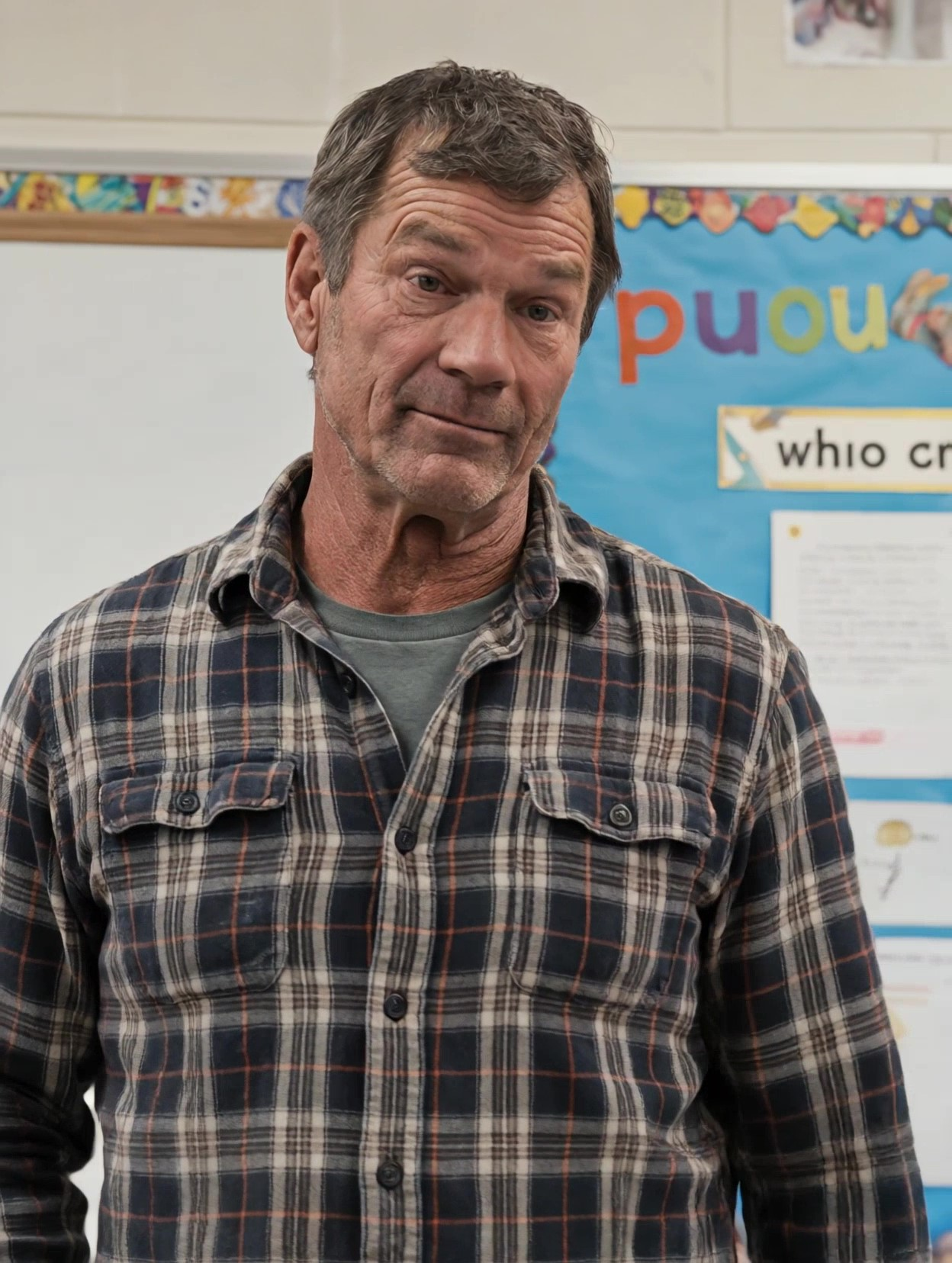
As we walked toward the heavy double doors of the school, Ms. Donovan caught up to us. She looked at me, then at the toolbelt, and finally at Caleb.
“Mr. Miller,” she said, her voice missing that previous hesitation. “I think… I think the students learned more about ‘infrastructure’ today than they have in three years of social studies.”
“It’s easy to ignore the foundation until the house starts leaning, Ma’am,” I replied, tipping my cap.
Outside, the spring air was crisp, but a dark line of clouds was bruising the horizon. A storm was rolling in from the west—the kind that makes the local news anchors start talking about “unprecedented conditions.”
Caleb stopped at the edge of the parking lot, looking at the sky. He didn’t look worried. He looked at my truck, then back at me.
“Are you going to have to go in tonight?” he asked.
I checked the wind. I could feel the drop in pressure in my knees, a biological barometer tuned by decades of exposure. “Likely. The lines over by the creek won’t hold if the gusts hit sixty.”
Caleb nodded. He didn’t whine about me missing dinner. He didn’t ask when I’d be home. Instead, he reached out and gripped the sleeve of my flannel shirt, his fingers brushing the rough fabric.
“Stay safe, Grandpa,” he said. Then, after a beat, he added the words that made forty-two winters worth every frostbitten mile: “The neighborhood needs you.”
I climbed into the cab of my truck, the engine turning over with a familiar, mechanical growl. As I pulled out of the lot, I glanced in the rearview mirror. Caleb was still standing there, watching the truck until it turned the corner.
The first heavy drops of rain began to splatter against the windshield. Most people were rushing home, turning up their heaters, and preparing to hide. I reached over, flipped on the amber strobes, and called into dispatch.
“This is Miller. I’m heading toward the substation. Tell the boys to get the coffee going. It’s going to be a long night.”
The lights on my dashboard flickered—a tiny, steady glow against the encroaching gray. The world was about to go dark, and I had work to do.