The night my apartment burned down, I stood barefoot in the parking lot with ash in my hair, watching orange tongues lick through what used to be my living room window. The air tasted like melted plastic and wet drywall. Someone had thrown a blanket around my shoulders, but it didn’t block the cold crawling up my spine.
Part 2:
“Now we build a case that survives court,” Silva said. “We execute a search warrant. We find the key. We find the fuel can. We find your mother, and we ask her questions without him hovering.”
“My mother,” I repeated, and the words tasted strange. “Is she in danger?”
Silva didn’t soften it. “Possibly. Her voicemail suggests fear. And your father’s behavior suggests escalation.”
That afternoon, Silva and two uniformed officers drove to my parents’ address. I went too—against every instinct—because part of me needed to see their front door with my own eyes, needed to know whether the world was still real.
The house looked the same as always: manicured shrubs, pale siding, the flag on the porch. The kind of place that screams stability. Silva knocked.
No answer.
He knocked again, louder. “Police.”
A curtain twitched. Then the door opened just a crack, chain still latched.
My mother’s eye appeared, red-rimmed and startled. When she saw me, her face crumpled—not with relief, but with dread.
“Morgan,” she whispered. “Why are you here?”
Silva held up his badge. “Ma’am, we need to speak with you privately.”
Her gaze flicked left, deeper into the house. A silent check. A permission she didn’t have to ask out loud.
From somewhere inside, my father’s voice floated, calm and irritated. “Who is it?”
My mother flinched like the sound had a physical force.
Silva’s posture changed—subtle, alert. “Ma’am, is your husband home?”
My mother swallowed, her throat working. “Yes.”
Silva nodded once to the officer beside him. “We have probable cause related to an arson investigation. We’re entering.”
My mother’s fingers trembled as she unlatched the chain. The door swung open, and the smell that hit me wasn’t smoke.
It was antiseptic.
Like someone had been cleaning obsessively.
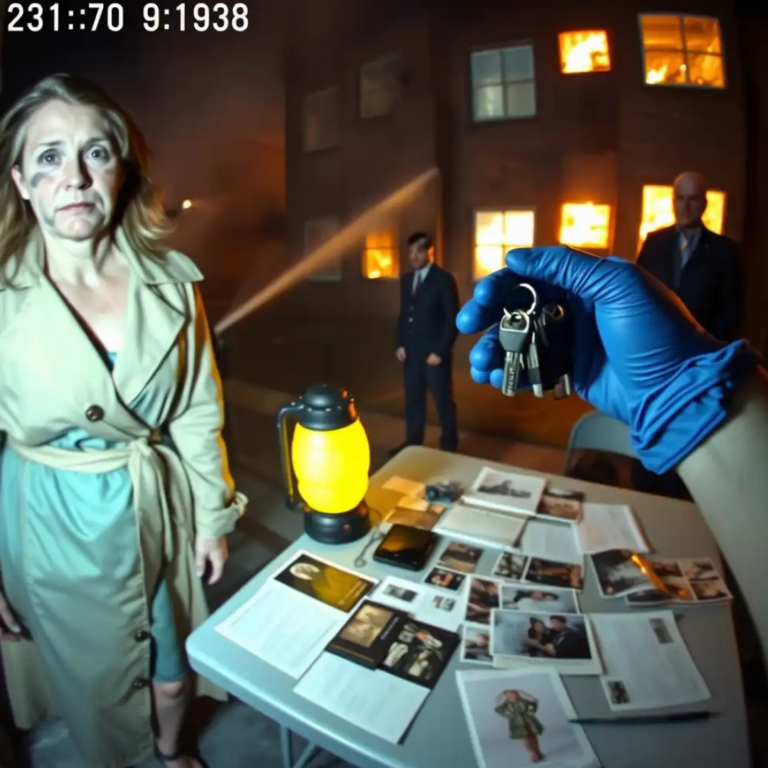
We stepped into a living room that looked staged for a realtor—no clutter, no warmth, nothing human. And then I saw it on the side table: my spare key ring, the one that had been in my junk drawer, sitting next to a stack of printed photos.
Photos of my apartment building.
Photos of my door.
A photo of me, taken from across the street, walking in with grocery bags.
Silva picked up the key ring with gloved hands. “This yours?”
I couldn’t breathe. I nodded.
My father appeared in the hallway, no hoodie now, no cap—just a pressed shirt and that familiar expression of annoyance, like we were tracking mud on his carpet.
He looked at Silva, then at me, and smiled a small, controlled smile.
“Morgan,” he said, voice warm as lacquer. “You always were dramatic.”
Silva stepped between us. “Evan Hayes, you’re being detained in connection with the fire at 214 West Marlowe.”
My father’s smile didn’t break. His eyes stayed on mine—steady, proprietary.
“You really want to do this?” he asked me, quietly. “After everything we’ve done for you?”
And in that moment, I understood exactly why he’d burned my apartment down.
It wasn’t about money.
It was about reminding me who was allowed to own my life.
And he was furious I’d started acting like it was mine.
Part 3:
The silence that followed my father’s question was different from the silence in the parking lot. That had been the silence of shock; this was the silence of a burial. I looked at the man who had taught me to ride a bike, who had signed my report cards, and who had just systematically incinerated every memory I owned because he couldn’t control the person I had become.
“You didn’t do anything for me, Dad,” I said, my voice finally finding a floor to stand on. “You did things to me. There’s a difference.”
Silva didn’t give him a chance to respond. The click of the handcuffs was a sharp, metallic period at the end of a very long, very dark chapter. As the officers turned him toward the door, my father didn’t struggle. He didn’t yell. He simply looked over his shoulder at my mother, a silent command still burning in his eyes.
But my mother wasn’t looking at him. She was looking at the spare key on the table.
Once the house was cleared of his physical presence, the “antiseptic” smell my father had cultivated began to fail. Underneath the bleach, there was something else—stale, sour, and old.
Investigator Silva stayed with me as other officers began the methodical crawl through the house. My mother sat on the edge of the floral sofa, her hands tucked under her thighs as if she were trying to keep herself from floating away.
“Mom,” I sat down beside her, but didn’t touch her. I wasn’t sure if she was a victim or an accomplice yet. “How long has he had that key?”
She didn’t look up. “Since the day you moved in, Morgan. You left your purse on the counter while we were helping you unload the first truck. He took it to the hardware store down the street while you were in the bathroom. He said… he said a girl alone in the city needs a ‘safety net.’”
A safety net. He had lived in my pocket for two years. He had likely been in my apartment dozens of times while I was at work, sifting through my mail, checking my trash, ensuring I wasn’t “getting ahead of myself.”
“And the photos?” I gestured to the stack on the table. “He was stalking me?”
“He thought you were seeing someone,” she whispered, her voice finally breaking. “He saw a man’s coat in one of your social media posts. He became obsessed. He said if he couldn’t protect your ‘virtue,’ he would at least make sure you had nowhere to hide but home.”
The fire hadn’t been an attempt to kill me. It had been a controlled demolition of my independence. He wanted me homeless so I would have to crawl back to the suburban fortress he commanded.
As the search progressed, Silva called me into my father’s home office. It was a room I had been forbidden to enter as a child.
On the computer screen, Silva had opened a series of spreadsheets. My father wasn’t just a controlling parent; he was a bookkeeper of my life. There were logs of my bank balances—he had somehow gained access to my login credentials—and a folder titled ‘MORGAN – EXIT STRATEGY.’
Inside were drafts of a “lease agreement” for the basement apartment of this house, dated two weeks before the fire. He had already prepared the cage before he lit the match.
“He’s a high-functioning sociopath, Morgan,” Silva said, rubbing the bridge of his nose. “He didn’t just want to hurt you. He wanted to own the recovery. He would have been the hero who took you in after the ‘tragic accident.’”
But then, an officer emerged from the basement holding a heavy, black ledger.
“Investigator? You’re going to want to see this.”
It wasn’t about me. At least, not entirely. The ledger contained records of a series of “accidental” fires at commercial properties my father had consulted for over the last decade. Each one had resulted in massive insurance payouts. Each one had been staged with the same precision, the same “small amount of accelerant” in a closet or a storage nook.
My apartment wasn’t his first fire. It was just his most personal one. He had used my life as a practice ground for his signature crime, or perhaps he had grown so arrogant he thought he could combine his ‘business’ with his ‘hobby.’
Three days later, I sat behind a glass partition at the county jail. Silva had advised against it, but I needed to see him without the mask of the “concerned father.”
He looked smaller in the orange jumpsuit, but his eyes were still cold.
“You’ve ruined your mother’s life,” he said, his first words to me. “She has nothing now. The house is being seized as part of the racketeering investigation. Are you happy?”
“I’m not happy, Dad. I’m just… awake.” I leaned toward the glass. “Why my closet? Why my clothes?”
He leaned in too, his breath fogging the glass. “Because you were starting to dress like someone who didn’t need me. That yellow dress you bought for the gallery opening? It was vulgar. The silk blouse? Pretentious. I was doing you a favor, Morgan. I was stripping away the things that were making you a stranger.”
I realized then that there was no “Dad” left to save. There was only a landlord who had lost his tenant.
“You’re going away for a long time,” I said quietly. “And Mom isn’t coming to see you. I’m taking her to the city. We’re getting an apartment together. A place with three locks and no spare keys.”
For the first time, his composure broke. His face contorted into something ugly, something feral. He slammed his fist against the glass. “You’ll fail! You’re nothing without my structure! You’ll be back on your knees in six months!”
I didn’t flinch. I just stood up and walked away. The sound of him screaming my name echoed in the hall, but for the first time in twenty-five years, it didn’t make me want to hide.
Epilogue:
Six months later, the smell of smoke has finally left my hair.
I live in a small, sunny studio on the fourth floor. It doesn’t have much—a mattress, a desk, and a few plants—but every single item in it was chosen by me, paid for by me, and belongs to me.
My mother lives two blocks away. She’s learning how to drive a car without asking for permission. She’s learning how to breathe.
Investigator Silva stops by sometimes with coffee. He told me yesterday that my father’s legal team is pushing for a plea deal, but the prosecution has enough evidence from those commercial fires to keep him behind bars until I’m an old woman.
I still have a small scar on my thumb from that night, a tiny reminder of the cold air and the orange tongues of flame. I look at it sometimes when I’m feeling overwhelmed. It reminds me that some things have to burn to the ground before you can see the horizon.
My father tried to use fire to bring me home. Instead, he gave me the light I needed to finally find my way out.