The limo was warm. So warm it felt like a lie.
My grandmother, Margot DeWitt, handed me a heavy blanket, then a cup of hot tea her driver passed back without a word. She didn’t ask me if I was okay. She didn’t need to. That wasn’t her way.
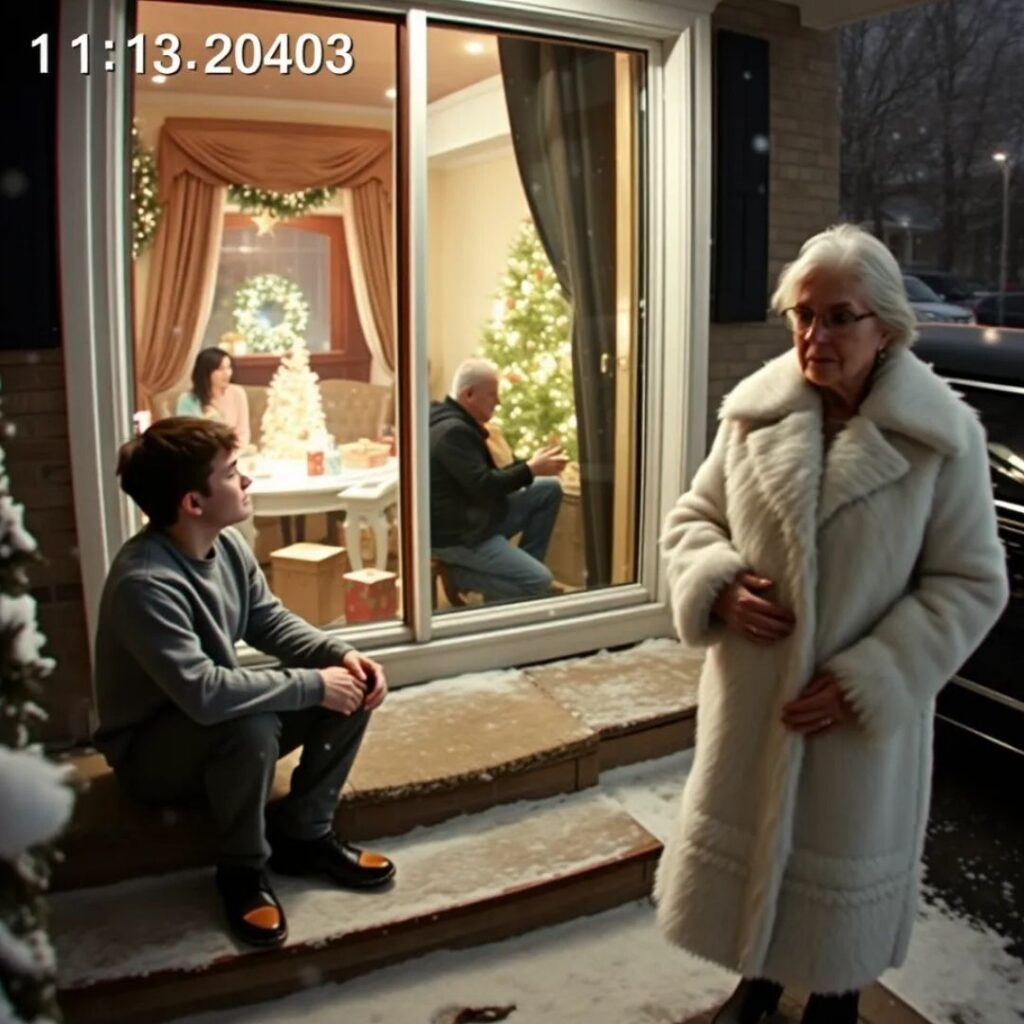
We drove in silence for a while, her sharp eyes watching the snowstorm outside like it was waiting for her permission to stop.
Finally, she spoke.
“Did he hit you?”
“No,” I whispered. “Just threw me out.”
She nodded. “Then he was being careful. That’s new.”
I blinked. “You knew?”
She turned to me slowly. “Darling, I paid for that house. I know exactly who I put inside it.”
That silence again.
“Why?” I asked. “Why leave me there?”
Margot didn’t flinch. “Because I needed to see what you’d become. I needed to know if you’d be like them—quiet, obedient, afraid. Or if you’d stand up.”
I couldn’t respond. My throat was still tight from the cold—and her words.
“Wealth,” she said, “exposes people. Poverty hides things. But power… power makes truth impossible to ignore.”
I was still shivering when we arrived—not at her mansion, but at a private hotel suite downtown. She had the entire top floor. Staff on call. Silk sheets and marble bathrooms. She told them to bring me dry clothes, hot food, and peppermint tea.
Then she said, “You’ll stay here. Until the demolition’s done.”
She meant it.
Within 48 hours, legal notices were served. My parents didn’t even understand what was happening until contractors arrived with permits and wrecking equipment. The house had been in Margot’s name since it was bought 15 years ago. A quiet clause in the deed allowed her to reclaim and remove the property at will.
They begged.
She didn’t respond.
But I did.
I sent one text to my father: “Hope the presents were worth it.”
Then I blocked his number.
Demolishing a house doesn’t erase the past.
But it sends a message.
The town buzzed for weeks. The DeWitt estate tearing down a suburban family home on Christmas morning? Rumors spread like wildfire. Margot never gave a statement. She didn’t need to. Her silence was power.
As for my parents—they moved into a cramped rental. The façade cracked. My father lost business clients. My mother withdrew. My siblings texted me apologies, but none of them really knew what to say. They had watched me shiver through a window.
I never replied.
Margot enrolled me in a private academy after New Year’s. One where her last name opened doors before I even walked through them. Tutors. Mentors. Tailored clothes. A driver. It was a world I didn’t know, and yet—it fit me better than the cold silence of my childhood home ever had.
One night, months later, I asked her why she chose that moment. Why she came back.
She sipped her wine slowly and said, “Because you didn’t cry.”
I stared.
“You didn’t beg. You didn’t scream. You waited. You survived. And when I saw that, I knew you were mine.”
She made me her legal ward the following week.
By the time I was eighteen, I had my own trust, my own lawyer, and her last name added to mine—Julian DeWitt.
My parents never recovered. They were not ruined financially—Margot never touched their bank accounts. But socially, reputationally, they were ghosts. Whispers followed them. People smiled less around them. No one forgets the family that locked their kid in the snow.
On Christmas Eve the next year, Margot and I lit a fire in her library. She gave me one gift: a small silver snow globe with a porcelain house inside.
When I shook it, the house crumbled.
We both laughed.
That night, she said, “You’ll inherit everything. But remember this: power is not what you own. It’s what people know you can do—and still hope you won’t.”
That was the last Christmas we had together.
She died three years later, peacefully.
At the funeral, I stood beside the casket in a custom black suit and watched my parents approach with downcast eyes. My father tried to speak.
I didn’t let him.
I simply looked at him and said the word that changed everything:
“Denied.”
The word “Denied” didn’t just end the conversation; it severed the final thread of their hope. My father’s mouth hung open, a jagged silence filling the space between us. My mother looked at the ground, her fingers nervously twisting the strap of a knock-off designer bag—a ghost of the luxury she had once tasted through Margot’s grace.
The Weight of the DeWitt Crown
Inheriting Margot’s empire was like being handed a loaded weapon. It wasn’t just the money; it was the data. The DeWitt name was woven into the infrastructure of the state. I didn’t just own buildings; I owned the mortgages of my enemies.
For two years, I stayed quiet. I let the rumors of my “luck” grow. People expected me to be a playboy heir, but I spent sixteen hours a day in the library where Margot had taught me the geometry of power.
One rainy Tuesday, my brother, Leo, came to the DeWitt headquarters. He was the one who had opened the biggest gift on that Christmas Eve while I froze. Now, he was a man in a cheap suit, looking for a break.
“Julian,” he said, standing in my glass-walled office. “Dad’s business… it’s failing. The banks won’t lend to him because of the ‘DeWitt Blacklist.’ Mom is sick with the stress. We just need a loan. A bridge.”
I didn’t look up from my tablet. “Leo, do you remember the color of the wrapping paper on the box you opened that night? The one you were laughing at while I was watching you through the glass?”
Leo’s face went pale. “It was just a mistake, Julian. We were kids. We were scared of him.”
“Fear is an explanation,” I said, finally meeting his eyes. “But it isn’t an excuse. I’m not a bank, Leo. I’m a DeWitt. And DeWitts don’t invest in sinking ships.”
Before he left, I gave him a flash drive.
“What’s this?” he asked.
“The recordings,” I replied. “Margot had the house bugged for years. Security. I listened to the audio from that night. I heard you tell Dad that if he let me back in, it would ‘ruin the mood.’ I heard Mom ask if she should bring me a blanket, and I heard you tell her it would only ‘encourage my disrespect.’”
Leo dropped the drive as if it were made of hot coals. He didn’t ask for money again. He ran.
I realized that letting them live in a “cramped rental” wasn’t enough. Margot had taught me that a weed only dies when you salt the earth.
I bought the rental property they lived in through a shell company. Then, I bought the grocery store where they shopped. I bought the firm where my father worked his miserable mid-level job. I didn’t fire him. That would have been a mercy.
Instead, I made him the janitor of the building he used to manage. I made my mother the receptionist for the daughter-in-law of a woman she once snubbed. I made them see the DeWitt name every time they looked at their paychecks.
On the five-year anniversary of Margot’s death—and the sixth of that Christmas Eve—I drove back to the empty lot where our old house had stood. It was still a vacant square of dead grass, a scar on a suburban street of perfect lawns.
I found my father there. He was sitting on the curb, a bottle in a brown paper bag. He looked like the monster he had always been, but without the mask of wealth.
“You think you’re better than me?” he hissed as I stepped out of the limo. “You’re just like me. Cold. Cruel.”
“No,” I said, looking down at him. “You used your hands to throw a child into the cold. I used a signature to erase a man from the world. We are nothing alike. You acted out of anger. I acted out of justice.”
I handed him an envelope. Inside was a one-way ticket to a remote town in the north. No DeWitt assets. No connections. Just a cabin and a small stipend that would end the moment he stepped back into this state.
“Go,” I said. “Be the man you wanted me to be: invisible.”
I returned to Margot’s estate. I didn’t sit in the library this time. I went to the kitchen and made myself a cup of tea.
The house was quiet, but it wasn’t the silence of fear. It was the silence of a house that belonged to someone who had finally stopped shivering.
I looked at the silver snow globe Margot had given me. I didn’t shake it. I placed it on the mantle, stable and still.
The snow was falling outside again. It was -12°C. But for the first time in my life, I didn’t feel the need to check if the door was locked.
I held the keys.
The person I met didn’t come to my office, and they didn’t send a legal summons. Instead, I found an old, tattered envelope tucked inside the secret compartment of Margot’s mahogany desk—a space I hadn’t discovered until a repairman pointed out a misaligned hinge.
Inside was an address for a nursing home in a sleepy coastal town, and a name: Arthur Vance.
I drove myself. No limo, no driver. I needed to see the man Margot had hidden from the family history for forty years.
The Secret Architect
Arthur Vance was ninety years old, his skin like parchment, sitting in a wheelchair by a window that looked out over a grey, churning sea. When I walked in, he didn’t look surprised. He looked like he’d been waiting for a ghost to finally arrive.
“You have her eyes,” he whispered. “But you have Julian’s chin. The original Julian.”
I sat across from him. “Who was the original Julian?”
Arthur let out a long, whistling breath. “Your grandfather. Not the man in the portraits. The man Margot actually loved. He was a gardener on her father’s estate. He was poor, brilliant, and kind. And when her father found out she was pregnant with his child—your father—he did to Julian exactly what your father did to you.”
My heart stopped. “He threw him out?”
“In the dead of winter,” Arthur nodded. “Without a coat. Without a cent. He died of pneumonia two weeks later in a charity ward. Margot’s father made her marry a ‘suitable’ man—the DeWitt heir—and forced her to pretend your father was a DeWitt. She spent the rest of her life hating the man she was forced to be with, and watching her son grow up to be exactly like the grandfather who killed the only man she ever loved.”
I leaned back, the weight of the revelation pressing into my chest. Margot hadn’t just been protecting me that Christmas Eve. She had been reliving her own trauma.
“She saw it happening again,” I realized.
“She saw the cycle,” Arthur said, reaching out to touch my hand with trembling fingers. “She told me once, ‘Arthur, if I see that bloodline manifest that cruelty one more time, I will tear the house down around them.’ She didn’t just demolish a building that night, Julian. She was trying to demolish the curse. She chose you because you were the only part of that family that didn’t have the DeWitt rot in your soul. You were the gardener’s grandson.”
Arthur reached into the side of his wheelchair and pulled out a small, leather-bound book. “She asked me to give you this when you were ‘ready.’ It’s the original Julian’s journals. Sketches of flowers. Poetry. The thoughts of a man who had nothing but was rich in spirit.”
I took the book. It felt heavier than the DeWitt ledgers. It felt real.
“She made you a billionaire,” Arthur said, a sad smile touching his lips. “But she hoped you’d use it to be a gardener. To grow things instead of just tearing them down.”
I drove back to the city in the dark. I thought about the demolition. I thought about the janitor who was my father and the receptionist who was my mother. I realized that by punishing them, I was still letting the “DeWitt rot” guide my hand. I was still acting out of a desire to destroy.
The next morning, I made three phone calls.
- To my father: I didn’t stop his stipend, but I instructed the property manager to offer him a real job—a humble one, but a chance to earn back his dignity.
- To my mother: I set up a trust for her medical care, managed by a third party. No strings, no receptionists to bow to. Just care.
- To the contractors: I gave them the plans for the vacant lot where our house once stood.
Epilogue: The Garden
A year later, on Christmas Eve, I stood at the site of the old house. It wasn’t a mansion, and it wasn’t a ruin.
It was a community conservatory—a massive glass house filled with rare plants, flowers that bloomed in the dead of winter, and a public library. Over the entrance, I didn’t put the DeWitt name.
I carved a single name into the stone: The Julian Vance Center.
I stood inside the warm glass walls as the snow fell outside, watching local families walk through the greenery. I looked at the original Julian’s sketches in my hand and then at the silver snow globe in my pocket.
I didn’t shake it. I didn’t need to see things crumble anymore.
Margot had demolished the house so I could build a garden. And as I watched the snow pile up against the glass, I realized I wasn’t cold anymore. I was finally, truly, warm.