“Sign it tonight, or Daniel will never speak to you again.”
My mother-in-law, Patricia Whitmore, said it so quietly that the threat sounded polite. Still, every person at the gala heard it. Forty guests stopped eating. Crystal glasses caught the chandelier light. The annual Whitmore Foundation dinner had turned into a public execution, and I was supposed to smile through it.
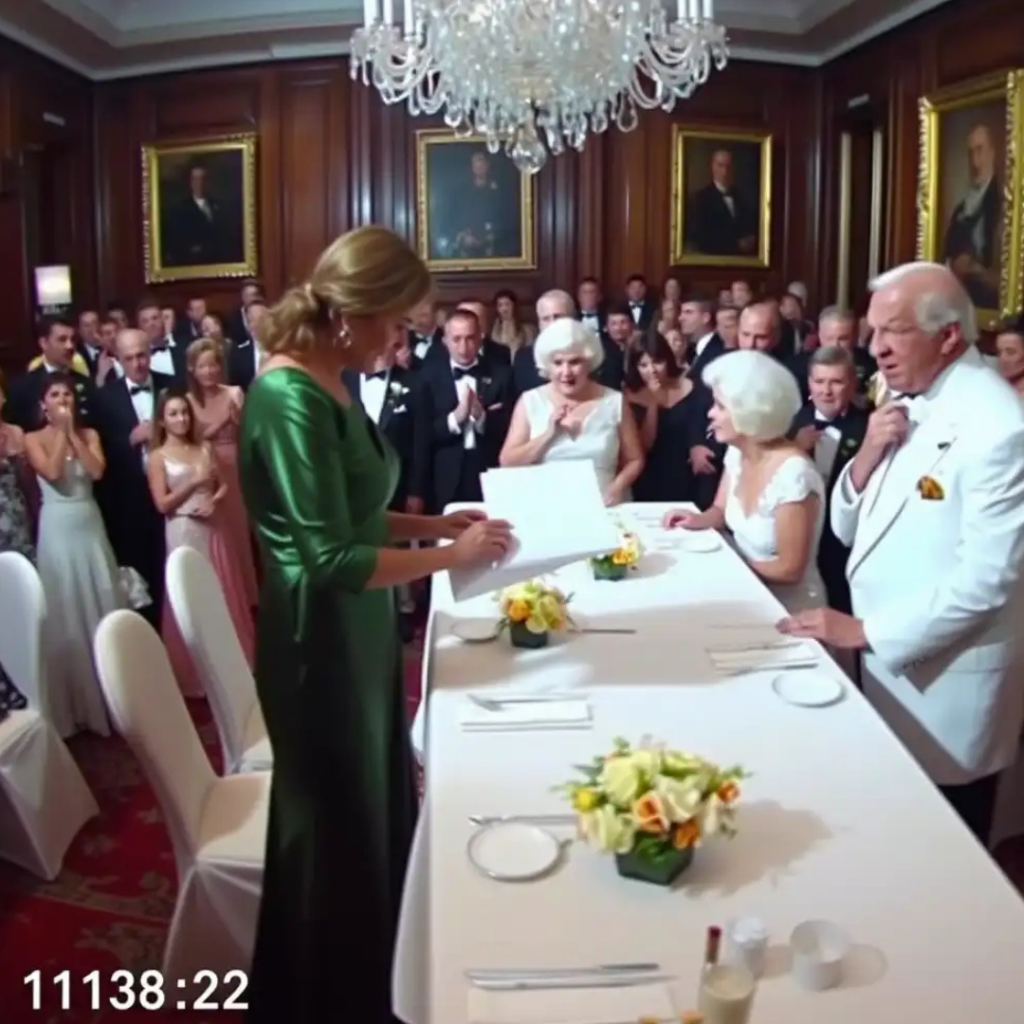
Patricia pushed a postnuptial agreement across the white tablecloth. Sixteen pages. If I signed it, I gave up any claim to the house, any marital assets, any leverage if Daniel and I divorced. My husband sat beside me staring at his plate, saying nothing. That silence told me he had known this was coming.
Across from me, my sister-in-law Vanessa watched with open contempt. Her fiancé, Adrian, a corporate lawyer, folded his hands and waited. My father-in-law, Charles, cleared his throat. “This is the mature solution, Elena. Sign it, and everyone moves on.”
I picked up the document. I read the first page slowly. Then I held out my hand.
“I need a pen.”
Patricia smiled. A server appeared with an expensive fountain pen. I uncapped it, let the room believe I was beaten, then placed it back on the table.
“No,” I said.
The word struck harder than shattered glass.
Patricia blinked. “Excuse me?”
“I’m not signing anything.”
Vanessa laughed. “Don’t embarrass yourself. You came from nothing. Daniel gave you a name, a house, a life. This agreement is generous.”
That was when Daniel finally looked at me, not to defend me, but to judge how ugly the moment might become.
I opened my clutch and removed a cream envelope.
“Before anyone says generous again,” I said, sliding it toward Charles, “you should read this.”
He opened the first page, and the color left his face. Adrian snatched it from him, scanned it once, then a second time.
“What is this?” Charles asked.
“A lease reassessment notice,” I said. “The building your law firm occupies was acquired last year through one of my holding companies. Starting next month, your rent increases forty-one percent.”
Nobody moved.
I placed a second document on top.
“And that is the mortgage file for this house. The loan was sold in a distressed debt package eight months ago. My company bought it. You are four payments behind.”
Vanessa shot to her feet so fast her chair scraped the floor. “You’re lying.”
“Check the signatures.”
Even the servers froze. Patricia’s face changed first, then Adrian’s, then Daniel’s. My husband looked sick, which told me something important: he hadn’t known everything, only enough to let his family humiliate me.
I met his eyes. “You let them call me a liability in front of forty people. That was your choice. This is mine.”
Patricia stood. “Whatever stunt you think you’re pulling, it ends now.”
I leaned back in my chair.
“No,” I said. “It ended three days ago. Tonight is just the fallout.”
Then I slid a second envelope into the center of the table and delivered the sentence that stopped the room cold.
“The foundation money is missing,” I said, “and I can prove exactly where it went.”
No one touched their wine.
Patricia recovered first, which was exactly why she had ruled this family for so long. “You are making a disgusting accusation in my home.”
“In my collateral,” I said.
Charles slammed the papers down. “Owning debt does not give you power here.”
He was wrong. Debt was exactly how power worked in their world. They just hated that I had learned the language better than they had.
“I didn’t come tonight for the house,” I said. “I came because your foundation raised millions for St. Anne’s Children’s Cancer Wing and sent only a fraction to the hospital.”
Vanessa’s face tightened. Adrian spoke carefully. “Do you understand what defamation can cost?”
“Yes,” I said. “Less than fraud.”
The envelope contained bank transfers, shell-company filings, donor records, and the original tax submissions before someone altered them. I had spent eleven months building that file. Eleven months using accountants, attorneys, property records, and the one advantage Patricia never respected: people talked freely around a woman they had already dismissed.
I learned to weaponize that years earlier.
When Daniel met me, I was broke. I waited tables, freelanced at night, and lived in a studio so small my desk touched my bed. He told me he loved that I was different from his family. Warm. Honest. Unimpressed by money. I believed him. For a while, I mistook his gentleness for courage.
Then I watched Patricia humiliate catering staff at our engagement dinner. I watched Charles threaten a valet over an old scratch. I watched Vanessa steal business contacts from a friend, then pretend she had never met her. And every time, Daniel chose the same response.
Silence.
People imagine betrayal as something loud. Affairs. Lies. Violence. Sometimes betrayal is a husband who lets his mother carve pieces off your dignity because challenging her would inconvenience him.
The night I changed, I was twenty-four and desperate to be accepted. I had just landed my first serious commercial design contract, the one that would move me from survival into strategy. I called Patricia, stupidly hoping she would be proud. She listened and said, “Daniel’s former girlfriend just made partner at a Manhattan firm. Every family has different standards.”
I cried for ten minutes. Then I opened my laptop and went back to work.
That contract became my first investment. Then my first LLC. Then a second acquisition. Then a third. I kept building quietly, because the Whitmores never asked what I did unless they were preparing to insult it. Daniel knew I worked. He never asked how successful I was. Asking would have meant seeing me as a full person instead of a convenient wife.
Across the table, Patricia reached for her phone. Adrian stopped her.
“Do not call anyone,” he said.
That was the first honest thing he had said all night.
Charles reread the transfers more slowly. Vanessa whispered, “Operating expenses.”
“That is what the amended filing says,” I replied. “The original filing routed money through four private accounts. Three belong to this family. The fourth belongs to a security contractor used to bury donations as event costs.”
Patricia lunged for the papers and tore two pages in half. It did not matter. I had copies with my legal team, copies in secure storage, and copies already delivered to the state attorney general’s office.
“Sit down,” I said.
She did.
Then the front bell rang.
A member of the household staff appeared in the doorway, pale and rigid. “Mr. Whitmore, there are investigators here. And a reporter.”
Patricia turned toward me slowly, like she had finally recognized the shape of the weapon in front of her.
“What did you do?” she whispered.
I checked the time.
“I invited the truth,” I said. “And it is right on time.”
The investigators entered with quiet authority. Two men from the attorney general’s office stepped into the dining room, followed by a woman from financial crimes and a reporter from the Baltimore Ledger. The gala was over. Only consequences remained.
Charles rose so quickly his chair toppled behind him. “You cannot come into my home like this.”
One investigator looked at him without emotion. “We can, sir. We have documentation involving misappropriation of charitable funds and financial concealment.”
Patricia lifted her chin. “My attorneys will destroy this.”
Adrian did not move toward her. He took one step back instead.
That tiny step said more than any confession could have.
“Patricia,” he said, “do not say another word.”
Vanessa stared at him in disbelief. Daniel remained seated, both hands flat on the table, staring at the unsigned postnuptial agreement as if it had become a mirror.
The reporter had already started recording. Staff were told not to remove laptops, boxes, or guest bags. Vanessa tried to slip toward the side hall and was stopped. Charles demanded calls. He was told he could make them after initial questioning.
Then my general counsel, Diana Mercer, entered carrying a leather case. I had hired her when my company was operating out of two rented rooms above a laundromat. She handed the lead investigator a sealed folder.
“Duplicate ledgers, access logs, chain-of-custody records,” she said. “Everything is indexed.”
Patricia looked from Diana to me and finally understood the part that hurt her most: none of this had been emotional. I had not snapped. I had prepared.
I stepped into the front hall for air. Daniel followed.
“Elena.”
I turned with my coat over my arm.
“I didn’t know about the foundation,” he said.
“I believe you.”
He looked relieved for half a second, until I added, “That doesn’t save you.”
His face fell. “Then why are you treating me like them?”
“You didn’t need to steal from sick children to betray me,” I said. “You only had to sit there while they tried to strip me in public.”
“I thought it was a formality.”
“We both know that’s a lie.”
He looked down. For the first time in our marriage, he had nothing polished to hide behind.
“You could have asked who I was,” I said. “You could have asked what I was building. You never did. It was easier to believe I needed your family than to risk finding out I never had.”
Diana joined us in the foyer. “The cars are here,” she said.
I nodded, but before leaving, I made one last call to my chief financial officer from the front steps. Flashing lights cut across the driveway.
“Give them ninety days on the house,” I said. “Standard terms. No extensions.”
My CFO paused. “That’s generous.”
“No,” I replied. “It’s measured.”
I ended the call and looked back at the mansion. For years I had imagined this moment would feel like revenge. It didn’t. It felt clean.
I had loved Daniel once. That was true. I had also confused patience with loyalty, silence with peace, and manners with character. That mistake would not survive this night.
Later, in my office downtown, I sat alone with the city burning beneath the windows and the divorce papers waiting beside my laptop. I called my grandmother in Ohio, the only person who had known every stage of what I was building.
“Well?” she asked.
“It’s over,” I said.
After a short silence, she asked, “Are you heartbroken?”
I looked at the skyline, at the papers, at my own reflection in the dark glass.
“No,” I said. “I’m finally accurate.”
If you’ve ever been underestimated by family, comment where you’re watching from, and tell me whether Elena was right tonight.