I walked into my sister Morgan’s engagement party after thirty-six straight hours inside a secure military operations bunker, and I knew the second I crossed the ballroom that I looked wrong for the room. My dress uniform was clean enough to pass inspection, but it still carried the wear of real work: wrinkled sleeves, tired eyes, boots that had seen concrete instead of polished marble. Morgan was standing under the chandelier in white silk with one hand looped through Major Julian Cross’s arm, smiling for politicians, officers, and donors like she had been born for applause. Then she saw me, stepped down from the center of the room, and took my arm with a smile that never reached her eyes.
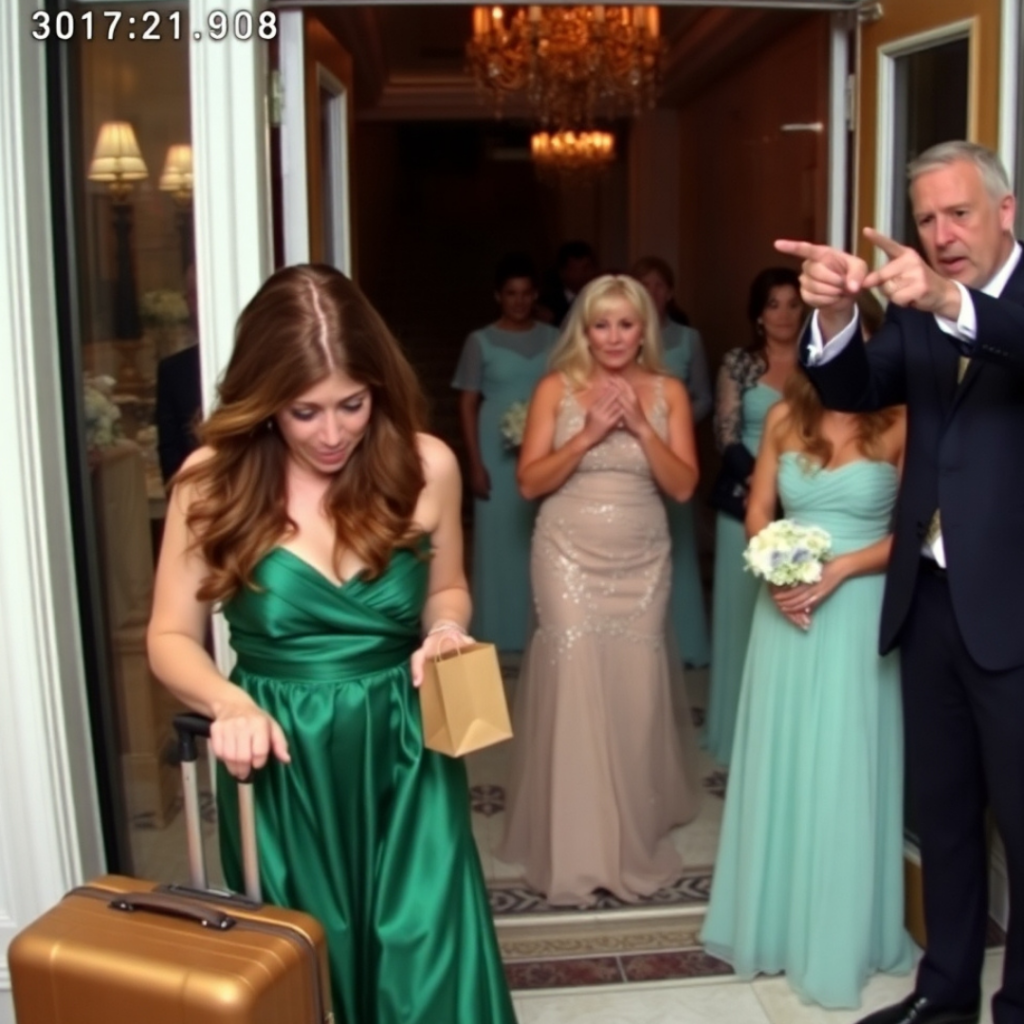
“What are you doing here?” she whispered.
“I was told to come.”
“Not dressed like that.” Her fingers tightened. “Leave that trashy uniform outside before you ruin this.”
She said it softly, but the humiliation landed hard because I knew exactly what she meant. In our family, image always came first. My father, Harrison Blake, had spent his whole career teaching us that appearances were power. Morgan fit that lesson perfectly. I never did. I didn’t argue. I turned around, walked out into the rain, and let the doors close behind me.
I had barely made it to my car when Julian came after me. He didn’t bother pretending he cared how I was doing. He leaned into the open door and handed me a folded transfer form, asking me to sign over my share of my late grandfather’s trust so he and Morgan could close on a new house. He called it a family contribution. I called it theft. Then I noticed the watch on his wrist: a piece worth more than a major’s annual savings should ever allow. That was the first moment something in my head clicked. His salary didn’t match his lifestyle. His pressure didn’t match a simple family favor. When I refused to sign, his tone changed. He hinted he could have me reassigned, sidelined, buried somewhere harmless. I shut the door in his face and went straight back to base.
By sunrise, I had Julian’s procurement history open across three classified systems. What started as a suspicion turned into a trail: inflated contracts, shell companies, unauthorized routing, and leaked infrastructure schematics tied to military logistics. Every path I pulled led back to one private contractor again and again: Harrison Defense Solutions. My father’s company. Julian wasn’t just greedy. He was helping move sensitive grid architecture outside secure channels, and my father was washing the money. Before I could escalate it, base legal summoned me. Someone had filed an emergency fitness review to suspend my clearance on grounds of instability. My father initiated it. Morgan supported it. They were trying to take me off the board before I could say a word.
I stopped that too. I put one offshore account statement on the table, watched the legal officer go pale, and walked out with my clearance intact. An hour later, my father called and ordered me to attend Morgan’s military gala that night, sit quietly, and stop embarrassing the family. I went because by then I understood something they didn’t: they thought they were controlling the story, but the story was already collapsing. Morgan took the stage that evening and delivered a polished speech about duty, sacrifice, and relatives who “couldn’t handle pressure.” Then Harrison leaned down beside me and promised that by morning, my rank and access would be gone.
I checked my watch, looked at him, and said, “You won’t need to wait that long.”
At that exact moment, every phone in the ballroom went off.
The alert sound cut through the ballroom like broken glass. Conversations died in mid-sentence. Chairs scraped. Officers reached for phones, staff froze, and the string quartet stopped playing without being told. A network breach. East Coast grid exposure. Multiple nodes under attack. In less than ten seconds, Morgan’s award ceremony turned into operational panic.
Harrison stepped toward the center of the room and tried to seize control with his voice. “Everyone stay calm. This is being handled.”
It wasn’t.
The main doors slammed open, and a military police response team entered in formation. They moved past the guests, past the colonels, past my father, past Morgan’s outraged demands, and came straight toward me. That was the moment the room changed. Not because people suddenly respected me, but because they realized they had misunderstood my place in the hierarchy all along.
The lead captain stopped in front of me and held out a hardened tablet. “Captain Blake,” he said clearly, “Pentagon operations is requesting immediate access.”
Morgan actually laughed once, sharp and disbelieving. “There has to be some mistake.”
The captain never looked at her. “No mistake, ma’am.”
I took the tablet and the secure feed opened instantly. Live grid mapping. Compromised nodes. Entry vectors. Failed barriers. The room disappeared for me the way it always did when the real work started. I began issuing orders before the captain finished briefing me.
“Seal external access points. Route all incoming traffic through isolation layers. Kill nonessential pathways. I want containment in sixty seconds.”
“Yes, ma’am.”
He repeated every command into his comms, and within moments the response team began moving. That was what real authority looked like. Not applause. Not expensive dresses. Not speeches. Just action.
I dug into the breach pattern and found what I was afraid of almost immediately. The attack wasn’t random, and it wasn’t foreign in origin. It was using internal architecture maps, low-level access routes, and maintenance back doors that only existed because someone had sold them. I expanded the trace, matched it to the schematics I had pulled that morning, and turned the tablet outward so the senior officers in the room could see the routing chain.
“This attack is domestic,” I said. “The access path matches infrastructure schematics transferred out of military systems last month.”
The room went silent.
I zoomed deeper, line by line. “Those transfers were authorized through logistics command. Specifically through Major Julian Cross.”
Julian took one step backward.
I didn’t stop. “The payments tied to those transfers were routed through shell companies and washed through Harrison Defense Solutions.”
This time even Harrison said nothing. He couldn’t. The names were on the screen. The money trail was visible. The timing matched the breach. A few officers who had spent the evening praising Morgan slowly moved away from my father without a word. Julian looked like he wanted to deny it, run, or disappear, but the exits were already covered.
Then one of the security specialists stepped forward and handed me a secure satellite phone. “Priority patch from Pentagon operations.”
I hit speaker.
The voice that came through was calm, direct, and instantly recognizable to everyone with any real seniority in that room. “Captain Blake. Status.”
“Primary breach contained,” I said. “Secondary vectors isolated. Attack is leveraging schematics leaked through internal procurement channels.”
A short pause. “Estimated consequence if successful?”
“Multi-state grid failure. Hospitals, transit, emergency dispatch, and water systems would have been compromised. High casualty probability.”
Another pause, heavier this time.
“You stopped it?”
“Yes, sir.”
“Well done. Remove anyone involved. We’ll take it from here.”
The line went dead.
No one moved for a full second after that. Then Morgan’s face lost all color. She staggered backward and dropped to the floor in front of the same crowd she had spent all night impressing. Harrison looked smaller than I had ever seen him. Not older. Smaller. The kind of small that comes when power leaves a man all at once. Julian stopped pretending he had options. Around me, the response team held position, waiting for the next order.
I handed the phone back, looked at the room that had judged me when I walked in, and said the only thing that mattered.
“This isn’t a breach,” I said. “It’s the bill coming due.”
Then the MPs moved.
Two officers crossed the room and took Julian first. He tried to pull back on instinct, then switched to the oldest defense in the book: outrage. He demanded counsel, claimed there was context, insisted the financial routing was being misread. None of it mattered. Once the cuffs were on, his voice lost its confidence and turned into noise.
My father lasted a few seconds longer.
He straightened his shoulders, tried to summon the command presence that had controlled rooms for years, and ordered the MPs to stand down. No one obeyed. He looked to the colonels nearest him, men who had been laughing at his table less than an hour earlier. Not one of them stepped in. That silence broke him more than the handcuffs did. When the officers secured his wrists, he didn’t fight. He just stared ahead like the room had betrayed him, when the truth was simpler: the room had finally seen him clearly.
Morgan was still on the floor when they led the men out. She pushed herself toward me, her mascara gone, her voice shaking, both hands catching at the leg of my uniform.
“Norah, please,” she said. “We’re family.”
That word should have meant something. For years, it had been used like a leash.
I looked down at her and felt no triumph, only distance. “Family doesn’t try to steal from me, destroy my clearance, and call me unstable to save itself.”
She shook her head violently. “You brought them here. You did this.”
I eased my leg free from her grip. “No. I exposed what was already there.”
She stared at me, waiting for softness, forgiveness, rescue. Morgan had always believed there would be one last door she could open with the right expression. There wasn’t. Not anymore.
“Do you remember what you said to me when I arrived?” I asked.
Her breathing hitched, but she said nothing.
“You told me to leave that trashy uniform outside.” I adjusted my sleeve and held her gaze. “I did. I left the trash outside.”
That was the first time she truly understood that this was over.
I walked out of the ballroom without looking back. The officers stepped aside to clear my path, not dramatically, just naturally. Outside, the night air felt colder and cleaner than the air inside that building had all evening. I got into my car, closed the door, and sat there for a moment with both hands on the wheel. The adrenaline faded first. Then the noise. What stayed was the cost.
People talk about integrity like it feels noble in real time. It doesn’t. It feels expensive. That night, I didn’t just expose corruption. I ended the last version of my family that I had still been pretending existed. Harrison was under investigation within hours. Julian was charged before the week was out. Morgan disappeared from public events and stopped answering every number I knew. I kept my rank, my clearance, and my job, but I lost any illusion that blood automatically means loyalty.
The truth is, loyalty without integrity is just complicity in better clothes.
I also learned something I wish I had understood earlier: people like Morgan and Harrison never respected silence. They mistook it for weakness. They respected visibility, performance, and whatever looked powerful under bright lights. My work had never looked glamorous. No one applauds the disaster that never happens. No one throws a gala for the system that holds. But when everything started breaking, the difference between real strength and decorative strength became impossible to miss.
That is why I never regretted the timing. I did not lash out emotionally. I did not expose them for revenge. I waited until the evidence was complete and the moment made denial impossible. Truth without timing gets buried. Truth with timing changes everything.
I drove for nearly an hour that night before I finally headed home. No music. No calls. Just the road and the strange quiet that comes after a battle you never wanted but could no longer avoid. I wasn’t happy. I was clear. There is a difference. I had not won my family back. I had simply refused to lose myself for them.
And if I had to choose again, I would still choose the truth.
If you were in my place, would you expose your own family, or stay silent? Share your answer below today.