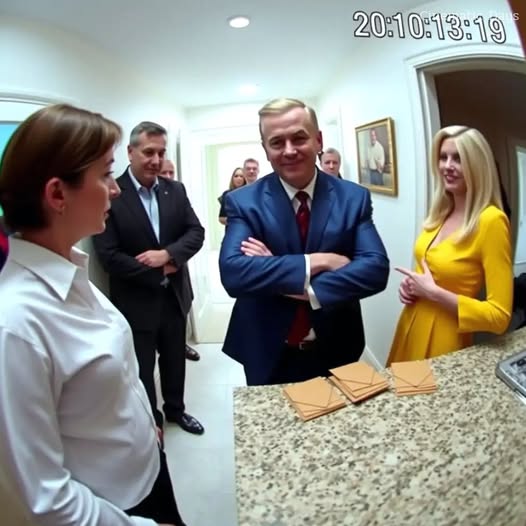
He slid a manila envelope across our granite island like it was a done deal, the paper hissing against the cold stone. “Sign these. Forty-eight hours,” Brad said, smoothing his tie with the practiced arrogance he usually reserved for junior associates. “Madison is moving in this weekend. She owns this house now.” He delivered the news with the steady, delusional calm of a mediocre financial advisor who believes that posture and a tailored suit can bend the laws of reality. I stared at the template divorce forms he had clearly printed off the internet, noting the cheap paper quality, and then I glanced up at him. I smiled. It wasn’t the fragile, trembling smile of a heartbroken wife he was hoping to crush. It was the sharp, terrifying curvature of a predator recognizing prey. It was the smile that said, You have genuinely forgotten who I am.
Because he had forgotten. In his eagerness to replace me with a younger, shinier model, he forgot that I am Harper Caldwell, the real estate attorney who structured the purchase of this very home. He forgot that the deed locked in the county safe doesn’t say “Bradley and Harper.” It reads Caldwell Property Holdings, LLC, an entity funded entirely by my Grandma Rose’s inheritance and recorded at the county clerk’s office with a notary stamp and a timestamp accurate to the second. He forgot the homestead affidavit protecting my occupancy rights, the title insurance binder sitting in the blue folder in my office, and the strict HOA bylaws that require the owner of record to authorize any new security fobs. He had overlooked the boring, official, American details—the kind of invisible bureaucratic steel that is impossible to argue with.
By evening, the porch lights on our quiet, manicured street glowed like beacons of normalcy. Someone across the cul-de-sac had a small American flag tucked into a fall wreath, and the scent of a neighbor’s grill drifted through the window. It was the kind of suburban Friday where yard sprinklers click on and off in rhythmic percussion, and nothing dramatic is supposed to happen. I sat in the dim light of the living room, closed my laptop on a county-records tab, and opened the group chat labeled “Civility League.” We were a tidy circle of women who never expected to meet, yet life had introduced us at precisely the right moment: Patricia, a former prosecutor; Victoria, a compliance officer at a Fortune 500; Jennifer, a CPA who could trace hidden assets in her sleep; and me. Patricia’s text came in first: “Reports filed. We are a GO.” No emojis. No fireworks. Just the quiet punctuation of accountability.
At 9:45 p.m., the front door opened like a curtain rising on a bad play. “Brad, honey, I brought dinner!” a bright, shrill voice sang from the foyer. I heard the crinkle of a paper bag and the heavy clink of a champagne bottle against the wall. “I thought we could celebrate your new freedom tonight.” Brad moved quickly, his footsteps bouncing off the hardwood stairs as he rushed to intercept her. “Madison, I told you to wait. Harper is still—” “Oh, don’t worry about her,” she interrupted, her voice warm and sugary, dripping with performative pity. “After tomorrow, she’ll be gone, and we can start fresh in our beautiful new home.” Our. New. Home. The audacity was almost adorable.
I straightened my blazer, checked the silver locket from Grandma Rose at my throat, and walked down the stairs like a woman stepping into a courtroom she knows by heart. They were standing in my kitchen, her arms draped possessively around his waist, both of them admiring the quartz counters I had chosen and paid for. Madison’s smile was easy, the kind practiced in reflective elevator doors. She turned to dismiss me politely, the way one might address the hired help. “Evening,” I said. My voice didn’t rise; it didn’t need to. It carried the weight of absolute authority. “We should clear up a small misunderstanding before anyone unpacks.” She tilted her head, confused. “Oh? And what would that be?” I set my phone on the island, the screen glowing with a county page showing the only line that mattered: Owner of Record. I looked at her, steady and unblinking. “Madison Rivers,” I said. And that was where her smile began to slip.
“Brad told you he bought me out, didn’t he?” I asked, my tone conversational. Madison looked at Brad, whose face had drained of color, turning a sickly shade of grey. “He told you that if you gave him the down payment for the renovation, he’d put your name on the title today. That’s what that forty-thousand-dollar transfer was for last Tuesday, correct?” Madison’s grip on Brad’s waist loosened, her hand dropping to her side. “How do you know about that?” she whispered. I swiped the screen on my phone. “Because Jennifer, my CPA, tracks household accounts. And Patricia, my lawyer friend, just filed a fraud report regarding that transfer. You see, Brad doesn’t own this house. He never has. He is a guest here. And guests cannot sell what isn’t theirs.”
The silence that followed was heavy enough to crush bones. Brad tried to speak, to bluster his way through, but his voice cracked. “Harper, we can talk about this—” “We are done talking,” I cut him off, my voice turning to ice. “This house belongs to Caldwell Property Holdings. You have 48 hours? No. You have ten minutes. If you are not off my property, I will call the police and have you removed for trespassing. And Madison,” I turned my gaze to her, watching the realization of her mistake wash over her face. She wasn’t the new owner; she was just another victim of a man living beyond his means. “I suggest you call your bank. Though, knowing Brad, that money is already gone.”
Madison stared at Brad, horror replacing the smugness. She realized then that the enemy wasn’t the ‘ex-wife’ holding on to the past; the enemy was the liar standing next to her. She didn’t scream at me. She didn’t smash the cake. She simply looked at him with pure disgust, the champagne bottle dangling loosely in her hand. “You told me you signed the papers,” she hissed at him. “You told me it was ours.” Brad backed away, stammering, looking for an exit that didn’t exist. The fantasy he had built—of being the wealthy provider, the man in charge—collapsed under the weight of a single PDF document.
I watched them leave from the front window. It wasn’t a dramatic exit with luggage and weeping. It was hasty, shameful, and quiet. Madison drove off in her car without letting him in. Brad was left standing on the curb, his phone to his ear, likely calling a friend for a couch to crash on. I locked the heavy oak door, engaged the deadbolt, and turned off the porch light. The house was silent again. The “Civility League” group chat pinged once more. It was Victoria: “Is it done?” I typed back a single word: “Done.” I walked to the kitchen, picked up the expensive champagne Madison had left behind, and poured it down the sink. I didn’t want their celebration. I had my peace.
That night, I slept soundly in the center of my bed, surrounded by the walls my grandmother’s legacy had built. The victory wasn’t in the shouting or the fighting. It was in the preparation. It was in knowing that while they played checkers with emotions, I was playing chess with the law. They thought they could bully me into submission because I was quiet. They mistook silence for weakness, not realizing that the quietest person in the room is often the one listening to the tumblers of the lock click into place.
Moral of the Story: True power does not roar; it whispers. Never mistake a person’s silence for ignorance or their patience for weakness. In a world full of noise and empty threats, the most dangerous weapon you can possess is not a loud voice, but the quiet, undeniable proof of your own worth—and the paperwork to back it up.