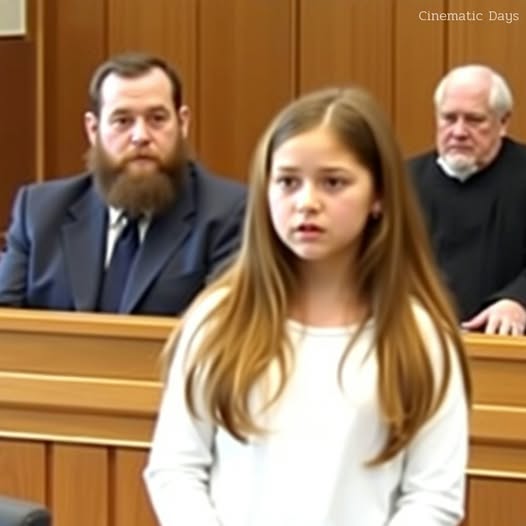
The courtroom was silent, a suffocating vacuum that pressed against the chest of every adult in the room, broken only by the sound of small, trembling footsteps echoing across the polished wooden floor. Dozens of eyes turned toward the source: a girl, barely twelve, clutching a worn brown folder to her chest as if it contained the secrets of the universe. Her hands shook violently, but her eyes—red-rimmed from sleepless nights and endless crying—burned with a resolve far stronger than fear. Judge Harrington, an older man with a voice like grinding gravel and eyes that could freeze a storm, narrowed his gaze from the bench. “Young lady,” he rumbled, his patience wearing thin, “this is a court of law, not a classroom. Sit down immediately.” But Emily Carter didn’t move. Instead, she lifted her chin, her gaze drifting to the defendant’s table where a weary man in a frayed gray suit sat staring at his hands. “Your Honor,” she said, her voice trembling but piercing the silence. “That man is my father. And I’m here to prove he’s innocent.”
Gasps rippled through the gallery like a shockwave; a reporter dropped his pen, the prosecutor blinked in disbelief, and even the bailiff froze. Judge Harrington leaned forward, his curiosity piqued despite protocol. “You’ll prove it?” he asked, his tone skeptical. “Yes, Your Honor,” Emily replied, raising the folder high above her head like a shield. “Because no one else will.” The courtroom exploded into chaos—whispers turning into shouts, the scrape of chairs, and the prosecutor sputtering frantic objections about procedure—but Emily stood perfectly still in the eye of the hurricane, locking eyes with her father. For the first time in months, Mark Carter smiled—a weak, proud, trembling expression that broke Emily’s heart and mended it all at once. Judge Harrington banged his gavel, the wooden crack silencing the room instantly. “Order! Let’s hear what she has to say,” he commanded, signaling for the bailiff to stand down.
To understand this moment, one had to look back just a few months, to when life was ordinary, imperfect, but happy. Morning sunlight used to filter through their small apartment, illuminating peeling wallpaper and a fridge that hummed too loudly, but it was a home filled with love. Mark Carter, a quiet man who smiled with his eyes, had raised Emily alone, teaching her values over breakfast pancakes. “Truth never fears courage,” he had told her just hours before the nightmare began. “As long as you tell the truth and stay brave, you’ll never lose.” Those words had felt like a simple fatherly lesson then, but they became a lifeline when the police burst through their door that rainy evening. Accused of stealing $80,000 from Dalton Industries, Mark had been dragged away in handcuffs, pleading his innocence while Emily stood frozen in the hallway, clutching his tie, the sirens wailing like mourners in the night.
The weeks that followed were a blur of cold courtrooms and the stinging whispers of classmates who labeled her the “thief’s daughter.” Emily had moved in with her well-meaning but overwhelmed Aunt Clare, who, defeated by the mounting evidence, had suggested Mark plead guilty just to end the ordeal. “The evidence is too strong,” Clare had whispered one night, unaware Emily was awake. “It’s over.” But lying in the dark, staring at the ceiling, Emily heard her father’s voice echo: Truth never fears courage. Refusing to accept defeat, she had skipped school the next day, returning to their sealed-off apartment. She spent hours sifting through her father’s meticulously kept records, dusting off old ledgers and receipts, looking for the detail the expensive lawyers had missed. That was when she found the “Dalton Partnership” folder and the withdrawal form that had condemned her father.
Now, standing before Judge Harrington, Emily opened that very folder. “The prosecution says my father signed this withdrawal for $80,000 on September 14th at 2:00 PM,” Emily stated, her voice gaining strength. She pulled out a document. “But he couldn’t have.” The prosecutor stood up, scoffing. “This is a waste of time. The signature is a match.” Emily didn’t flinch. “The signature matches,” she admitted, turning to face the gallery, “but the timeline doesn’t.” She pulled out a second piece of paper—a wrinkled, juice-stained receipt from a hospital emergency room. “On September 14th at 2:00 PM, my dad wasn’t at the bank. He was at St. Mary’s Hospital, holding my hand while I got three stitches in my chin because I fell off the swing set at school.”
The courtroom fell into a stunned silence, deeper and more profound than before. Emily walked toward the bench and handed the papers to the bailiff, who passed them to the Judge. “The timestamp on the hospital intake form is 1:45 PM. The discharge is 4:00 PM,” Emily continued, tears finally spilling onto her cheeks. “He couldn’t have signed a bank withdrawal across town at 2:00 PM. Someone digitized his signature and pasted it there.” Judge Harrington studied the papers, his brow furrowed. He looked at the hospital receipt, then at the bank document, and finally at the prosecutor, whose face had drained of all color. The “irrefutable” digital evidence suddenly looked like a clumsy frame-up when placed against the tangible, physical proof of a father’s love for his injured daughter.
“Mr. Prosecutor,” Judge Harrington said, his voice dangerously low. “Do you have an explanation for this alibi?” The prosecutor stammered, shuffling his papers, looking toward the back of the room where Mr. Dalton, the CEO of Dalton Industries, was shifting uncomfortably in his seat. Emily turned, pointing a small finger directly at the CEO. “My dad found out about the offshore accounts, didn’t he?” she accused, her voice ringing clear. “He wasn’t stealing the money. He was the only one trying to stop you.” It was a gamble, a guess based on the other papers in the folder, but the look of sheer panic on Mr. Dalton’s face confirmed everything. The murmur in the courtroom turned into a roar of realization. The police officers near the door took a step toward the gallery, not the defendant.
Judge Harrington looked at Mark Carter, then at Emily. He took a deep breath and removed his glasses. “In thirty years on the bench, I have never seen a defense counsel as effective as this young lady,” he declared. “The timeline provided by this receipt makes the prosecution’s key evidence physically impossible. The motion to dismiss all charges is granted, with prejudice.” He slammed the gavel down—BANG—a sound that shattered the nightmare. “And I suggest the District Attorney open an immediate investigation into Dalton Industries for fraud and filing false charges.” The words hung in the air for a second before the room erupted, this time in cheers.
Mark Carter stood up, his legs shaking, as the bailiff unlocked his handcuffs. He didn’t look at the judge or the lawyers; he ran straight to the small wooden gate separating the well from the gallery. Emily vaulted over the railing, burying her face in his chest. They collapsed to the floor together, a tangle of tears and relief, oblivious to the flashing cameras and the shouting reporters. “You did it,” Mark sobbed into her hair, holding her tighter than he ever had. “You saved me.” Emily pulled back, wiping her eyes, looking at the man who had taught her everything she knew about bravery. “I just told the truth, Dad,” she whispered. “Just like you said.”
They walked out of the courthouse hand in hand, stepping into the blinding afternoon sun. The storm clouds from months ago had finally cleared. The cameras flashed, but the headlines the next day wouldn’t be about a thief; they would be about the girl who took on the legal system and won. Emily looked up at her father, the weight of the world finally lifted from his shoulders. She realized then that the courtroom wasn’t a place where truth just happened; it was a place where truth had to be fought for. She squeezed his hand, ready to go home.
Moral of the Story
“Truth never fears courage, but truth alone is not enough—it requires a voice brave enough to speak it.”
Justice is not always automatic; often, it hides in the smallest details, waiting for someone with enough love and determination to bring it to light. Even when the world stands against you, one person standing firm in the truth is a majority.