Thanksgiving was never just a meal in my family. It was an annual performance—assigned seats, rehearsed compliments, laugh cues timed like commercials. Aunt Sandra hosted because she liked the power of a full table that depended on her timing. She liked being the director.
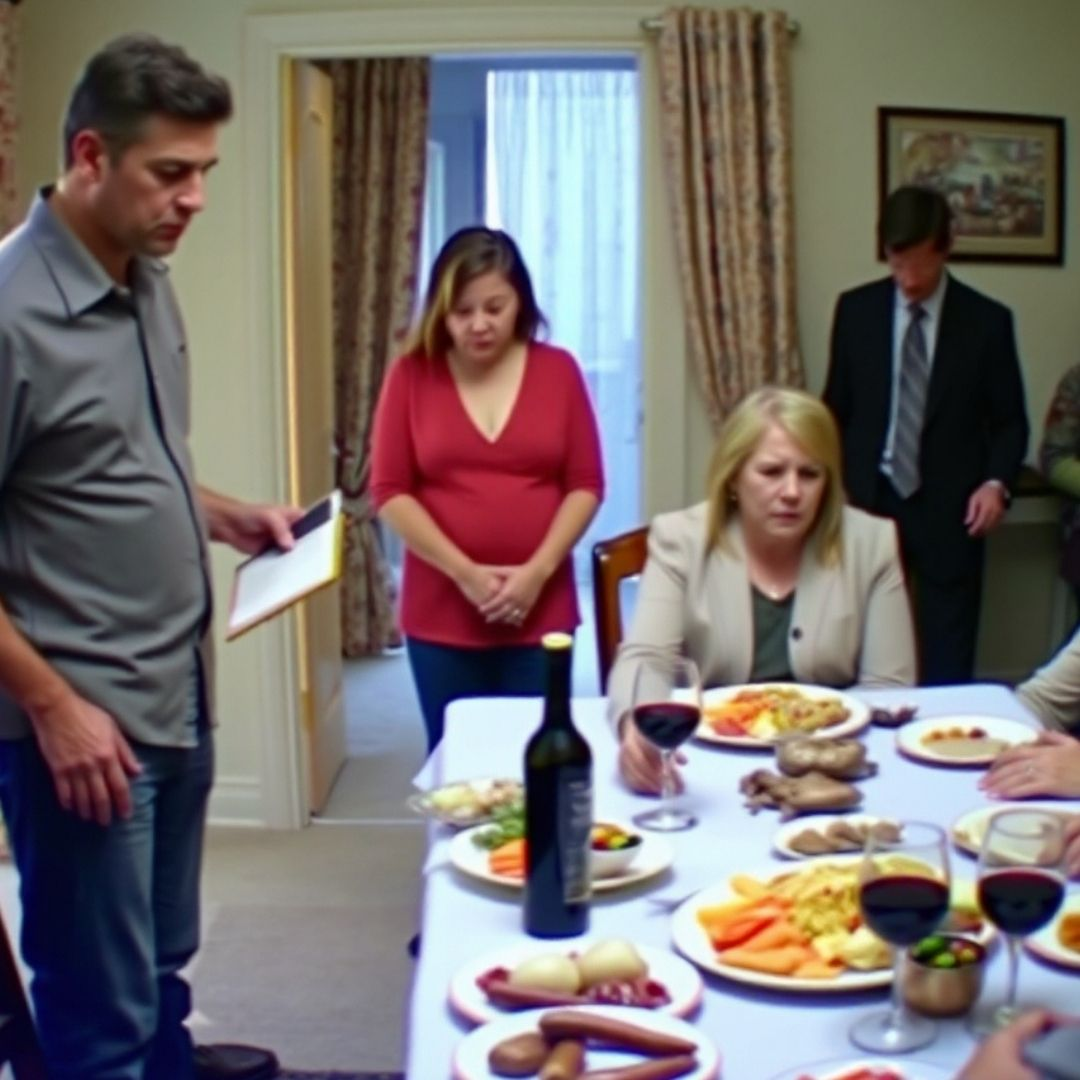
I had played my role for years: Daniel, the one who “could’ve been something.” The quiet son. The one who “ran that little computer hobby.” As if the work I did lived in a basement, lit by blue screens and regret.
Blake Harrison, meanwhile, was the star Sandra rented and bragged about like a new chandelier. He wasn’t blood. He was better—proof that her side of the family produced winners even if the universe was unfair enough to give her a sister with a son like me.
Blake came into the family story the year I graduated college with a scholarship, a job offer, and a naive belief that facts were louder than opinions. Sandra introduced him at Easter like a headline: “Blake. Finance. Real trajectory.” He shook hands like he was collecting signatures. He laughed too loudly at his own jokes, but everyone forgave him because they mistook noise for confidence.
Every holiday after that was the same: Sandra updated Blake’s legend—new client, new watch, new lease he called a penthouse—and I did my part: polite nods, quiet smiles, the same line that kept the peace.
“Still working on the tech thing,” I would say.
Tech thing. As if it were an app I made for fun. As if it wasn’t the reason my calendar had more time zones than birthdays.
But people get lazy when they’re certain you won’t push back.
That year, Thanksgiving arrived with a cold front and an even colder certainty: I could feel something in me thinning, like a rope fraying. A decade of swallowing turned my silence into a habit, and habits are hard to notice until you stop.
Sandra’s dining room glowed with planned warmth—candles, imported napkins, a centerpiece that looked like it had its own insurance policy. My dad sat in the same chair he always did, shoulders slightly hunched, like he wanted to take up less space. My mom moved between kitchen and table, smile stretched tight, trying to hold everyone together with politeness.
Blake arrived late in a pea coat that probably cost more than my first car. He kissed Sandra’s cheek with the familiarity of a favored nephew and winked at my cousin Jenna like they shared a private language. Then he found me and did what he always did—treated my existence like a setup for a punchline.
“Danny boy,” he said, clapping my shoulder as if we were friends. “How’s the little laptop empire? Still selling keyboards out of your trunk?”
The table laughed. Not because it was funny, but because it was expected.
My mom shot me that familiar, fragile look: please, not tonight. The look that meant she’d been negotiating peace since before I was born.
Blake raised his glass like he owned the room. “To real jobs,” he said, eyes flicking to me. Laughter rolled around the table the way it always did—too loud, too eager, too practiced.
My dad stared down at the cranberry sauce. He didn’t laugh. He didn’t defend me either. He just… vanished behind his silence the way he’d done when Sandra’s opinions got sharp. My father’s love was steady, but it had always been quiet. Quiet doesn’t cut through applause.
I took a sip of wine that tasted like grapes and restraint.
Halfway through turkey, after Sandra had made her rounds praising the ham glaze and complimenting Blake’s “growth mindset,” Blake leaned toward me with that smirk he thought was charm.
“Hey,” he said, voice carrying just enough for the near end of the table to hear. “Your little company hiring? Thinking of trying out a startup. Market’s hot.”
He said startup the way people say kale—like it made them healthier by proximity.
“Something managerial,” he added. “I’m a people guy.”
I could’ve told him then.
That HR had already forwarded me a résumé tagged HARRISON, B.—that he’d applied for a mid-level analyst role and didn’t clear screening. That the CEO he wanted to impress was the same guy Blake had called “allergic to success” since 2014 because the man wouldn’t buy his pitch deck.
I could’ve said it. I could’ve watched his face lose its shine right there among the mashed potatoes.
Instead, I did what I always did.
“I’ll see what I can do,” I said, like I was asking the weather for permission.
Blake grinned, satisfied. Sandra patted his arm. “You’d be lucky to have him,” she said, and the room nodded like a choir.
Jenna, who’d once asked me privately how to build a portfolio, laughed loudest. My uncle Ron made a noise that was almost a cough. My mom’s smile cracked at the edges.
The thing about silence is it teaches you to see.
To clock who laughs first, who looks away, who checks which way the wind is blowing before they breathe. It teaches you timing.
That night, when I drove home with my parents, my dad kept both hands tight on the wheel.
“Your aunt gets carried away,” he said finally, as if Sandra were a weather pattern.
“It’s fine,” I lied.
My mom looked out the window. Streetlights slid across her face, bright then gone, bright then gone.
“You don’t have to keep doing this,” she whispered, so quietly I almost missed it.
I said nothing, because a part of me still believed that if I stayed small enough, they would stop stepping on me.
Two weeks later, the email landed in my inbox at 2:13 p.m. on a Wednesday, the subject line blunt and ordinary: Candidate Update: Harrison, Blake.
I didn’t open it right away because I already knew. I’d seen his application earlier, forwarded from HR with a polite note: FYI—looks like a referral request might come through family?
Blake’s résumé was all confident verbs and vague numbers. He’d written “Spearheaded strategic initiatives” like a spell. He listed “Leadership” three times in different fonts. He claimed to have “managed multi-million-dollar portfolios,” but the only firm he’d stayed with longer than eight months was a place that sold motivational seminars disguised as finance.
When I finally clicked the email, it was simple:
Thank you for your interest. At this time, we are moving forward with candidates whose experience more closely aligns with the role.
Rejection, professionally wrapped.
I should’ve deleted it. I should’ve gone back to my work—back to the project that had me leading a team across New York, Singapore, and London, back to the software rolling out to millions of users, back to the job that paid my mortgage, my parents’ rising medical bills, and the quiet pride I never paraded.
But instead, I printed it.
Not because I wanted revenge.
Because something in me had finally stopped hoping they’d see me on their own.
The next day, my mom called.
“Aunt Sandra texted,” she said. Her voice was careful, like she was stepping around something fragile. “She wants to know if you can… talk to someone. About Blake.”
I kept my tone neutral. “About what?”
“She said he’s between opportunities,” Mom said, and I could hear the way she softened the words, like she’d been trained to cushion reality. “And he’s… close to something big.”
Close to something big. Sandra’s favorite phrase. It let her claim a victory without proof.
“What did she ask Dad?” I said.
A pause. The kind of pause that carries history.
“She asked your father for a loan,” my mom admitted. “For Blake. She said it’s just to cover… a gap. Until his new firm signs.”
My chest tightened. “And?”
“He said no,” she said quickly. “He said… we can’t. Not right now.”
I pictured my father saying no to Sandra—my father, who hated conflict like an allergy. I pictured the guilt that would come afterward, the way he’d sit in silence and wonder if he’d failed as a brother-in-law, even if he’d done the right thing as a father.
“And she didn’t like that,” I said.
My mom exhaled. “She said some things.”
“Like what?”
“She said… if you were doing well, you’d help. She said… you’ve always been selfish with your talent.”
The words hit with an old familiarity, like a bruise pressed too hard. Sandra had been calling me selfish since I was twenty-two and wouldn’t hand over my internship contact list to Blake “just to help him network.” Since I wouldn’t write his cover letters. Since I wouldn’t turn my life into a steppingstone.
My mom continued, softer. “She said… Blake deserves a chance.”
I stared at the printed email on my desk. Black ink. Plain font. A truth that didn’t care about family politics.
“Mom,” I said, and my voice came out steadier than I felt. “Blake already got chances. He’s just been spending them like someone else will pay the bill.”
Silence stretched on the line.
Then my mom said something I wasn’t ready for.
“I’m tired,” she whispered. “I’m tired of asking you to swallow it.”
Something in me broke—not loud, not dramatic. More like a knot finally loosening after years of strain.
Sandra’s Christmas pageant—she called it that as if she were staging Broadway—was scheduled for the following Saturday. She had mailed invitations. Real paper. Gold lettering. A banner hung in the foyer that read: WELCOME TO THE HARRISON HOLIDAY SPECTACULAR.
My father wanted to skip it, I could tell. He moved slower that morning, as if delay could become an excuse. But my mom ironed his shirt anyway. She ironed mine too. Not because she cared about Sandra’s standards, but because she couldn’t stop caring. Caring was her language.
On the drive there, snow threatened but never committed. The sky was the color of old dishwater.
Sandra’s house was already loud when we arrived—Christmas music playing too high, laughter spilling from the living room. Someone had imported pine-scented candles that smelled like money trying to impersonate nature.
Blake stood near the tree holding court, telling a story about “a founder” who’d begged him to join a venture. Sandra hovered beside him, beaming like he’d personally invented December.
When I walked in, Blake’s eyes flicked to me and he smirked.
“Well, if it isn’t Silicon Valley,” he said. “How’s the basement?”
I smiled.
“Warm,” I said.
He laughed like he’d won something.
Dinner was the same script with new decorations. Sandra made sure Blake’s glass stayed full. She told everyone about his “upcoming interview” with “a major tech firm.” She said it like she’d signed the offer herself.
“And Daniel,” she said, turning toward me with that bright, weaponized cheer. “Still running that little computer hobby?”
There it was. The line she’d rehearsed. The line everyone expected me to swallow.
I looked at her, then at the table.
“Actually,” I said, gently, “I’m curious. Blake, which firm?”
The room shifted, subtle as a collective inhale. Sandra’s smile froze for half a second.
Blake’s eyes darted. “You know,” he said. “Can’t say yet. Confidential. CEO’s supposedly in the room when I interview.”
“Big deal,” I said softly.
He puffed up. “Huge.”
Sandra clinked her fork against her glass. “We don’t need details,” she said, too quickly. “We just need to celebrate him.”
Celebrate him. Always him.
I ate my ham and let the conversation flow around me like water around a stone. But inside, something was taking shape. Not anger, exactly. More like clarity.
After dinner, while Sandra herded everyone toward the living room for “toasts” and “announcements,” I stepped onto the porch. The December air cut through the noise and made everything feel sharper.
My mom joined me, pulling her cardigan tight.
“She’s going to do it,” she said.
“Do what?”
“She’s going to ask again,” my mom said, and her voice cracked with exhaustion. “For money. In front of everyone. She thinks public pressure is leverage.”
I stared out at Sandra’s yard, the lights strung perfectly across bushes that had never known neglect.
My mom kept her voice low. “Your father hates being embarrassed. She knows that.”
“And you?” I asked.
My mom hesitated. Her eyes looked tired in a way I hadn’t let myself fully see. “I hate watching you shrink,” she said. “I hate watching him shrink too. I hate… the way we’ve been living around her moods.”
There was a long moment where the cold did what cold does—made truth easier to say.
“I printed something,” I said.
My mom looked at me. “What?”
I didn’t answer. I didn’t need to. My briefcase sat by the door inside, waiting like a sealed envelope.
We went back in.
The living room had been rearranged like a stage. Sandra stood by the fireplace with her wine glass lifted, Blake beside her with an expression that tried to be humble and failed.
“Attention,” Sandra sang. “Everyone, please. A toast.”
People quieted. Jenna perched on the arm of a chair, smiling too brightly. Uncle Ron adjusted his belt. My father sat down slowly, as if bracing.
Sandra beamed. “This season is about blessings,” she said. “And we are blessed to have Blake in our family.”
Blake gave a small nod like a prince acknowledging applause.
Sandra continued, “Blake has incredible news. He’s on the brink of something major. A new job. A new chapter. A level of success that—well, not everyone achieves.”
Her eyes flicked to me. Just a flick. But it landed like a slap dressed in velvet.
Blake cleared his throat. “Yeah,” he said, and he held up his glass. “To new beginnings.”
People clapped.
Sandra leaned forward. “And,” she added, voice sweet, “we all know how hard it is between opportunities. So if anyone wants to support him—just until the paperwork is final—”
My dad’s shoulders tightened. My mom’s hand found his knee under the table, steadying him.
Something in me went very still.
I picked up my briefcase.
The folder inside was light—eight pages, one cover letter, one lie printed in black and white.
I could end it in sixty seconds.
Or I could end it well.
Sandra clinked her glass again. “Daniel,” she called, like I was a prop she’d summoned. “Why don’t you say something? You’re in tech. You understand these things.”
Everyone looked at me.
For a second, the old instinct flared—smile, nod, swallow. Be easy. Don’t make it worse.
Then I heard my mom’s voice from the porch: I’m tired of watching you shrink.
I walked forward, glass in my hand, and stood where Sandra wanted me: visible, exposed, convenient.
I raised my glass.
“To honesty,” I said.
The room made a small, uncertain noise—half laugh, half confusion.
“It always shows up,” I added, letting my eyes land on Sandra, then Blake. “Right on time.”
Sandra’s smile faltered. Blake’s grin flickered, the first crack in the polish.
I set my briefcase on the coffee table with a soft thud. The sound was small, but it silenced the last whispers.
I took out the folder and placed it on Sandra’s linen runner like an offering.
“Blake,” I said, calmly, “this is yours.”
Blake blinked. “What is that?”
“Your application,” I said. “And the response.”
Sandra’s face tightened. “Daniel—”
I held up a hand—not dramatic, just firm. The gesture startled even me. I’d never interrupted her before.
“I didn’t bring this to humiliate anyone,” I said, and my voice surprised me with how steady it was. “I brought it because I’m tired of stories replacing reality.”
Blake laughed sharply, like he could slice the moment with sound. “You’re kidding, right? You printed—what—an email? That’s pathetic.”
I nodded. “Maybe,” I said. “But what’s more pathetic is standing in a room full of family and asking them to fund a lie.”
Sandra’s cheeks flushed. “Watch your tone.”
“I’ve watched it for ten years,” I said. “I’m done.”
The words hung in the air like a bell that kept ringing after it should’ve stopped.
Jenna’s smile evaporated. Uncle Ron stared at the carpet. My father looked at me—really looked at me—like he was seeing the outline of a son he’d always known but never fully met.
My mom’s eyes filled with tears she didn’t wipe away.
Blake stepped forward, reaching for the folder like he could erase it by touch. “This isn’t—this isn’t even the job I told you about,” he snapped. “I have other things in motion.”
“Then say the firm,” I replied, still calm. “Say the role. Say the date. Give one detail that isn’t a fog machine.”
Blake opened his mouth. Closed it. His jaw worked like he was chewing pride.
Sandra’s voice rose, sharp. “Daniel, you always do this. You always think you’re better because you hide behind your computer. You don’t understand people.”
I looked at her. Really looked.
“You’re right,” I said. “I didn’t understand people for a long time. I thought if I worked hard, they’d respect me. I thought if I stayed polite, they’d stop.”
Sandra scoffed.
“But I understand now,” I continued. “Some people don’t want you to succeed. They want you to stay small so they can feel big.”
The room went quiet enough to hear the Christmas music still playing from the speakers—some cheerful song about joy that suddenly sounded like irony.
Sandra’s lips trembled. “After everything I’ve done for this family—”
“What you’ve done,” I said, and I kept my voice gentle because anger would turn this into entertainment, “is build your self-worth on a scoreboard no one agreed to.”
My dad flinched at the directness, but he didn’t look away.
Sandra turned to him, as if summoning him to his old role. “Tell him,” she demanded. “Tell him he’s out of line.”
My father swallowed. His hands clasped and unclasped.
For years, his silence had felt like betrayal. But in that moment I saw the truth: he had been afraid. Afraid of conflict, afraid of Sandra’s storms, afraid of losing whatever fragile peace he’d managed to keep.
He looked at my mom, then at me.
And he did something I had not expected.
He stood up.
“Stop,” he said, quietly.
Sandra blinked like she hadn’t heard him.
“Stop,” my father repeated, and his voice carried more weight the second time. “You don’t get to talk to my son like that.”
Sandra’s face twisted with shock, then anger. “Your son is humiliating us.”
“No,” my father said. His hands shook slightly, but he didn’t sit down. “You’ve been humiliating him for years. And I let it happen.”
The admission landed like a heavy object in the center of the room.
My mom covered her mouth, tears finally spilling.
Blake scoffed, trying to regain control. “This is insane. You’re all acting like I’m some villain.”
My mom’s voice came out, small but clear. “You asked us for money,” she said. “Again. In front of everyone.”
Blake’s eyes flashed. “Because family helps family.”
“Family doesn’t perform,” I said. “Family doesn’t make someone a punchline to keep the spotlight.”
Sandra’s shoulders rose as if bracing against a wave. For a second, she looked smaller—not innocent, not forgiven, just… human. Then she hardened again.
“So what?” she snapped. “You want applause? Is that it? You want us to beg for your forgiveness because you have a good job?”
I let the question sit. The old me would’ve rushed to deny it, to soothe.
Instead, I answered the truth.
“I don’t want applause,” I said. “I want respect. And if I can’t get that here, I’ll stop showing up to be used as contrast.”
Blake laughed again, brittle. “Good luck with that. You’ll be lonely.”
I looked at my parents—my father standing straighter than I’d ever seen him, my mother crying openly now, unashamed.
“I’d rather be lonely than small,” I said.
Silence again. Not the kind that hides things. The kind that reveals them.
Sandra opened her mouth, but no script came out. Without her jokes, without her audience’s automatic laughter, she seemed unsure what to do with her hands.
Blake backed toward the doorway like a man leaving a stage after forgetting his lines.
“Well,” he muttered, “this is… whatever. I don’t need this.”
He grabbed his coat. The door slammed harder than necessary.
No one moved for a moment. The tree lights blinked steadily, indifferent.
Then my mom exhaled, long and shaky, like she’d been holding her breath for years.
My father sat down slowly, and his eyes were wet.
“I’m sorry,” he said to me. “I thought keeping peace was protecting you.”
“I know,” I said. And I meant it.
Sandra stared at the folder still on the table, as if it were radioactive.
“I didn’t know,” she said, but it came out thin, defensive. “I didn’t know he was… sensitive.”
I almost laughed at the word. Sensitive. The label people use when they can’t admit they were cruel.
“It’s not sensitivity,” I said. “It’s dignity.”
Sandra’s gaze lifted to mine. For the first time, she didn’t look amused. She looked… cornered by reality.
“I just wanted…” she started, then stopped.
What she wanted was obvious: admiration, control, a story where she wasn’t ordinary. But wanting something doesn’t justify what you do to get it.
I picked up the folder and put it back in my briefcase.
“I’m leaving,” I said.
My mom stood immediately. “We’re leaving,” she corrected, with a quiet strength that made my throat tighten.
My father nodded.
Sandra’s mouth opened, then closed. She didn’t apologize. Not fully. Maybe she couldn’t yet.
But as we walked to the door, I heard her say, barely audible, “I didn’t think you’d ever… speak.”
I paused, hand on the doorknob.
Neither did I.
Outside, the air felt cleaner. Not warmer—December still bit—but cleaner, like a window opened after smoke.
On the drive home, my mom held my hand across the console, her thumb rubbing circles over my knuckles like she was reminding herself I was real and still here.
My dad drove in silence for a while. Then he said, “You’re doing well, aren’t you?”
It wasn’t a question about salary. It was a question about whether I’d survived being underestimated.
I looked out at the dark road, the lights stretching forward.
“I am,” I said. “But I didn’t need her to believe it for it to be true.”
My dad nodded, eyes glossy. “I should’ve believed it out loud.”
“Maybe now,” my mom said softly, “we can stop performing.”
At home, I hung my coat and stood in my quiet kitchen. The house was small compared to Sandra’s, but it was mine. It held no stages, no scripts, no laughter that needed permission.
I thought about the moment the room went quiet enough to hear truth walking in.
People think drama is yelling, slamming doors, spectacle.
But the real drama—the kind that changes your life—is quieter: it’s the second you realize you don’t have to accept the role someone wrote for you.
That night, before bed, I opened my laptop and deleted the printed email’s file from my desktop. I didn’t need proof anymore. Not for them. Not for me.
I sent one message to my parents in a group chat:
I love you. I’m proud of us.
My mom replied with a heart emoji and the words: Me too.
My dad replied: I’m proud of you, son.
I stared at his message for a long time, letting it sink in like warmth.
Sometimes the “jokes” in a family aren’t jokes—they’re contracts. They’re agreements that one person will stay small so everyone else can stay comfortable. The moment you refuse that contract, it will feel like you’re breaking the family. But often, you’re just breaking the pattern. And when you choose honesty over approval, you don’t lose your voice—you finally get your life back.