I was seven months pregnant, broke, exhausted, and barely holding myself together when I saw him for the first time—an elderly man with weary eyes, stooped shoulders, and a scruffy dog pressed tightly against his leg as if it were the only steady thing left in his world.
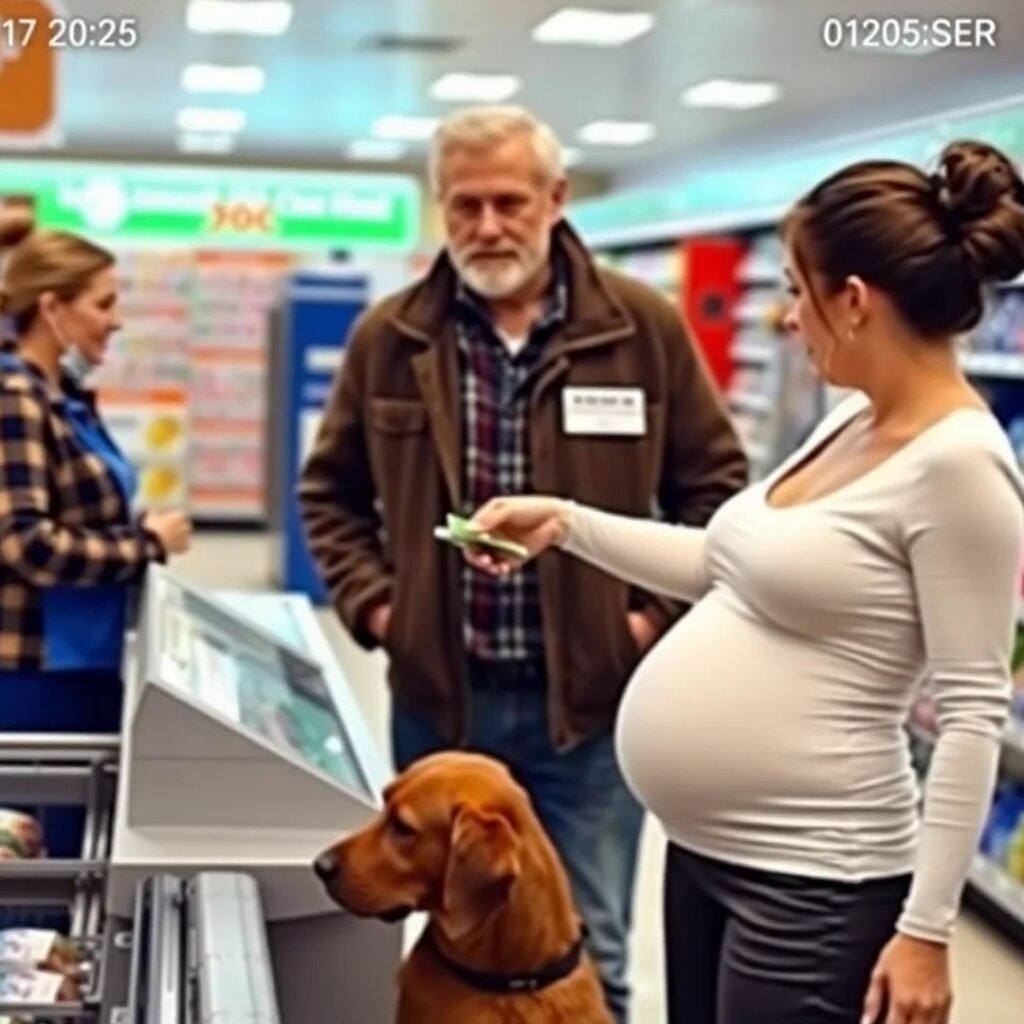
That day had already drained every ounce of strength from my body. My lower back throbbed with a deep, constant ache. Each step through the grocery store left me breathless. Even the simple act of pushing the cart felt like dragging something twice my weight. The crumpled grocery list in my hand didn’t feel like a plan—it felt like a quiet accusation, a reminder of all the things I needed but couldn’t afford.
Tyler, my husband, had just been laid off from his construction job. The layoff had come suddenly, without warning, like so many things do. One week we were managing; the next, we were calculating how long we could stretch what little we had left. My part-time call center job barely covered rent and utilities. There was no room for emergencies. No room for surprises. Preparing for our baby felt like trying to build a future on sand—no matter how carefully we stacked our hopes, everything felt unstable.
I stood in the aisle staring at a pack of diapers, mentally negotiating with myself. If I skipped the peanut butter, could I afford them? What about bread? Could we stretch what we had at home just a little longer? Every item became a trade-off. Every decision carried weight.
That was when I noticed him at the register.
The old man seemed strangely out of place amid the bright lights and hurried shoppers. People moved around him impatiently, carts rattling, phones ringing, conversations overlapping in a constant hum. Yet he stood there quietly, as if he existed in a slower, heavier world.
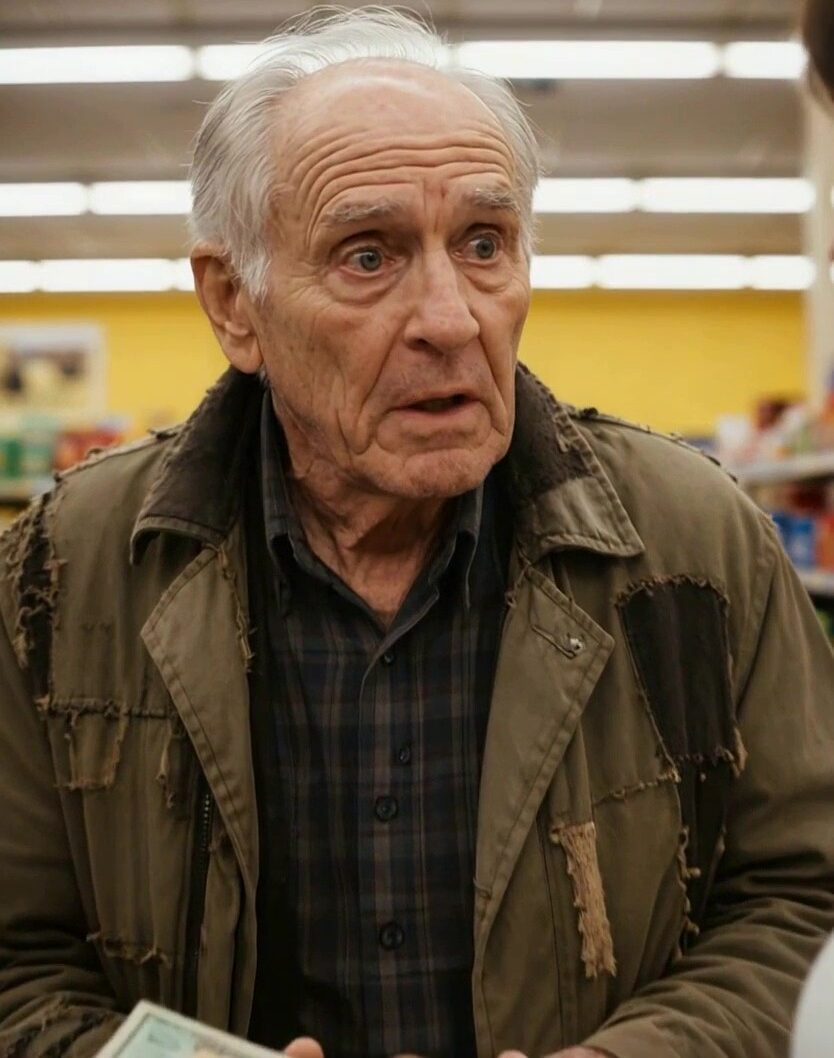
His coat was frayed at the cuffs, the fabric thinning in places. His hands trembled visibly as he fumbled through a handful of coins and crumpled bills. The scruffy dog at his side stayed close, ribs faintly visible beneath its rough fur. Its soft eyes never left him.
The cashier’s voice broke through the noise, flat and businesslike. “I’m sorry, sir, but you’re short.”
The words seemed to hang in the air.
He slowly set aside a single can of beans, placing it carefully on the counter as if it were something fragile. “Is it enough now?” he asked, his voice barely above a whisper.
“You’re still short by three dollars,” she replied. “Do you want to put back the rice too?”
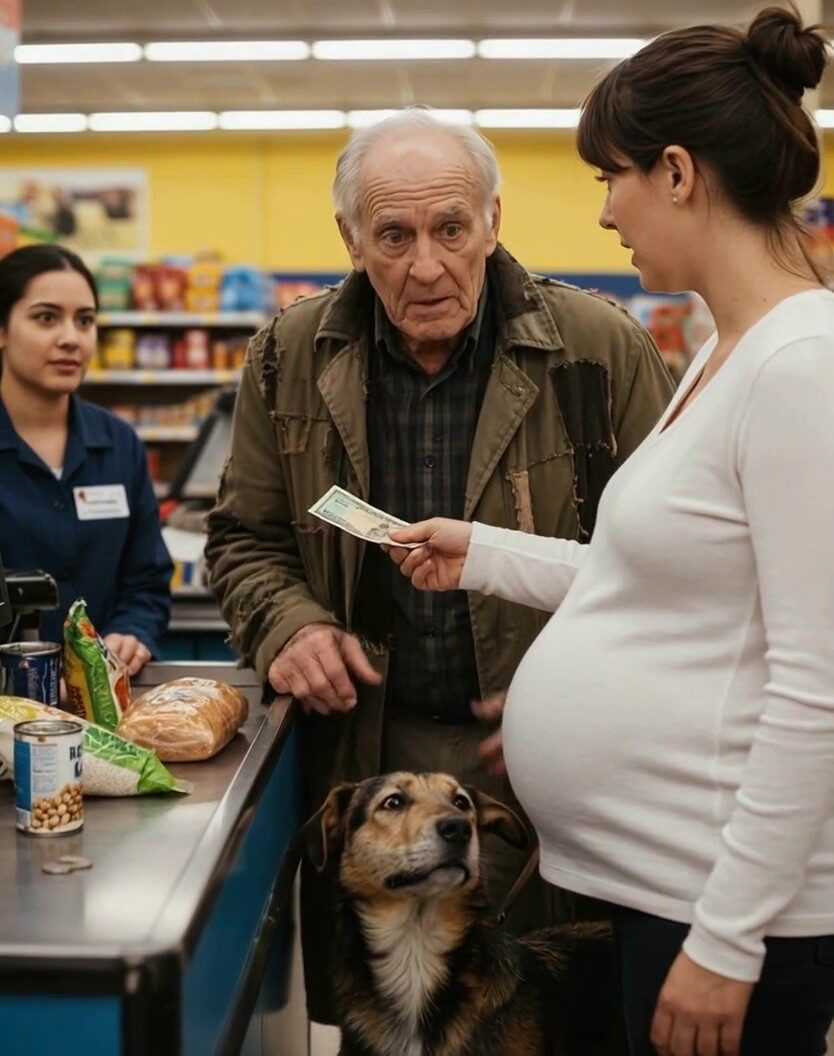
He looked down at his dog. For a moment, he didn’t move. His hand hovered uncertainly over the small bag of rice, the last substantial item he had chosen. The dog wagged its tail gently, unaware of the silent calculation taking place, unaware of the sacrifice about to be made.
Something inside me tightened.
Before I could stop myself, before I could think about my own cart or the numbers in my bank account, I stepped forward.
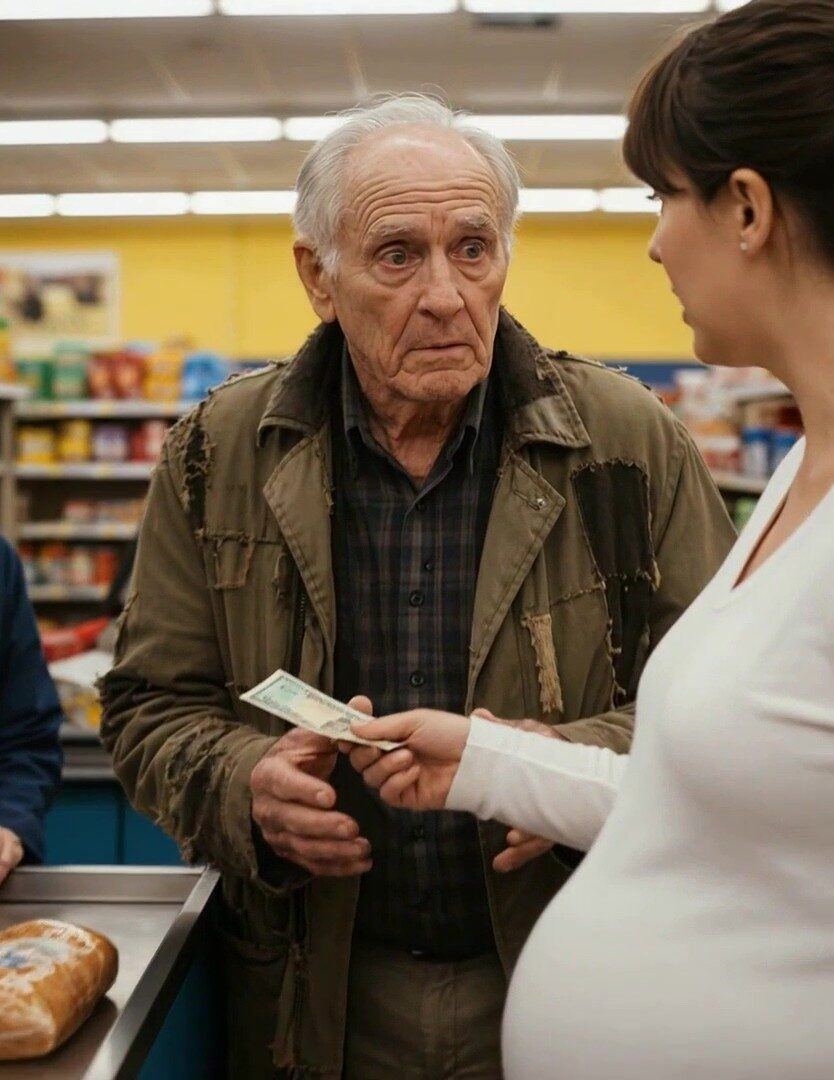
“Wait,” I said, louder than I intended. Heads turned. My face burned, but I kept moving. I held out the twenty-dollar bill I’d been clutching in my fist like it was a lifeline. “Here. Cover it with this.”
His eyes widened in surprise. “No, I can’t—”
“Please,” I cut him off, my throat tightening unexpectedly. At that exact moment, my baby kicked inside me—strong and deliberate, as if reminding me what kind of mother I wanted to be. “Take it. Get your food. And keep the change.”
The cashier exhaled softly in relief and quickly rang up the items. The scanner beeped. The total cleared. She slid the bags toward him.
His hands trembled even more as he picked them up. He turned toward me slowly, his eyes glistening with tears he didn’t try to hide.
“Bless you, child,” he whispered. “You don’t know what this means.”
I forced a smile, even though my stomach twisted with sudden panic.
That twenty-dollar bill had been my safety net. It was my margin for error, my cushion for something unexpected. I didn’t know how we would make up for it. I didn’t know what bill would now go unpaid or what meal would be smaller.
But as I watched him shuffle toward the exit, his dog pressing loyally against his leg, I felt something unexpected.
I felt lighter.
It was as if I had handed away more than money. I had handed away a piece of despair—the kind that grows quietly when you start believing you have nothing left to give.
When I told Tyler that evening, he rubbed his forehead and shook his head slowly.
“Babe, we don’t have twenty dollars to give away,” he said.
“I know,” I whispered. I did know. The weight of it had been with me all afternoon. “But he looked like he hadn’t eaten in days. And his dog…”
Tyler sighed, then pulled me gently into his arms. His embrace was warm and steady, the way it had always been.
“That’s why I love you,” he said softly. “You’ve got a heart too big for your own good.”
I rested my head against his chest. We didn’t have much. But in that moment, I felt certain of one thing: whatever else we lacked, we still had each other.
That night, I went to bed hungry—but peaceful.
The next morning, everything changed.
Sharp, insistent knocks rattled the front door, jolting me awake. My heart lurched into my throat. For a split second, I was certain it was the landlord again, coming to remind us of the rent deadline we were already struggling to meet.
I shuffled toward the door, still in my pajamas, bracing myself.
When I opened it, I froze.
There, neatly placed on our worn doormat, sat a large cardboard box. It was sealed carefully and tied with simple twine. Resting on top was a folded note.
The hallway outside was completely empty. No footsteps echoed. No elevator hummed. Whoever had left it was already gone.
My hands trembled as I bent down and picked up the note. The handwriting was shaky but deliberate.
For the angel who helped me when I had nothing. May this help you and your little one more than you know. With all my gratitude – Thomas (and Buddy).
My knees buckled before I could process what I was reading. I sank slowly onto the floor, the note still clutched in my hand.
Thomas.
Buddy.
Carefully, almost reverently, I untied the twine and lifted the box’s flaps.
Inside was more than I could have imagined.
There were diapers—several packs in the exact size I had been staring at the day before. Containers of formula. Canned goods stacked neatly along the sides. Fresh fruit wrapped in paper to keep it from bruising. Loaves of bread. Peanut butter. Rice. Beans.
Tucked gently into one corner was a tiny stuffed bear, soft and clean, with a small tag attached that read: For Baby.
At the very bottom of the box was an envelope.
My fingers shook as I opened it.
Inside was $200 in cash.
The tears came all at once, hot and unstoppable. I pressed my hand against my mouth, trying to steady my breathing.
I didn’t know where Thomas lived. I didn’t know how he had managed to gather all of this. I didn’t know whether he had help, whether someone had stepped in for him the way I had.
But I understood something clearly in that moment.
Kindness echoes.
It moves outward in ways we can’t predict. It travels farther than we expect. And sometimes, it circles back when we need it most.
I had given twenty dollars believing it might make one small difference in someone else’s day.
Instead, it came back multiplied—not just in money, but in hope.
That morning, sitting on the floor of our tiny apartment, surrounded by diapers and canned goods and a stuffed bear for the child I hadn’t yet met, I realized something I will carry with me for the rest of my life.
Even when we feel like we have nothing left, we still have something to give.
And sometimes, the smallest act of compassion can open the door to miracles.
The weeks following the delivery of that box felt like a fever dream. Tyler and I sat in our living room, staring at the supplies like they were holy relics. For the first time in months, the air in our apartment didn’t feel heavy with the scent of impending disaster.
But the story didn’t end with a box on a doormat. It was only the beginning of a transformation that would redefine our lives.
I couldn’t just let it go. I needed to find him—not to give the money back, because we desperately needed it, but to look him in the eye and tell him that he had saved more than our pantry. He had saved our spirits.
Two days later, I went back to the same grocery store. I walked the aisles, my eyes scanning for a frayed coat and a scruffy dog. I asked the cashier from that day, a girl named Sarah.
“The old man with the dog?” she said, her eyes softening. “His name is Thomas. He’s been coming here for years. He lives in the veterans’ housing a few blocks over.” Her voice dropped to a whisper. “He used to be a high-school teacher. Lost his wife a few years back. Now it’s just him and Buddy.”
I went to the address she gave me. It was a brick building, weathered but clean. I found him sitting on a bench out front, Buddy resting his chin on Thomas’s boot. When he saw me, he didn’t look surprised. He just smiled, a slow, knowing crinkle around his eyes.
“You found us,” he said.
“How did you do it, Thomas?” I asked, sitting beside him, my hand resting on my belly. “The box… the money. You were short at the register. How did you give us so much?”
Thomas looked out at the street. “I wasn’t lying when I said I was short. My pension check was late, and I’d spent my last bit on Buddy’s medicine. But when you stepped up… when you gave me that twenty… you reminded me of something my wife used to say.”
He turned to me. “She said that money is just paper until you use it to show someone they aren’t alone. I went home and called a former student of mine. He’s a successful lawyer now. I told him about the ‘angel’ at the store. He was the one who helped me fill that box. He told me that if a pregnant woman with nothing was willing to give her last twenty, the least he could do was clear out his pantry and his wallet.”
The miracle didn’t stop there. Thomas’s former student, the lawyer, didn’t just help with one box. He asked Thomas for Tyler’s resume.
A week later, Tyler received a call for an interview at a large development firm. The lawyer had put in a word, but Tyler won the job on his own merit—his years of experience and his hunger to provide for his family. He was hired as a site foreman, with a salary that felt like a fortune compared to our previous struggles.
By the time our daughter, Maya, was born, we weren’t just surviving; we were thriving.
One Year Later
On Maya’s first birthday, we didn’t have a big, expensive party. Instead, we went back to that same brick building. We brought a cake, a new collar for Buddy, and a framed photo of Maya holding the stuffed bear Thomas had left in that box.
Thomas was older, his hands a bit shakier, but his eyes were bright as he held Maya. She grabbed his finger and laughed, the sound echoing in the small apartment.
“You know,” Thomas whispered as he looked at her. “That twenty dollars you gave me… I never spent it.”
He reached into his pocket and pulled out a worn, folded bill. It was the same twenty.
“I kept it as a reminder,” he said. “Whenever I felt like the world was too cold, I’d pull this out and remember that someone saw me. Really saw me.”
I realized then that the miracle wasn’t the food, or the money, or even Tyler’s job. The miracle was the connection. It was the moment two people in the dark decided to hold a light for each other.
As we walked back to our car, Tyler holding Maya and me leaning against him, I looked back at the grocery store across the street. It looked like any other building, but I knew better. It was the place where I learned that the only thing you truly keep in this life is what you give away.