“Get in line back there,” the officer said, pointing toward the people who had just walked in. One of the Black twins let out a bitter laugh. “We were here first.” The officer’s hand landed on his chest—too casual, too confident. “Don’t get smart with me.” The bartender looked away. Then a woman at the corner table stood up, her voice sharp as a blade. “That’s my brother.” She raised her phone. “And I’m the federal prosecutor you’ve all been trying to avoid.”
“Get in line back there,” Officer Daniel Mercer said, jabbing two fingers toward the cluster of people who had just entered Malone’s Bar & Grill.
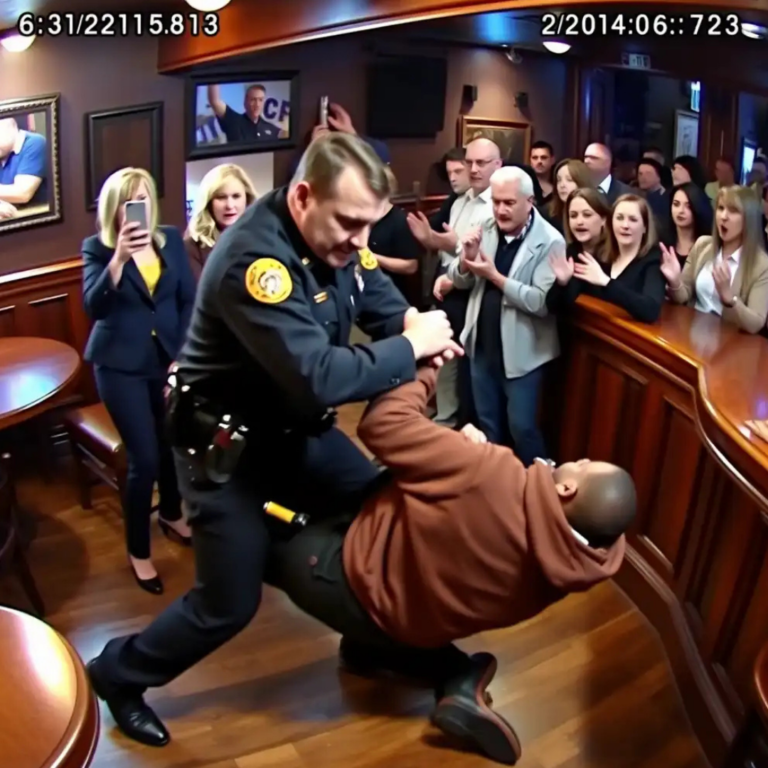
The command cut through the room louder than the jukebox. Glasses stopped halfway to lips. The pool game at the back slowed. A television over the bar kept flashing baseball highlights no one was watching anymore.
Andre Whitaker turned his head slowly, disbelief hardening into anger. His twin brother, Aaron, stood beside him, jaw tight, shoulders squared. They were both still wearing work boots, reflective jackets unzipped after a twelve-hour shift restoring power lines outside St. Louis. They had been sitting at the bar for nearly twenty minutes, nursing beers and waiting for their takeout order.
Andre let out a bitter laugh. “We were here first.”
Mercer stepped closer. He was broad through the chest, with the easy swagger of a man used to being obeyed before he had to explain himself. “Then you can wait a little longer.”
Aaron slid off his stool. “That’s not what you said to them.”
Everyone knew who “them” meant. Four white men in Cardinals caps had just walked in, laughed with the bartender, and been served immediately.
The bartender, Rick Malone, polished a glass with nervous concentration, staring into it as if he could scrub himself invisible. He was thick in the middle, face red from either heat or shame. He did not look up.
Andre kept his voice even, which somehow made it sharper. “We ordered first. We pay the same. So what exactly is the problem?”
Mercer’s hand landed flat on Andre’s chest—too casual, too confident, more insult than force. “Don’t get smart with me.”
The room went still in the dangerous way rooms do right before something breaks.
Aaron caught Mercer’s wrist. Not hard, but enough. “Take your hand off my brother.”
Mercer yanked free and his other hand dropped toward his belt. “You want to make this an issue?”
Rick finally spoke, but only to the twins. “Come on, fellas. Let’s not do this here.”
Andre stared at him. “Not do what? Stand here while he puts his hands on me?”
At a corner table, a woman in a charcoal suit rose so quickly her chair scraped the floor like a warning shot. She had been sitting alone with a legal pad, a half-finished bourbon, and the stillness of someone who missed nothing. She was tall, controlled, and furious in a way that looked disciplined rather than loud.
Her name was Naomi Whitaker.
Mercer glanced at her, irritated. “Ma’am, sit down.”
She was already moving, heels clicking across the wood floor. “That’s my brother.”
Andre blinked. “Nae?”
Every eye in the bar shifted between them. Same cheekbones. Same steady gaze. Same stubborn chin.
Naomi lifted her phone, camera recording, badge case already open in her other hand.
“And I’m Assistant United States Attorney Naomi Whitaker,” she said, her voice sharp as a blade. “So before anyone here lies, deletes footage, or decides to remember this differently, you should know I’ve spent the last six months building a civil rights case around complaints with your name on them, Officer Mercer.”
Mercer’s face emptied.
Then Naomi turned the phone slightly, catching the bartender, the witnesses, the room.
“And now,” she said, “you just touched the wrong man in front of the wrong sister.”
Part 2: For one suspended second, no one moved.
The only sound came from the television over the bar—some commentator shouting about a home run in another city, another world. Then Mercer straightened, his expression shifting with visible effort from aggression to performance.
“You’re making this bigger than it is,” he said. “This was a routine interaction.”
Naomi didn’t lower the phone. “Good. Routine means familiar. Familiar means a pattern.”
Rick Malone finally looked up. Sweat glistened at his temples. “Now hold on,” he said, voice wobbling. “Nobody wants trouble.”
Andre rounded on him. “You should’ve thought of that before you pretended not to see what happened.”
Aaron stepped closer to his brother, not restraining him, just anchoring him. The twins had always done that for each other. Andre burned hotter, quicker. Aaron held the line once the fire started.
Mercer looked around the room, scanning for support. “Anybody with sense can see these men were being disruptive.”
A man at a high-top near the window cleared his throat. Middle-aged, white, in a hospital scrub jacket under a raincoat. He raised one hand halfway. “That’s not true.”
Mercer turned. “Excuse me?”
“I said that’s not true,” the man repeated, stronger now. “I came in before you. Those two were already seated. They weren’t causing any problem. You walked in and went straight to them.”
A woman beside him nodded. “I saw it too.”
The air changed. Slightly, but enough. Fear was still there, but now it had company.
Naomi seized it. “Please keep talking. State your names clearly.”
The man did. Then the woman. Then, from two stools down, a young Latino server from the kitchen appeared in the doorway, apron still on, face pale. “There’s camera coverage over the bar, the register, and the entrance,” he said, looking at Rick instead of Mercer. “And the audio in the bar usually works.”
Rick shot him a murderous glance. “Luis—”
Naomi cut in. “Luis, thank you. Don’t say another word until agents contact you.”
Mercer’s jaw flexed. “You can’t intimidate civilians.”
Naomi smiled without warmth. “That’s rich.”
Andre folded his arms across his chest where Mercer had touched him. “You do this a lot?”
Mercer ignored him. He had started to understand the danger now. Not just embarrassment. Exposure. Public, legal, documented exposure. Naomi saw the exact moment calculation replaced temper.
He reached for his radio.
Aaron saw it too. “He’s calling somebody.”
Mercer pressed the button on his shoulder mic. “Need a supervisor at Malone’s. Possible disturbance.”
Naomi laughed once. “A disturbance? That’s the story you’re choosing on camera?”
Mercer’s eyes flicked to her phone, then away. “Turn that off.”
“No.”
“I’m giving you a lawful order.”
“And I’m telling you,” Naomi replied, “that anything you do next gets added to the record.”
Outside, tires hissed on wet pavement. Red and blue reflections smeared across the front windows as another squad car pulled up. Then another.
Rick muttered, “Jesus Christ.”
The four men in baseball caps slipped into silence, suddenly fascinated by their drinks. None of them had said a word since Naomi identified herself. Cowardice, Andre thought, had a way of shrinking fast when power changed hands.
A stocky sergeant entered first, silver-haired, cautious eyes taking in the scene with one sweep. “What happened?”
Mercer answered immediately. “Two intoxicated males became confrontational when asked to wait their turn. This woman is interfering—”
Naomi pivoted the phone toward the sergeant. “Assistant U.S. Attorney Naomi Whitaker. My brothers were seated and served before four later arrivals. Officer Mercer put his hands on one of them. Multiple witnesses contradict his version. There is likely bar surveillance, and I want it preserved immediately.”
The sergeant’s face tightened.
Mercer pushed ahead. “Sir, with respect, she’s escalating this because she knows these guys.”
“Of course I know them,” Naomi snapped. “That doesn’t make your report true.”
The sergeant held out a hand. “Enough.”
He looked at Andre, then Aaron, then at the witnesses, then at Rick, whose silence now looked less neutral than guilty. Finally he turned back to Mercer.
“Did you make physical contact?”
Mercer hesitated.
That was all Naomi needed.
She stepped closer, voice lower now, deadlier for it. “Be careful, Officer. Your next sentence isn’t just for tonight. It’s for internal affairs, discovery, depositions, and every complaint file with your badge number on it.”
Mercer stared at her, breathing hard.
And then, before anyone could stop him, Rick Malone lunged for the DVR cabinet beneath the register.
Luis shouted, “He’s trying to pull the footage!”
Aaron moved first, vaulting over a stool.
The cabinet door burst open.
And Mercer reached for Naomi’s phone.
Part 3: Aaron slammed into Rick before Rick could rip the cables free.
The two men crashed into the side of the bar, bottles rattling violently overhead. One shattered on the floor. Rick cursed and swung an elbow backward, but Aaron trapped his arm and drove him chest-first onto the counter.
“Don’t touch that system,” Aaron barked.
At the same instant, Mercer grabbed for Naomi’s wrist.
He was fast, but Naomi had spent years in courtrooms full of men who mistook composure for softness. She twisted back, protecting the phone against her body, and the stocky sergeant stepped in like a door slamming shut.
“Mercer!” he roared.
The word froze the room.
Mercer let go, but too late. Too many people had seen it. The witnesses. The other officers. The bartender pinned against the bar. Andre standing two steps away with murder in his eyes and restraint he no longer owed anyone.
Naomi steadied herself and lifted the phone again. Her voice was breathless only for a second. “Attempted interference with evidence,” she said to the camera. Then she looked straight at Mercer. “And retaliation in front of supervisors. Thank you.”
Mercer’s face went gray.
The sergeant turned to the arriving officers. “Separate everybody. Now. And nobody touches that recorder.”
Within moments the bar broke into islands of tension. One officer pulled Rick away from Aaron and handcuffed him while Rick sputtered protests about his property. Another guided witnesses to tables and began taking statements. Luis stood near the kitchen doorway, shaken but upright, repeating where the cameras were and when the system had last been serviced. Andre remained where he was, fists opening and closing, forcing himself to breathe.
Naomi walked to him then, finally lowering the phone.
“You okay?”
Andre gave a short, humorless laugh. “You always did know how to make an entrance.”
She touched the center of his chest, exactly where Mercer’s hand had been, but gently. “Did he hurt you?”
“No.” He glanced past her at Mercer. “He just thought he could.”
Naomi nodded. “That’s usually where it starts.”
Across the room, the sergeant was speaking in a hard, controlled voice into his own radio. Not requesting help now—requesting internal affairs, a duty captain, body-camera uploads, preservation orders. The vocabulary of damage control. The vocabulary of institutions trying, belatedly, to survive the truth.
One of the witnesses, the man in scrubs, caught Naomi’s attention. “Ma’am,” he said, “I’ll testify if needed.”
Naomi crossed to him and shook his hand. “Thank you. Most people don’t.”
He looked ashamed. “Most people are scared.”
“That’s how this lasts,” she said. “Until someone decides being scared is more expensive.”
Near the entrance, the four men in baseball caps were being stopped before they could leave. One complained they had nothing to do with anything. An officer told them they might be material witnesses. Their outrage seemed almost comical now that inconvenience had brushed against them.
Rick, however, had stopped pretending. Red-faced and furious in handcuffs, he jerked his chin toward Naomi. “You’ve been after this place for months.”
Naomi met his stare. “No. I’ve been after what people do when they think certain customers don’t count.”
Rick gave a bitter snort. “This is a bar, not some grand conspiracy.”
“Not grand,” Naomi said. “Just common. That’s worse.”
The sergeant approached them then, older now than when he had first walked in, as though ten minutes had cost him ten years. “Ms. Whitaker,” he said carefully, “the footage will be secured. Officer Mercer is being relieved pending investigation.”
Mercer whipped his head up. “You’re burying me over this?”
The sergeant didn’t even look at him. “You buried yourself.”
For the first time all night, Mercer seemed truly alone. No swagger. No easy confidence. Just a man standing in the wreckage of his own habits, staring at a room that had stopped protecting him.
Andre watched him and felt the anger inside him settle into something colder, heavier, more useful. Not victory. Not yet. He knew better than that. One night did not erase years. One recording did not fix a city. Men like Mercer rarely acted alone, and places like Malone’s did not become what they were by accident.
But tonight the silence had broken.
Naomi slipped her arm through his. Aaron joined on the other side, rubbing a sore shoulder and grinning despite everything. For a moment they stood together exactly as they had as kids on the cracked front steps of their mother’s apartment in North St. Louis—three stubborn children promising each other they would never look away when it mattered.
Outside, the rain had started again.
Inside, statements were being written, footage copied, names taken down.
And for the first time since Officer Mercer had pointed them to the back like they were less than human, Andre felt the room adjusting to a new reality: the truth was no longer trapped in whispers, and everyone still standing there would have to decide which side of it they meant to live on.