My father called me at 6:42 on a Thursday evening, his voice thin and embarrassed.
“Ethan,” he said, breathing hard. “Could you come by the house?”
I had not been inside that house for almost two years.
After my mother died, my father, Richard Whitaker, married Denise. She smiled in public, wore pearls to church, and spoke about “family values” as if she had invented them. Behind closed doors, she treated my father like a burden with a bank account. Her son, Kyle, twenty-nine and permanently unemployed, treated him like an ATM with gray hair.
I drove from downtown Chicago to Lake Forest in my black Rolls-Royce Cullinan, the car my father did not know I owned. He still thought I ran “a small logistics office.” He had no idea that Whitaker Freight Solutions, the company he had once built in a rented garage, had become a national operation after I bought out his silent partners and rebuilt it under a holding company.
When I arrived, the front door was open.
I heard Denise before I saw her.
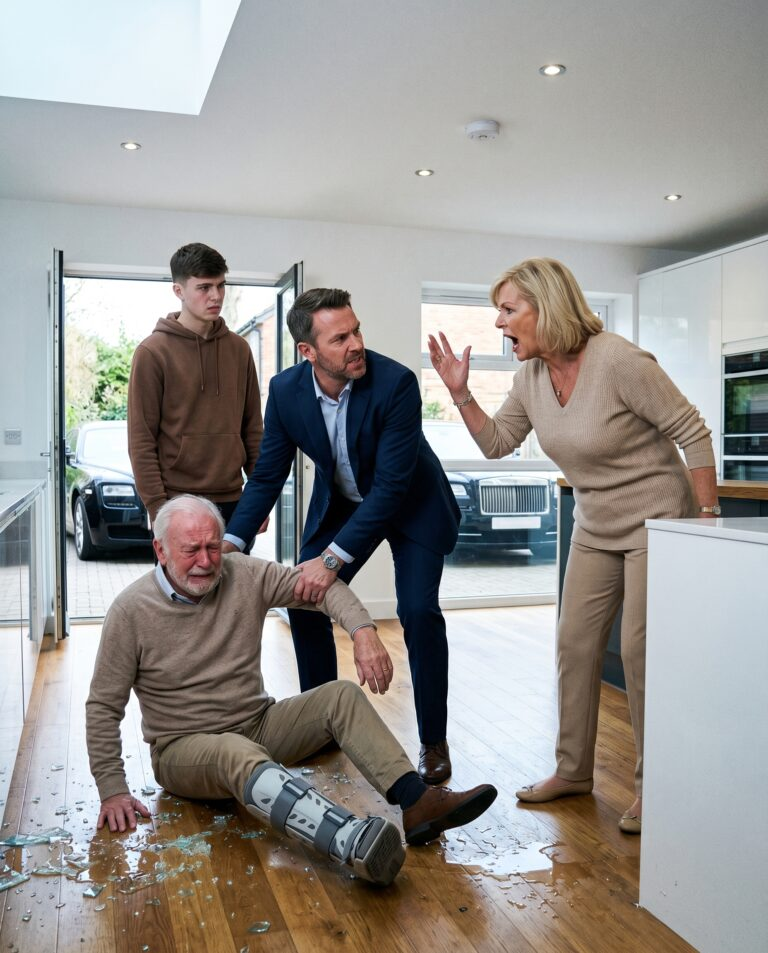
“Go crawl for it yourself, you crippled old man.”
I stopped in the hallway.
My father was on the kitchen floor, one leg trapped awkwardly under him, a medical boot strapped around his broken right leg. His face was pale. A glass lay shattered near the sink. Water spread across the tile.
Denise stood over him with a wineglass in her hand.
Kyle leaned against the counter, staring at his phone.
“Dad,” I said.
His eyes lifted. Shame passed across his face before relief did.
“I slipped,” he whispered. “Just needed water.”
Denise turned, and her expression changed fast. “Ethan. We didn’t know you were coming.”
“No,” I said. “You didn’t.”
Kyle gave a lazy shrug. “He’s being dramatic. Doctor said he should move around.”
My father tried to push himself up and winced so sharply that his hand shook.
I walked past Denise, crouched beside him, and put my arm behind his back.
“Don’t touch him like you care now,” Denise snapped. “You vanished.”
I looked at her for one second. “Pack nothing.”
Her smile faltered. “Excuse me?”
I helped my father stand. He leaned almost entirely on me. He weighed less than he used to.
Kyle laughed once. “What are you gonna do, Ethan? Call someone?”
I guided my father toward the door.
“Yes,” I said.
Outside, I settled him carefully into the passenger seat of the Rolls-Royce. Denise and Kyle followed us onto the porch, their smugness thinning as they saw the car.
I closed my father’s door, took out my phone, and called my attorney.
“Marianne,” I said, looking straight at Denise. “Activate the emergency removal clause. Freeze the household accounts. Notify the trust board, Adult Protective Services, and Lake County Sheriff’s Office. And start the eviction process tonight.”
Denise’s wineglass slipped from her fingers.
Hours later, she and Kyle lost everything they thought they owned.
My father did not speak for the first twenty minutes of the drive.
He sat with both hands folded in his lap, staring through the windshield as Lake Forest’s manicured lawns gave way to the lights of downtown Chicago. Every few seconds, his jaw tightened from pain, but he refused to complain.
That was Richard Whitaker. He had once worked eighteen-hour days loading trucks himself because he could not afford another driver. He had missed dinners, holidays, and sleep, but never a school play. When my mother got sick, he sold two warehouses to pay for specialists insurance would not cover. He was not a weak man.
But humiliation can bend even strong men.
At Northwestern Memorial, I had a private orthopedic team waiting. The doctor confirmed what I already suspected: my father had not just “slipped.” He had been walking too much on an unstable fracture. His blood pressure was high, he was dehydrated, and the bruising along his forearm did not match a single fall.
The doctor asked him gently, “Mr. Whitaker, do you feel safe at home?”
My father looked at me.
For a moment, I saw the old conflict in his eyes. Pride. Loyalty. Fear of scandal. Fear of admitting he had chosen badly.
Then he looked down and said, “No.”
That single word did more damage to Denise than any insult could have.
By 9:15 p.m., Marianne Caldwell, my attorney, arrived with a leather folder and the calm expression of a woman who had already won.
“Your father’s residence is held by the Whitaker Family Trust,” she explained in the hospital suite. “Denise never owned it. She had conditional occupancy rights as his spouse, provided she did not financially exploit, neglect, abuse, or endanger him.”
Personalizedfamily gifts
My father blinked. “I forgot that clause existed.”
“You wrote it after your second cousin tried to take Aunt Helen’s house,” I said.
His mouth trembled slightly. Not quite a smile.
Marianne continued. “The trust also controls the household operating account, the vehicle lease, Kyle’s monthly allowance, and Denise’s discretionary spending card. All of it has been suspended pending investigation.”
My father closed his eyes.
I knew what he was thinking. Not about the money. About how far it had gone without him seeing it.
Across town, Denise was discovering the same facts in a louder way.
At 9:38 p.m., the first call came from her. I let it ring.
Then Kyle called. Then Denise again. Then an unknown number.
Marianne listened to one voicemail on speaker.
“Ethan, this is insane,” Denise said, her polished voice cracking. “You can’t just cut us off. Your father is confused. He needs me. Call me immediately before this becomes ugly.”
Marianne stopped the message.
“It already is ugly,” she said.
At 10:12 p.m., two deputies arrived at the Lake Forest house with an emergency protective notice and documentation from the trust. Denise was informed that she could remain only long enough to collect personal medication, identification, and essential clothing. Kyle, who had no legal tenancy and had been living there without a lease, was ordered to leave immediately.
He did not take it well.
He shouted that the house was “basically his.” He threatened to sue. He called my father an ungrateful fossil loud enough for one deputy’s body camera to catch every word.
Denise tried a different strategy. She cried.
She told the deputies that she had dedicated years to caring for a difficult elderly husband. She claimed I was greedy, that I wanted the house, the business, the trust, everything.
The problem was the kitchen camera.
My father had installed it months earlier after a contractor dispute. Denise never noticed the small black lens tucked beneath the cabinet molding. It had recorded the entire scene: my father on the floor, asking for water; Denise sneering down at him; Kyle turning away; the broken glass; the long minutes before I arrived.
Marianne sent the footage to Adult Protective Services and the sheriff’s office before midnight.
At 11:03 p.m., my father finally asked, “Where will I go?”
I looked at him. “Home.”
He gave a tired, bitter breath. “I don’t think I have one anymore.”
“You do,” I said. “Just not that house.”
I took him to my penthouse on North Lake Shore Drive, the place I had bought three years earlier and never shown him because I still carried too much resentment. He had married Denise six months after my mother’s funeral. I had called it betrayal. He had called it loneliness. We had both been right in some ways, and both too stubborn to admit pain could make people foolish.
When the elevator doors opened into the private foyer, he stared at the marble floors, the lake beyond the glass walls, the nurse already waiting in the guest suite.
“Ethan,” he said slowly, “what exactly do you do now?”
I loosened my tie.
“I run the company, Dad.”
His eyes sharpened. “What company?”
I met his gaze.
“Yours.”
The next morning, Denise arrived at the Whitaker Freight Solutions headquarters in a cream-colored coat and oversized sunglasses.
She always believed appearances could force reality to obey.
Security stopped her in the lobby.
“This is my husband’s company,” she said loudly, making sure the receptionist heard. “I need to speak with the board.”
The security manager, Marcus Hale, did not blink. “Mrs. Whitaker, you are not authorized beyond the lobby.”
“I am Richard Whitaker’s wife.”
“And Mr. Richard Whitaker is no longer the majority voting officer,” Marcus replied. “Mr. Ethan Whitaker is.”
She froze.
By then, the board had already convened upstairs. Marianne presented the medical report, the trust documents, the camera footage, and the financial audit I had ordered three months earlier.
That audit was the reason my father’s phone call had not surprised me as much as it should have.
Denise had been moving money in quiet, careful ways. A renovation invoice from a contractor who never existed. Jewelry purchases labeled as medical equipment. Cash withdrawals from an account meant for my father’s home care. Kyle’s “consulting fees” from a shell company registered in Nevada.
She had assumed my father was too tired to notice.
She had assumed I was still the angry son who stayed away.
She had assumed wrong.
By noon, Denise’s cards were dead, her access revoked, and her attorney had advised her to stop calling me. Kyle’s leased Mercedes was located at a sports bar in Evanston and repossessed while he stood outside shouting into his phone. The Lake Forest house locks were changed under trust authority. Their belongings were cataloged, boxed, and made available through counsel.
No screaming match decided it. No dramatic punch was thrown.
Paperwork did what rage could not.
Three days later, my father sat in my living room with his leg elevated, wearing a navy robe and looking ten years older than he had a month before. Sunlight moved across the lake. A nurse had just left. A physical therapist was scheduled for the afternoon.
He held a cup of water in both hands.
“I should have listened to you,” he said.
I sat across from him. “I should have come sooner.”
He shook his head. “You were hurt.”
“So were you.”
For a while, neither of us spoke.
Then he said, “Denise wasn’t always like that.”
I did not argue. People rarely become cruel all at once. Sometimes they test one boundary, then another. Sometimes kindness disappears by inches until only entitlement remains.
“What happens now?” he asked.
“APS will finish its investigation. The sheriff’s office has the footage. Marianne is filing for protective orders and a divorce attorney is ready when you are.”
He looked toward the window.
“And Kyle?”
“He’ll find someone else to blame.”
That made my father laugh once, quietly, painfully.
Two weeks later, Denise’s name disappeared from every account connected to my father. Her petition for emergency spousal support failed after the judge reviewed preliminary evidence of financial exploitation and neglect. Kyle tried to sell a watch my father had given him years earlier, only to learn it had been purchased with trust funds and documented as recoverable property.
They did not end up ruined because I shouted louder.
They lost everything because everything they had was built on access to my father.
And that access ended the moment he told the truth.
On the first Sunday of spring, I drove him back to Lake Forest. Not to stay. Just to look.
The house stood quiet, cleaned and empty, ready to be sold. My father stood beside me with a cane, his broken leg healing, his shoulders straighter than before.
“I thought dying alone would be the worst thing,” he said.
I looked at him. “You’re not alone.”
He nodded, eyes fixed on the house.
“No,” he said. “I suppose I was only living with the wrong people.”
A month later, he moved into a smaller home near the lake, one level, wide halls, morning light in every room. I visited every Wednesday night. We ate takeout, argued about baseball, and slowly learned how to speak without old grief standing between every sentence.
Denise sent one final letter.
My father read the first line, folded it, and handed it to Marianne.
“Respond through counsel,” he said.
Then he reached for his water glass.
This time, no one made him crawl.