The next morning, the sunlight felt like an accusation.
Emma ate her cereal in slow, quiet bites, the way she did when she was thinking too hard for a seven-year-old. The unicorn I’d given her the night before sat propped beside her bowl like a tiny guard dog. Every now and then she’d glance at me, like she was checking whether my face had changed into something safer while she slept.
I kept my voice light anyway. “We’re going to have a good day, Em.”
She nodded without looking up. “Okay.”
That “okay” landed in my chest and stayed there.
When she left for school, her backpack seemed too big, straps swallowing her shoulders. She paused at the door, then turned back.
“Mom?”
“Yeah?”
“Can you… not tell Grandma about the picture I drew?” she asked. “I don’t want her to feel bad.”
My heart did that thing where it clenched like a fist. Emma had drawn Grandma Linda’s chocolate cake for two weeks, and now she was worried about Grandma’s feelings.
I crouched to her level. “You don’t have to protect grownups, sweetheart.”
She gave me a small smile. “I know. I just… want everybody to be happy.”
After she walked away, I stood with my hand on the doorknob for a long time, staring at the empty porch. Then I went back inside, picked up my phone, and opened my banking app again.
The mortgage transfer sat there like a habit: $1,847 scheduled for the first of the month. Two years of it. Twenty-four payments. A number so precise it had become part of my life like teeth brushing. I’d told myself it was temporary, that it was what daughters did when their parents were “running low,” that it was love in the language of dollars.
My finger hovered over Cancel.
I didn’t press it yet.
Instead, I pulled open the drawer in my home office and slid out the folder I hadn’t opened since I’d started “helping.” The one labeled in my own handwriting: Mom & Dad — Mortgage. Receipts, screenshots, check stubs. Proof, like I’d suspected I’d need it one day.
My phone buzzed.
Madison had posted again.
I stared at her name until my eyes watered. Madison was my older sister by eight years, and she wore that eight years like a crown: confident, loud, “the fun one.” She had always known how to make a room tilt toward her. When we were kids, she could cry on cue and get out of chores. When we were adults, she could laugh into a camera and make the world applaud.
I didn’t open the post. Not yet. I set the phone facedown like it was hot.
Then I called my mom.
She answered on the third ring, breathy and upbeat like she’d been waiting for an excuse to sound cheerful.
“Hi, honey! Everything okay?”
My throat tried to close. I forced it open. “I saw the video.”
Silence, the kind that’s full of quick mental math.
“What video?” she asked, too fast.
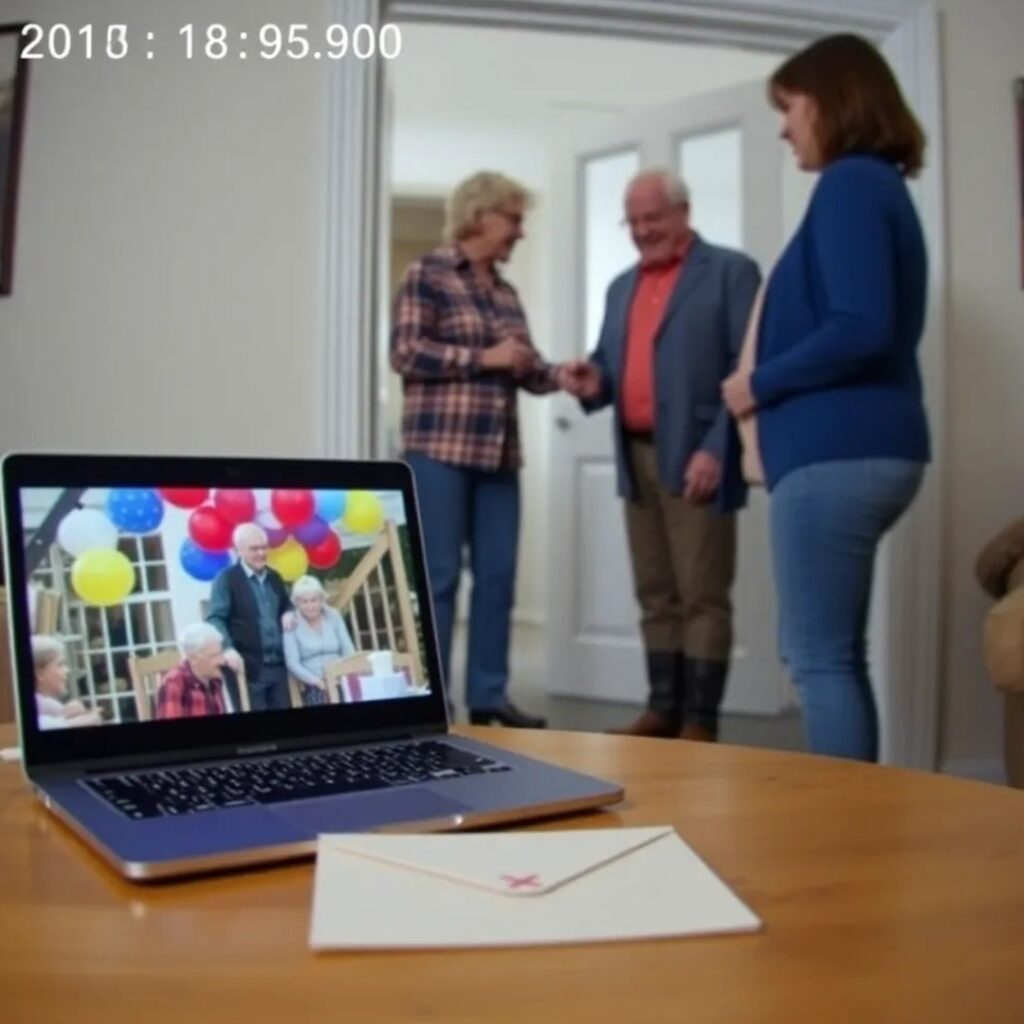
“Madison’s,” I said. “Dylan’s surprise party. The balloons. The gifts. Dad playing the harmonica. The cake.”
Another pause. My mom’s voice changed. The apologetic voice—the one she saves for breaking news—slid into place like a mask.
“Oh,” she said softly. “That.”
I heard something in the background: children squealing, a door closing, my dad’s distant cough.
“Mom,” I said, and my voice cracked on the word. “Emma watched it. She asked me if she even exists for you.”
“Don’t—” My mom inhaled sharply. “Don’t put that on me.”
I gripped the edge of my desk until my fingertips hurt. “You didn’t show up. You told me money was tight. You told me you might skip her party.”
“It was tight,” she snapped, and the mask slipped. “We can’t do everything. We have so many expenses.”
“You threw a surprise party with floor-to-ceiling balloons,” I said, keeping each word careful so I wouldn’t scream. “You made a three-layer chocolate cake.”
“That cake wasn’t expensive,” she insisted. “I baked it myself.”
“You told Emma you couldn’t bake this year because you couldn’t afford it.”
My mom’s voice went small, then sharp again. “You know Madison needs help. You know how hard it is with three kids and—”
“And I don’t?” I cut in. “I have one kid and I’m working overtime just to keep us afloat. And on top of that I’ve been paying your mortgage.”
That one landed. The line went so quiet I could hear my own heartbeat.
Then my mom laughed—one short, startled sound, like I’d accused her of stealing the moon.
“Oh, sweetie,” she said, and I hated the way she said it, like I was naive. “You offered. We never asked you for that.”
I stared at the folder on my desk. The first email I’d saved popped into my mind—my mom’s words: If we lose the house, I don’t know what we’ll do. Your father’s health… I remembered myself typing back: I’ll help. I promise.
“You said you needed it,” I whispered.
“We did,” she said quickly. “And we appreciated it. But that doesn’t mean you get to—”
“Get to what?” My voice rose despite my effort. “Get to expect you to show up for your granddaughter?”
“Don’t be dramatic,” she scolded. “We’ll make it up to her.”
“How?” I asked. “With a post?”
My mom exhaled, irritated now. “Look, Madison’s kids are more… they need more attention. Dylan’s been having a hard time. You know how sensitive he is.”
Emma was sensitive too, I wanted to scream. Emma was sensitive enough to protect Grandma’s feelings even when Grandma didn’t protect hers.
I closed my eyes. “So you lied to me.”
“No,” she said, and there was a practiced edge to it. “We didn’t lie. We were… managing. We didn’t want to disappoint you.”
“You did disappoint me,” I said, very quietly. “You disappointed Emma.”
“Don’t make me the villain,” my mom warned. “After everything we’ve done for you.”
And there it was. The old script. After everything we’ve done.
My childhood unspooled in flashes: Madison’s dance recitals with front-row seats and bouquets. Me in the audience clapping until my palms stung, hoping they’d look at me and see me clapping. My report cards taped to the fridge for a day, then replaced with Madison’s cheer photos. Me learning early that the easiest way to be loved was to not need too much.
I opened my eyes.
“Okay,” I said. My voice surprised me—calm, almost gentle. “I won’t make you the villain.”
My mom relaxed, like she’d won. “Good. Because family—”
“But I’m done funding the story,” I said.
“What?” She sounded confused, like the world had shifted and she hadn’t adjusted her footing.
“I’m not paying your mortgage anymore,” I said. “Not another dollar.”
A beat of silence, then my mom’s voice went cold. “You can’t do that.”
“I can,” I said. “And I am.”
“You’re going to let us lose our house?” Her breath hitched. Now she was fully in performance mode. “After your father’s medication? After—”
“Call Madison,” I said. “She’s clearly in a position to throw a party.”
My mom’s tone sharpened. “Madison has kids!”
“So do I,” I said. “And mine is the one who asked if she exists.”
“Don’t be cruel,” my mom hissed.
Cruel. Like canceling a payment was cruel, but canceling a child’s trust wasn’t.
“I’m not being cruel,” I said. “I’m setting a boundary.”
My mother scoffed like boundary was a dirty word. “You’re being ungrateful. You’re being selfish.”
A part of me—old, trained, obedient—wanted to apologize immediately. To fix it. To be the reasonable daughter. To smooth it over until everyone could breathe.
But then I pictured Emma’s small voice: Do I even exist for them?
I swallowed. “I’m being a mom.”
I hung up before she could answer.
My hands shook afterward, so I pressed my palms flat to the desk and breathed until the trembling slowed. Then I opened my banking app, found the scheduled transfer, and hit Cancel.
A warning popped up: Are you sure?
I thought of the check stubs in my drawer. Of my parents’ living room full of balloons. Of Dad playing the harmonica into Madison’s phone like he was auditioning for Grandfather of the Year.
I pressed Yes.
The confirmation message appeared: Payment canceled.
It didn’t feel triumphant. It felt like stepping off a cliff and discovering I could still breathe.
Two hours later, my phone rang again. Dad’s name.
I stared at it until it stopped ringing. Then it rang again. And again.
I let it go to voicemail. My dad’s voice came through in a gruff whisper, like he was trying to sound weak.
“Hey, kiddo,” he said, and my stomach twisted at the nickname. “Your mom says you’re upset. We… we didn’t mean nothing by it. Call me back.”
He paused, then added, “You know the mortgage is due. We’re… we’re counting on you.”
Counting on you. Not missing you. Not Emma. Counting.
I listened to the message twice, then I saved it to the folder in my phone labeled Receipts.
That afternoon, I picked Emma up from school. She climbed into the back seat quietly and buckled herself. Her hands moved like she’d done it a million times, because she had. Kids learn routine fast when adults are unreliable.
“How was school?” I asked.
She stared out the window. “Okay.”
I drove a block, then said softly, “Em… about last night.”
She didn’t answer.
I pulled into a quiet parking lot—empty except for one dusty minivan—and put the car in park. Then I turned around in my seat so I could see her.
“Sweetheart,” I said, “you asked me something. If you exist for them.”
Emma’s eyes flicked to mine, then away. “It was a stupid question.”
“It wasn’t,” I said. “It was honest.”
Her lower lip trembled and she pressed it between her teeth like she was trying to hold it in place.
I took a breath. “You exist. You matter. Sometimes… sometimes grownups mess up in big ways. Not because you’re not lovable. Because they’re… not brave enough to love evenly.”
Emma frowned. “Evenly?”
“Like… fair,” I said, searching for words a child could hold. “Some people love loud for whoever is closest to the noise. And you’re quiet and kind, so they forget to listen.”
Emma’s eyes filled. “But I was waiting. I waited and waited.”
“I know,” I whispered.
A tear slid down her cheek, and she wiped it quickly like she was embarrassed.
I reached back and held her hand. “I’m not going to make you wait for people who don’t show up,” I said. “Not anymore.”
Emma squeezed my fingers. “Are we… in trouble now?”
Her question broke me a little. She wasn’t asking about Grandma’s feelings now. She was asking about security. About whether the world would punish us for asking to be treated right.
I forced a smile. “No, baby. We’re okay.”
Then I asked, “Can we do something together tonight? Something that’s just ours?”
She blinked. “Like what?”
I thought of Grandma’s cake. I thought of balloons. I thought of harmonica notes.
“I have an idea,” I said. “We’re going to make the chocolate cake.”
Emma’s eyes widened. “But Grandma—”
“I can bake,” I said, surprising myself with how true it sounded. “And even if it’s not perfect… it’ll be ours.”
For the first time since last night, Emma’s face softened. “Can we do roses on top?”
“We can try,” I said. “And if the roses look like blobs, we’ll call them abstract art.”
A small laugh escaped her, watery but real.
That night, our kitchen became a mess of cocoa powder and flour clouds. Emma wore my apron like a cape. She cracked eggs with intense concentration and got shells in the bowl twice. I fished them out without making it a lesson. She stirred too hard and splashed batter onto the counter. We licked frosting off spoons like conspirators.
When the cake baked, the whole house smelled like something warm and safe. Emma stood on a chair to watch through the oven window like it was magic.
We didn’t have three layers. We didn’t have hand-piped roses. We had one round cake, slightly uneven, and frosting that slid a little because we were impatient. Emma tried to pipe roses anyway and ended up making spirals that looked like snail shells.
“They’re beautiful,” I said, and this time I meant it.
We put seven candles on top. Not because it was still her birthday, but because that number deserved a better memory.
“Make a wish,” I told her.
Emma closed her eyes hard. Her lashes pressed against her cheeks. Then she blew, and the flames went out in one determined breath.
“What did you wish for?” I asked.
She shook her head solemnly. “If I tell, it won’t come true.”
I nodded. “Fair.”
Later, after she fell asleep with frosting still faintly on her chin, I sat at the table with my laptop open. My inbox was full of work. My head should’ve been full of deadlines.
Instead, my phone buzzed with a new message.
Madison: Mom said you’re being dramatic again. What’s your problem?
There it was. Again. Like this was a pattern—my feelings, always an inconvenience.
I stared at the text until my fingers stopped itching to explain.
I could write an essay. I could send screenshots. I could remind her about the mortgage. I could list every time I’d swallowed my hurt to keep the family smooth.
But I’d been explaining my existence my whole life. And explanations, I was realizing, were just invitations for people to argue with your pain.
So I typed one sentence:
My problem is that Emma watched your party video after her grandparents didn’t show up for her birthday.
Madison’s reply came fast.
So? They can’t be everywhere. Stop acting like your kid is the center of the universe.
I felt something settle in me, heavy and clear. Not rage. Clarity.
I typed again.
She doesn’t need to be the center of the universe. She just needs to be someone’s priority sometimes.
Madison sent a laughing emoji.
That was all.
I set the phone down and didn’t pick it up again.
The next day was Monday, which meant normal life tried to return. Work meetings. School drop-off. Laundry. The world doesn’t pause for heartbreak.
But my family, apparently, had decided to speed up.
At noon, my mom sent a message in the family group chat—one of those group chats that existed mostly so my parents could broadcast guilt like it was weather.
Mom: We are so hurt by what you’re doing. Family helps family. If you stop the mortgage payment, I don’t know what will happen to us. Your father is very stressed. Please don’t do this.
Then, minutes later:
Dad: Call us. This is not how we raised you.
And finally, the one that made my stomach drop:
Mom: Emma will be so sad if she loses her grandparents because you’re stubborn.
I stared at that line until the words blurred.
There it was again. Not we will miss Emma. Not we made a mistake. Just: If you don’t comply, it’s your fault she loses us.
I could almost hear my mom saying it out loud, soft and tragic, like she was the victim of my spine.
I closed my eyes. In my head, I placed that sentence in a box labeled Manipulation. Naming it didn’t make it disappear, but it made it smaller.
Then I did something I’d never done before.
I opened a new email. Addressed it to my mom and dad.
Subject line: About Emma + the mortgage
And I wrote, slowly, carefully, like someone building a bridge out of firm planks.
I attached screenshots of every transfer. A list of dates. A simple summary: twenty-four payments totaling more money than I wanted to admit.
Then I wrote:
I helped because I believed you needed it and because I love you. But I will not continue paying your mortgage while you choose to show up lavishly for Madison’s children and not show up at all for Emma.
This isn’t about gifts. It’s about honesty and priorities.
If you want a relationship with Emma, you will show up consistently, not only when it’s convenient or when you need something from me.
I am taking a break from financial support, effective immediately. I’m open to family counseling if you’re willing. Until then, please communicate with me respectfully.
I read it twice, waiting for the old panic to surge. Waiting for the guilt to make me delete it.
It didn’t.
I hit Send.
My hand trembled afterward anyway, but it was the tremble of someone walking through fear instead of around it.
That weekend, my parents showed up at my house unannounced.
I saw their car through the blinds and my first instinct was to hide. To pretend we weren’t home. Emma was in the living room coloring, humming softly—an off-key tune she’d made up.
“Who is it?” she asked, not looking up.
I swallowed. “Grandma and Grandpa.”
Emma’s hum stopped.
Her marker hovered over the page.
For a moment, I saw the old Emma—the hopeful one who ran to gates and listened for cars.
Then I saw the new Emma—quiet, careful, learning how to survive disappointment.
She didn’t move.
“Do you want to see them?” I asked gently.
Emma’s shoulders rose and fell. “I don’t know.”
I walked to the door and opened it halfway. My mom stood there with a bag in her hand like a peace offering. My dad stood slightly behind her, jaw set like stone.
My mom’s face was already arranged into sorrow. “Honey,” she said, soft. “We came to talk.”
My dad cut in, voice blunt. “This mortgage thing—”
I held up a hand. “Not at the door,” I said. “And not in front of Emma.”
My mom’s eyes flicked past me toward the living room. She brightened instantly, her voice shifting into Grandma Mode. “Emma! Sweetheart! Grandma brought you something!”
Emma didn’t come closer. She stayed on the carpet, marker in hand, looking at them like they were strangers in a story she didn’t trust.
My mom’s smile twitched. “Baby, come say hi.”
Emma’s voice was small but steady. “Why didn’t you come to my birthday?”
The question sat between us, pure and unadorned. No blame theatrics. No adult words. Just the truth.
My mom blinked rapidly. “Oh, honey, we told your mom we might not be able to—”
“You said money was tight,” Emma said, still not moving. “But I saw the video.”
My dad shifted, uncomfortable. My mom’s mouth opened, then closed. For the first time, she looked like she didn’t know what to say, because children don’t care about excuses shaped like adult convenience.
Emma continued, quieter. “I waited for you.”
My mom’s eyes filled—real tears or strategic ones, I couldn’t tell. “We’re sorry,” she said. “We didn’t mean to hurt you.”
Emma’s chin lifted a little, like she was holding herself up. “It hurt.”
I felt proud and devastated at the same time.
My dad cleared his throat. “We… we didn’t think you’d see that.”
Emma stared at him. “So you knew it was wrong.”
Silence.
My mom stepped forward, bag still dangling. “We brought you a cake mix,” she said brightly, desperate for a reset. “And a little present. See?”
Emma looked at the bag like it was proof of something ugly. “I don’t want it,” she whispered.
My mom stiffened, offended. “Emma, don’t be rude.”
I stepped forward, my voice calm but firm. “She isn’t being rude,” I said. “She’s being honest.”
My mom’s head snapped toward me. “So you’re encouraging this?”
“I’m encouraging her to trust what she feels,” I said. “Because she’s been taught to ignore it for other people’s comfort.”
My dad’s voice rose. “For God’s sake, can we talk about the mortgage now? We came here to fix this.”
“Fix what?” I asked. “The missing money? Or the missing relationship?”
My mom flinched like I’d slapped her. “That’s not fair.”
“Neither was skipping her birthday,” I said quietly.
My dad’s jaw tightened. “We’re your parents.”
“And I’m her mother,” I replied. “And I’m choosing her safety over your approval.”
There was a long moment where my family, as I’d always known it, hung in the air—unsteady, exposed.
Then my mom did something I didn’t expect.
She turned to Emma and set the bag down on the porch, like she was surrendering it. Then she crouched—actually crouched, lowering herself to Emma’s eye level.
“I messed up,” she said. The words came out smaller than her usual speeches. “I lied. I shouldn’t have. I wanted… I wanted to make Madison happy because she’s loud and she gets upset, and I thought you’d be okay because you’re sweet.”
Emma’s eyes widened slightly, like she couldn’t believe Grandma was saying it out loud.
My mom’s voice trembled. “But being sweet shouldn’t mean getting less. That’s not fair.”
I felt my throat tighten. That sentence—if she meant it—was years overdue.
Emma didn’t run into her arms. She didn’t forgive instantly like a movie child.
She just asked, “Are you going to do it again?”
My mom hesitated. That hesitation mattered. It was the pause of someone facing the truth: promises are easy; change is not.
“I’m going to try,” she said finally. “And I’m going to show you. Not just say it.”
Emma looked down at her coloring page. Then she nodded once, almost imperceptibly. “Okay.”
Not forgiveness. A chance.
My dad exhaled, loud. “So… about the mortgage.”
I held his gaze. “No,” I said. “Not today.”
My dad’s face reddened. “We need—”
“I know what you need,” I said. “And now you know what Emma needs.”
My dad’s mouth worked, searching for the old authority. It didn’t land the same in the presence of a child who had learned to ask clean questions.
My mom stood slowly. “Robert,” she said, low. “Stop.”
My dad stared at her like she’d betrayed him. “Linda—”
She shook her head once. “We can’t demand money and ignore feelings,” she said. “Not anymore.”
That was the first time I’d ever seen my mom choose anything other than the easiest path.
My dad looked past us, toward the street, like the world might offer him a different family if he stared hard enough.
Then he muttered, “Fine,” like a man agreeing to eat vegetables.
They left without talking about payments.
After they drove away, I closed the door and leaned against it, dizzy.
Emma came over and pressed her small hand against my arm. “Mom?”
“Yeah?”
“Did I do good?” she asked, uncertainty woven into the words.
I pulled her close. “You did amazing,” I whispered. “You told the truth kindly. That’s a superpower.”
Emma exhaled, like she’d been holding her breath for days.
That night, when she was asleep, I sat at my kitchen table and opened my laptop. I pulled up my budget. Without the mortgage payment, there was space—actual space, like someone had opened a window in a room I’d been suffocating in.
I could start building a savings buffer. I could pay down the credit card I’d been pretending wasn’t growing. I could stop living one surprise expense away from panic.
And I could do something else.
I opened a new tab and searched for beginner harmonica lessons.
Not because I wanted to prove anything.
Because Emma had been waiting for four notes, and if the people she loved wouldn’t show up with music, I would learn to bring it myself.
Two weeks later, on a random Tuesday, I sat on the couch with a cheap harmonica and watched a video tutorial while Emma giggled at the squeaky sounds I made.
“Mom,” she laughed, “it sounds like a duck!”
“I know,” I said, puffing my cheeks dramatically. “I am humiliating myself for you. This is love.”
Emma snorted and fell sideways onto the cushions, laughter shaking her small body. The sound filled the room like sunlight.
And in that moment, something in me loosened.
Not everything was fixed. My parents still sent passive-aggressive texts sometimes. Madison still posted perfect videos and never apologized. Family patterns don’t evaporate just because you finally name them.
But Emma was laughing.
And my house—my small, imperfect house—felt like a place where love was real, not performative. Where attention wasn’t something you begged for. Where “money is tight” wasn’t used as a costume to hide choices.
Later that night, Emma curled into my side and asked, casually, like she was asking about the weather, “Mom, if someone doesn’t come when they promise… what do you do?”
I kissed the top of her head. “You believe what they do,” I said. “And then you decide what you’ll do next.”
Emma was quiet for a moment. Then she said softly, “I think… I’ll stop waiting at the gate.”
My eyes burned.
“Me too,” I whispered.
Because that was the lesson, wasn’t it?
Love isn’t proven by the titles people have—parent, sister, grandparent. Love is proven by who shows up when it matters, who tells the truth, who makes room for you without making you beg.
And sometimes, the bravest thing you can do for your child is teach them that they don’t have to earn a place in someone’s heart—especially not from the people who should’ve made that place first.