I was seventeen the summer everything collapsed. We lived in a quiet suburb outside Portland, Oregon, where people waved politely at neighbors and kids rode bikes through cul-de-sacs. My family had adopted Elena Novak—a shy, dark-haired girl from Ukraine—when she was ten. I was twelve then, and although we weren’t close, we coexisted easily, the way siblings sometimes do without thinking much about it. Nothing in our history hinted at the storm that was coming
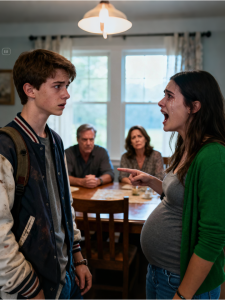
It started on a Wednesday afternoon. I came home from baseball practice to find my parents sitting rigidly at the dining table, faces pale, eyes fixed on me like I was a stranger who had wandered into their house. Before I could ask what was wrong, my father slid his phone across the table. On the screen was a text message from Elena to a friend—screenshotted and forwarded to my mother.
“I’m pregnant. It’s Adrian’s.”
I froze. My name—Adrian Keller—stared back at me like an accusation carved in stone. I laughed at first, thinking it had to be some cruel joke. But my parents weren’t laughing. They demanded answers, explanations, confessions. My voice cracked from panic as I repeated the truth: I had nothing to do with it. But they had already built the verdict in their heads.
My mother whispered, “How could you do this to her?”
My father shouted, “You’re finished in this house!”
Within hours, the fallout began. My girlfriend, Maya, called, sobbing, accusing me of being a monster. Her parents banned me from their home. At school, rumors spread like wildfire. By the weekend, I was the villain in every hallway whisper.
Elena barely looked at me. When she did, her expression was a mix of fear and something colder—resolve. She repeated the lie whenever asked. My parents believed her with a devotion that stunned me.
Three days later, I packed a duffel bag, walked out, and didn’t look back. My last image of home was my mother crying into my father’s chest while he glared at me like a stain he wished he could scrub out of existence.
I moved states, changed schools, worked part-time jobs, and built a life from scratch. At seventeen, I disappeared—erased myself because my family erased me first.
What I didn’t know then was that truth has a patient way of resurfacing, even after a decade of silence.
The first few years after leaving home felt like wandering through fog—cold, shapeless, and disorienting. I settled in Spokane, Washington, because it was the first city where I knew absolutely no one. anonymity felt safer than familiarity. I lived in a cheap studio apartment above a laundromat, worked nights stocking shelves at a supermarket, and finished high school online.
Every birthday, every holiday, every family milestone passed without a single message from home. Not one text. Not one call. Not even the generic Christmas card families send to people they barely know. My therapist years later told me that this kind of rejection rewires your sense of worth. Back then, I simply thought I deserved it.
At nineteen, I started rebuilding. I enrolled in community college, discovering a genuine talent for automotive engineering. Machines were easier than people—they didn’t lie, twist stories, or judge. They either worked or they didn’t, and the cause was always traceable. I loved that. After transferring to Washington State University, I earned my degree while working at a small auto shop run by a retired mechanic named Harold Jennings. He became the closest thing to family I had left. He didn’t ask about my past; he cared about my future.
Meanwhile, Elena’s lie remained buried. I refused to look up my family online, terrified of reopening wounds that had barely scarred. In my mind, they had chosen their side, and I had learned to live without them.
By twenty-five, I owned a modest but successful auto repair business. I bought a townhouse in a quiet neighborhood, adopted a German shepherd named Rusty, and tried—genuinely tried—to believe I had moved on. But trauma leaves fingerprints. I avoided relationships, terrified of anyone having the power to destroy me again. Trusting someone felt like walking barefoot across broken glass.
Everything changed in my twenty-seventh year.
One October morning, a letter arrived with no return address. Inside was a single sheet of paper. A message written in shaky handwriting:
“Adrian, I am so sorry. The truth is finally out. Please let us explain.”
—Mom”
I sat on my couch for nearly an hour, Rusty’s head resting on my knee as I stared at the letter. My mother’s handwriting was unmistakable. A flood of memories crashed over me: her laughter, her hugs, and the moment she chose to believe I was capable of the worst thing imaginable.
Apparently, something had unraveled, and I had no idea what.
Two weeks later, while I was closing the shop for the night, my phone buzzed. A number I didn’t recognize. I let it ring. Seconds later, another buzz: a voicemail.
It was my father’s voice. Gravelly. Older. Breakable.
“Son… we were wrong. God, we were so wrong. Elena confessed. She’s sick, Adrian. She has a heart condition, and she couldn’t live with the guilt anymore. The baby’s father was a guy she met at a party back then, someone who terrified her. She used your name because she knew we’d never kick her out if it was family. Please… we just want to see you.”
I deleted the message. Then I blocked the number.
The “truth” they talked about didn’t feel like a relief. It felt like a secondary assault. They weren’t sorry because they had realized I was a good person; they were sorry because the evidence had changed. If Elena hadn’t confessed, I would still be a monster in their eyes. Their love was conditional, based on a balance sheet of rumors and facts, while my suffering had been absolute.

The Arrival
A month later, they found me.
I was pulling the grate down on my shop when a black SUV pulled into the lot. My heart hammered against my ribs—that familiar, sickly rhythm from my seventeenth year. My parents stepped out. My mother looked fragile, her hair now entirely white. My father’s broad shoulders were hunched, his pride replaced by a desperate, searching look.
And behind them was Maya. My high school girlfriend. The girl who had promised to love me forever until a single text message made her call me a “predator.”
“Adrian,” my mother sobbed, reaching out a hand that I didn’t take. “You look so much like your grandfather.”
“I look like a man who’s been on his own for ten years,” I said. My voice was flat, devoid of the rage I expected to feel. There was only a hollow, echoing exhaustion.
“We searched for years,” my father said, his voice cracking. “Once we knew… we hired investigators. We just wanted to apologize. To bring you home.”
“Home?” I asked, looking at the gravel. “You gave my room to Elena’s daughter, didn’t you? You raised her child while I was sleeping on a bus station bench in Spokane. You didn’t search for ‘years.’ You searched for months, after the guilt became too heavy for you to carry.”
The False Redemption
Maya stepped forward, her eyes brimming with tears. “Adrian, I was just a kid. I was scared. Everyone was saying such horrible things… I’ve never stopped thinking about you.”
I looked at her—the woman who had been the center of my universe. Now, she was just a stranger with a familiar face. “Maya, when the world turned against me, you didn’t even ask me for my side. You didn’t give me five minutes. You handed me a life sentence without a trial. You don’t get to ‘think about me’ now that it’s safe to do so.”
“We want to make it up to you,” my mother pleaded. “We have money saved. We want to help with the business. We want you at Sunday dinner.”
I looked at the three of them. They were waiting for a cinematic moment—the tearful embrace, the big “I forgive you,” the return of the prodigal son. But life isn’t a movie. In real life, when you break something into a million pieces, you can glue it back together, but the cracks are all you ever see.
The Final Silence
“I don’t want your money,” I said quietly. “And I don’t want your dinners. For ten years, I built a life where I didn’t have to wonder if the people I loved would turn on me. It’s a quiet life, but it’s mine.”
“Are you saying you’ll never forgive us?” my father asked, a flash of his old authority flickering for a second.
“Forgiveness is for people who made a mistake,” I replied. “What you did wasn’t a mistake. It was a choice. You chose a lie over your son. You chose comfort over justice. I’ve already forgiven myself for not being what you wanted. As for you? You’re just people I used to know.”
I turned my back on them and walked toward my truck. My mother started to wail—a high, thin sound that cut through the chilly October air. My father shouted my name, but I didn’t turn around.
I got into the truck, Rusty jumped into the passenger seat, and I drove away. I watched them in the rearview mirror—three small figures standing in the middle of a dark parking lot, surrounded by the silence they had created ten years ago.
I went home, made dinner, and sat on my porch. The truth had emerged, but it didn’t change the past. It only confirmed that I was right to leave. I had lost a family, but I had found a man I could trust: myself.
And in the quiet of the night, that was enough.