My boyfriend knew me as Claire Bennett. In reality, I’m Claire Sterling—the only daughter of Robert Sterling, a tech billionaire whose name opens doors. I grew up rich and lonely, surrounded by people who wanted connections, not me. So at twenty-five I disappeared: a modest apartment, a normal design job, a regular car, and a fake last name. I wanted someone who would choose me without the money.
Part 2
The roar of rotor blades swallowed the ballroom’s chatter. Glasses trembled. Heads tilted toward the windows as light swept the ceiling.
Victoria Caldwell’s mouth pinched. “Ignore it,” she snapped. “Security—remove her.”
The guards hesitated when the ballroom doors opened.
My father walked in.
Robert Sterling moved with quiet authority, silver at the temples, suit perfectly cut, four security men behind him. The room recognized him in seconds. Laughter died. People stepped aside as if the air itself demanded it.
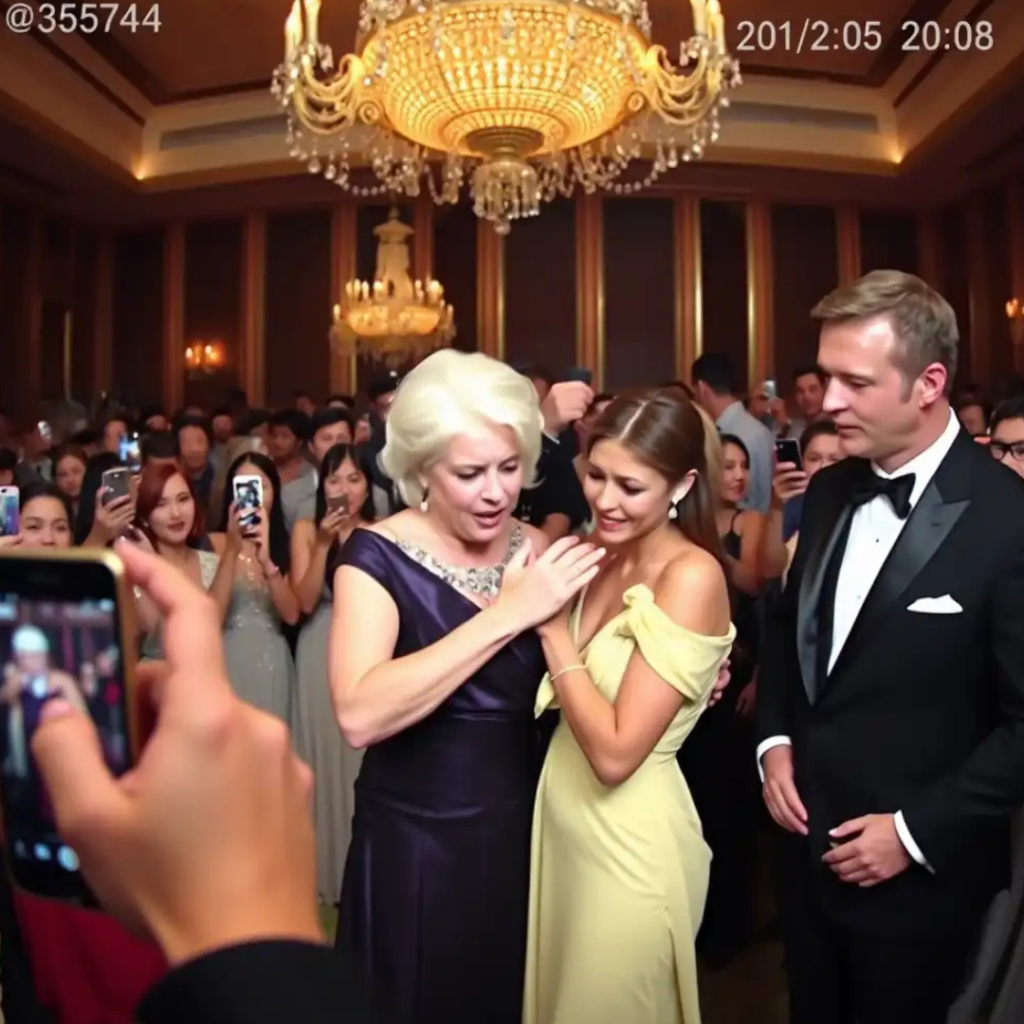
His eyes found me—my torn dress, my hand clutching fabric, my cheek marked red. He reached me and slipped his jacket around my shoulders, covering me like a shield.
“Claire,” he said softly, “are you hurt?”
I tried to speak, but only a breath came out. Tears fell anyway.
Then he turned toward Victoria. “You slapped my daughter.”
Victoria’s face drained. “M-Mr. Sterling, I… I didn’t know who she was.”
“And that,” my father said, voice cold, “is exactly the problem.”
Ethan’s father, Richard Caldwell, rushed forward with a forced smile. “Mr. Sterling, please—this is a misunderstanding. We can explain—”
My father lifted his phone. “There are multiple videos. And a livestream.” He nodded toward a glowing screen, the LIVE icon blinking. “Still broadcasting, apparently.”
Guests lowered their phones, suddenly aware they were holding evidence.
Sloane’s confidence crumbled. “Claire, I’m sorry,” she blurted, mascara smearing. Their cousin Brooke hovered behind her, silent and pale, as if she wished she could fold into the wall.
I stepped forward, wiping my face. “I came tonight as Claire Bennett,” I said, looking around the circle of watching faces. “Not Claire Sterling. I wanted to meet Ethan’s family as a normal person. I wanted to know how you treat someone you think has no power.”
My eyes landed on Ethan. He stood rigid, staring at me like I’d become a stranger. “I asked you to defend me,” I said. “You stayed silent while they humiliated me.”
Ethan took a step. “Claire, I—”
“Stop,” I cut in. “Your silence was an answer.”
Victoria’s voice cracked. “Please, I didn’t mean—”
“You meant every word,” I said. “You called me trash. You hit me. You let your daughter rip my dress while everyone laughed.”
My father’s gaze swept the room. “Let me be clear,” he said. “If you only respect people when you think they’re useful, you have no respect at all.”
Then he spoke into his phone. “Miles, speaker.”
Miles answered immediately. “Yes, sir.”
“Pull all Sterling Group investment from Caldwell & Hart Real Estate,” my father said. “Effective now.”
Richard’s face hardened, then shattered. “You can’t. That stake—”
“We’re done,” my father replied. “You should have thought about your partnerships before your family assaulted my daughter.”
Victoria’s knees buckled. “No—please—”
My father didn’t flinch. “And contact legal. File assault charges. Collect the livestream and every recording.”
Ethan’s voice broke. “Claire, I love you. I swear. I just didn’t know—”
I stared at him, the truth settling like stone. “That’s why I’m leaving,” I said quietly. “You’re sorry because of my last name, not because you watched me get hurt.”
He reached out. I stepped back. For a second, he looked like he might fall to his knees, but pride held him upright—another kind of cowardice.
My father offered his arm. “Let’s go home, sweetheart.”
We walked toward the doors. The crowd parted in silence—no laughter, no whispers, only the faint sound of Victoria sobbing and Richard making frantic calls.
I didn’t look back at Ethan.
I didn’t need to.
Part 3
The week after the gala felt unreal. The livestream didn’t end when my father arrived—it exploded. Clips spread everywhere, replayed with strangers’ captions and “reaction” videos. People argued about privilege and karma, but all I could see was my own face, stunned and shaking, while a room full of adults laughed.
My father’s attorneys moved fast. The assault report was filed, the hotel released security footage, and guests were ordered to preserve their recordings. The phones that had filmed my humiliation became evidence. Victoria
Caldwell tried to apologize through messages—long paragraphs about “pressure” and “not knowing.” Then her lawyer tried. Then Richard tried, offering meetings and donations like everything could be bought.
None of it reached the real wound.
Because the worst part hadn’t been the slap.
It had been Ethan.
I kept replaying the moment I whispered his name and he stared at the floor. Ethan emailed me again and again—ashamed, sorry, claiming he froze, claiming he loved me. But every apology made one thing clearer: he would have found his voice if my pain had mattered more than his fear of his family.
When my father pulled Sterling Group’s investment, Caldwell & Hart began to crumble. Partners bailed, lenders tightened terms, and clients ran from the scandal. The company spiraled. Victoria showed up at court in sunglasses, head down, and suddenly the “queen” of that ballroom looked small. People told me to celebrate the downfall. I didn’t feel joy. I felt clean—like the truth had been dragged into daylight where it couldn’t hide.
I stopped using my alias. Not because my real name is powerful, but because I was tired of acting like I had to earn the right to exist. I also made one rule: no more “tests.” A test assumes you expect failure. What I needed wasn’t a trap—it was a standard: kindness, courage, respect when it’s inconvenient.
Three months later, I worked a charity event for families facing homelessness. No cameras, no speeches—just sorting supplies and helping kids pick coats. That’s where I met Jordan Reyes, a volunteer with paint on his hands and a steady smile. He spoke to donors and janitors the same way. When a child spilled juice on his shoes, he laughed and cleaned it up. When an elderly woman needed a chair, he moved before she asked.
Jordan didn’t know who I was. And when he eventually did—because someone always recognizes the Sterling name—nothing in his eyes changed. No calculation. No sudden sweetness. Just, “Do you want coffee after we finish?”
We’re taking it slow. Not because I’m afraid of love, but because I respect it now. Love isn’t a speech. It’s a reflex. It’s what someone does the second the room turns cruel.
In the quiet moments, my father reminded me that dignity isn’t something other people can take—it’s something you choose to keep. I started therapy, rebuilt my routines, and promised myself I would never beg for basic respect again. I can’t control who judges me, but I can control who gets access to my life.
People ask if I regret showing up in that yellow dress. I regret only one thing: mistaking silence for gentleness. Ethan wasn’t a monster; he was weak. And weakness, when it hides behind politeness, can still break you.
Epilogue
A year later, the video still exists.
Not on the front page anymore—not trending, not dissected in a thousand loud opinions—but it lingers in quiet corners of the internet, like a scar that never fully fades. Sometimes someone recognizes me. Sometimes they whisper. Sometimes they don’t.
And for the first time in my life, I don’t feel the need to hide from it.
Because that night no longer belongs to them.
It belongs to me.
Spring arrived softly that year, like the world was trying not to startle me again.
The city felt different—not because it had changed, but because I had. I no longer walked through it pretending to be smaller, quieter, easier to accept. I didn’t shrink my voice or soften my presence just to make other people comfortable.
I existed exactly as I was.
And it was enough.
The lawsuit concluded faster than anyone expected. The evidence had been overwhelming—clear, undeniable, impossible to twist into anything else. The livestream that once humiliated me became the very thing that held them accountable.
Victoria Caldwell was ordered to issue a public apology, one that sounded rehearsed and hollow even to strangers. There was a settlement, of course. There always is. Money has a way of closing doors quietly.
But it didn’t feel like victory.
Because justice and healing are not the same thing.
Richard Caldwell’s company never recovered. Without my father’s backing—and with their reputation shattered—partners distanced themselves, clients disappeared, and what had once been their pride collapsed piece by piece. The empire that looked untouchable under ballroom chandeliers couldn’t survive the weight of truth.
I watched it all from a distance.
Not with satisfaction.
But with clarity.
Karma doesn’t roar the way people think it does. It doesn’t arrive with fireworks or applause. It moves quietly, steadily, until one day the people who believed they were untouchable realize they are standing alone.
And by then, it’s already too late.
Ethan tried one last time.
Six months after the gala, he showed up outside my office.
I saw him through the glass doors before he saw me.
For a moment, time folded in on itself—the memory of a rainy afternoon, a broken laptop, a smile that once felt like home. For a moment, I remembered the version of him I had loved.
And then I remembered the man who stood still while I was breaking.
That memory was louder.
I stepped outside before he could come in.
“Claire,” he said, his voice softer than I remembered. Careful. Fragile.
As if I might shatter.
I didn’t.
“I’m not here to cause trouble,” he added quickly. “I just… I needed to see you. To say this properly.”
I nodded once. “Then say it.”
He swallowed, eyes searching mine for something—permission, maybe. Or forgiveness.
“I was a coward,” he said. “I’ve had a year to think about it, and there’s no excuse. I was afraid of losing my family, my place, everything I thought mattered. And in that moment… I chose wrong.”
I didn’t interrupt.
Because this time, I didn’t need anything from him.
“I loved you,” he continued. “I still do. And I know that doesn’t fix anything. I just—” His voice broke slightly. “I wish I had been the man you believed I was.”
There it was.
The truth.
Not dramatic. Not defensive. Just… late.
“I believe you,” I said quietly.
He blinked, surprised.
“I believe that you loved me,” I continued. “But love isn’t what failed that night. Character did.”
The words landed gently.
But they didn’t bend.
Ethan nodded slowly, like he had expected that answer all along.
“I don’t expect another chance,” he said.
“You’re right not to,” I replied.
There was no anger in my voice. No bitterness. Just certainty.
And somehow, that hurt him more.
“I hope you become better,” I added after a moment. “Not for me. For yourself. For whoever comes next.”
Because someone would.
People like Ethan don’t stay alone forever.
But whether they grow or repeat the same mistake—that’s the real consequence they carry.
He gave a small, broken smile. “Goodbye, Claire.”
“Goodbye, Ethan.”
And this time, when he walked away—
I didn’t watch.
Life didn’t transform overnight after that.
There was no sudden, perfect happiness waiting for me on the other side of pain. Healing came in quiet, uneven steps. Some days were strong. Some days still hurt in places I didn’t expect.
But the difference was this:
I was no longer trying to earn my place in my own life.
Jordan became part of that life slowly, naturally—like something that didn’t need to be forced to be real.
There were no grand gestures, no dramatic declarations. Just consistency.
He showed up.
Not just on the easy days—but on the quiet ones, the difficult ones, the ones where I said very little and needed even less.
One evening, months later, we found ourselves back at a different event. Smaller. Warmer. No chandeliers, no cameras—just people, conversation, and soft music drifting through the room.
I wore another simple dress.
Not as a test.
Just because I liked it.
At one point, someone spilled wine nearby, and a few guests turned, watching the small chaos unfold. It wasn’t a big moment. Not important.
But I felt it—that flicker of memory, the echo of a night that once changed everything.
My body remembered before my mind could stop it.
Jordan noticed.
He didn’t ask a question.
He didn’t make a scene.
He simply reached for my hand—steady, grounding—and gave it a small, reassuring squeeze.
“I’m right here,” he said quietly.
No hesitation.
No fear.
Just presence.
And in that simple, unspoken reflex—
I understood everything I had been trying to learn.
Love doesn’t wait to see who’s watching.
It doesn’t calculate consequences.
It doesn’t freeze when it matters most.
It acts.
Later that night, as we stepped outside into the cool air, I looked up at the open sky.
No cameras.
No noise.
No expectations.
Just… peace.
“I used to think karma was about revenge,” I said softly.
Jordan glanced at me. “And now?”
I smiled faintly.
“I think it’s about alignment,” I answered. “People reveal who they are. And eventually, life meets them there.”
He nodded, like that made perfect sense.
Maybe it did.
I took a slow breath, feeling something settle deep inside me—something that had been restless for a long time.
That night didn’t define me.
It revealed me.
Not the girl who was humiliated under bright lights.
But the woman who walked out of them with her dignity intact.
And never begged for it again.
The video still exists.
But it no longer tells the whole story.
Because what happened after—
the choices, the boundaries, the quiet strength rebuilt piece by piece—
that’s the part no camera ever captured.
And maybe that’s the point.
Not everything powerful needs an audience.
Some things only need truth.
And the courage to walk away—
without looking back.
If this story proves anything, it’s this: your worth doesn’t change with your outfit, your car, or your bank account. The only thing that changes is how much someone reveals about themselves.
So tell me—if you were in my shoes, would you have walked out the first time they mocked you, or would you have waited for the helicopter, too?