I Came Home From My Trip. My Key Didn’t Fit The Lock. I Called My Son Ryan: “What’s Going On?” He Said, “Dad, This Is For Your Own Good. We Sold The House.” Diane Nodded, “You’ll Be Better Off, Walter.” I Smiled And Sat Down On The Porch Steps. Then I Texted My Lawyer: …
I came home from my trip, set my suitcase down on the porch, slid my key into the lock, and felt it stop halfway like it had hit something that did not belong to me.
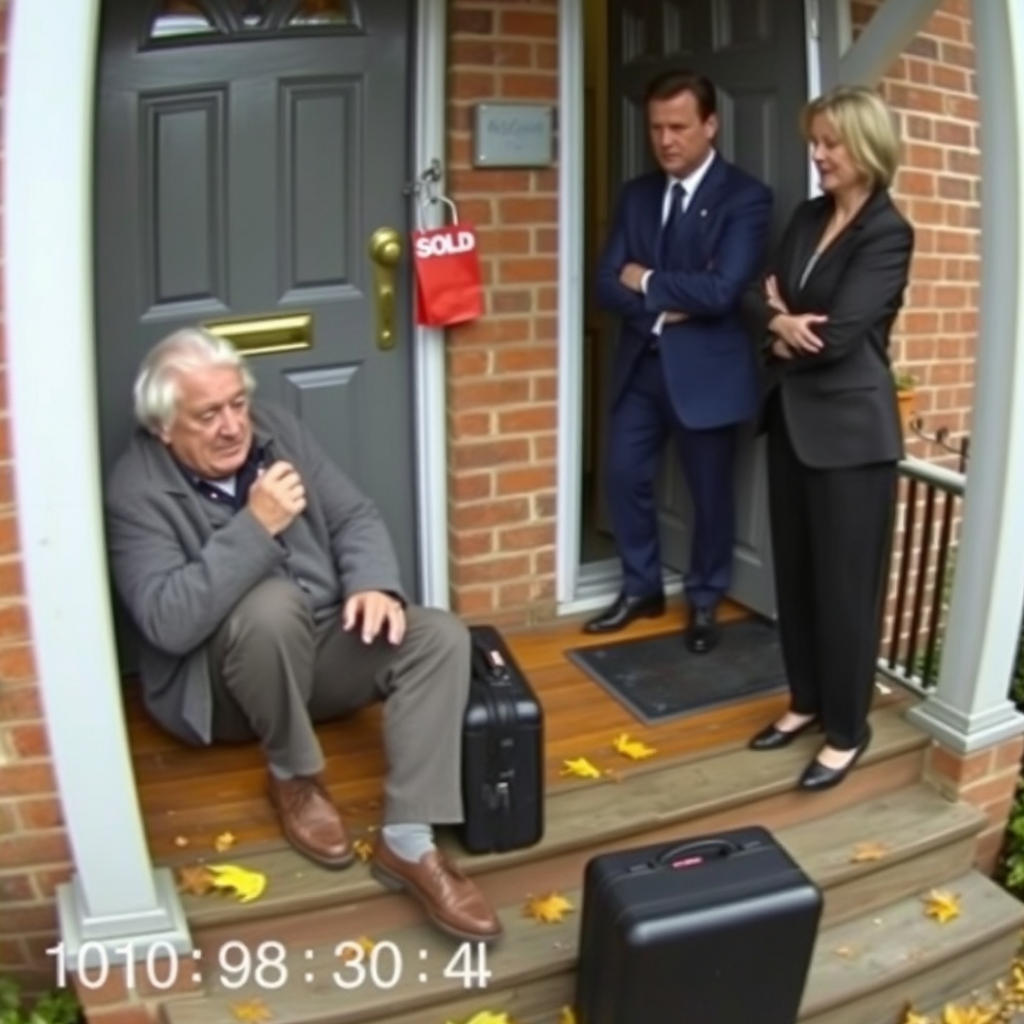
The key went in smoothly enough, but when I turned it, the lock did not move, and that was the moment I realized the house I had lived in for thirty-eight years no longer recognized me.
I stood there on my own front porch in Sudbury, Ontario, on a Tuesday afternoon in late October, the air carrying that familiar scent of wood smoke and damp leaves, the kind that always signals winter is waiting just beyond the trees.
I had been gone eleven days on a fishing trip near Chapleau with my old friend Gerald, something we had done every fall for the better part of two decades, and I had left my house exactly as I always did, furnace set low, workshop locked, curtains drawn just enough to let light in without advertising an empty place.
I tried the key again, slower this time, pressing inward with more intention as if patience might persuade the mechanism to cooperate, but the brass handle did not give and the deadbolt did not budge.
I stepped back and stared at the front door, the same door I had installed myself in 1987 after the original warped in a particularly cruel winter, the same door Patricia had insisted we paint forest green because she said it made the house look welcoming.
I pulled out my phone and called my son.
Ryan picked up on the second ring, and his voice carried a tone that told me he already knew why I was calling.
“Dad,” he said, “you’re back early.”
“I’m standing on my porch,” I replied evenly. “Ryan, my key doesn’t work.”
There was a pause, not long enough to call dramatic but long enough to confirm what I had suspected for six weeks.
“Dad,” he said finally, his voice tightening, “we need to talk. Are you okay to drive? Can you come to our place?”
“I’m not going anywhere,” I answered, glancing at the unfamiliar shine of the new lock against my old wood door. “Whose lock is on my house?”
Another pause followed, and I could hear Diane’s voice in the background, low and urgent, though I could not make out her words.
“Dad,” Ryan said, “just stay there. We’ll come to you.”
They arrived twenty-two minutes later, and I know it was twenty-two because I sat down on the porch steps and watched the clock on my phone tick forward minute by minute while I folded my hands in my lap and breathed slowly through my nose.
I did not call a locksmith.
I did not call the police.
I did not knock on the door as if a stranger might answer.
I sat in the cold with my suitcase beside me because I had already known this moment was coming.
What surprised me was not the betrayal but the calm.
My name is Walter Kowalski, and I am sixty-seven years old.
I worked thirty-one years as a structural engineer for the same firm in Sudbury, designing beams and load-bearing systems that kept buildings upright through snowstorms and shifting foundations, and I retired at sixty-two with a modest pension and the quiet pride of a man who had built things meant to last.
Patricia and I bought that house on Martindale Road in 1986 for ninety-four thousand dollars, back when interest rates were punishing and everyone said we were stretching too far, and we spent the next three decades filling it with birthdays, arguments, Christmas mornings, and the ordinary rhythm of family life.
It is not a mansion.
It is a four-bedroom brick house on a corner lot with a double garage and a workshop out back where I build furniture from hardwood I select myself, tables and chairs and shelves designed to outlive trends.
When Patricia passed three years ago from a sudden , I had the house appraised because Beverly, my lawyer, insisted it was prudent.
The number came back just over seven hundred and twenty thousand dollars, and I remember staring at that figure as if someone had attached a price tag to my memories.
Ryan is my only child.
He is forty-one years old, lives fifteen minutes away with his wife Diane and their two kids, and for most of his life he was a good son in the way busy adults often are, present on holidays, available for occasional projects, reliable but not particularly close.
After Patricia died, he began visiting more frequently.
At the time, I thought it was grief drawing him in.
Now I understand it was assessment.
It started gently.
“Dad, are you eating properly? You’ve lost weight.”
“Dad, have you seen your doctor lately? You should get a checkup.”
“Dad, this driveway is cracking. Why don’t you let me arrange to have it resurfaced?”
It felt like concern, and I appreciated it, because loneliness has a way of making even small gestures feel meaningful.
Then the tone shifted.
“Dad, this house is a lot for one person. Four bedrooms, all those stairs.”
“Diane’s mom moved into a place in Barrie last year and she loves it. Meals included, activities, no maintenance.”
“You could take the equity out of this house and live comfortably without worrying about furnaces or property taxes.”
Each time he raised the subject, I told him no.
I told him this house was where his mother planted tulips every spring, where I built the dining table we ate at for twenty-five years, where I intended to stay until I could no longer climb the stairs.
He would nod, retreat, and then circle back weeks later with a slightly different angle.
Once he brought Diane along, her tone warm and reasonable as she described brochures from retirement communities.
Once he mentioned what might happen if I fell in the workshop and nobody found me for days.
That comment unsettled me more than he could have known.
Two weeks before that conversation, I had slipped in the workshop while lifting a heavy plank of maple, and I lay on the concrete floor for twenty minutes staring at the ceiling, ribs aching, thinking about Patricia and about aging.
I did not tell anyone.
So when Ryan mentioned the possibility of me falling, it felt like coincidence pressing against paranoia.
Around that same time, he suggested I add him to my bank account in case of emergencies.
It sounded practical, and I agreed.
Diane asked casually where I kept my will and property deed.
I showed her the filing cabinet in the spare bedroom.
I even gave them a key to the house so they could water the plants when I traveled.
None of it seemed alarming in isolation.
Together, it formed a pattern I chose not to see.
The turning point came in late August when I received an envelope from a Toronto law office I did not recognize.
Inside was a summary of a power of attorney document naming Ryan as my attorney, effective two weeks prior.
I had never signed such a document.
I read the page four times, turned it over as if an explanation might appear on the back, and then I called Beverly Tanaka, my lawyer of twenty years.
She listened carefully and told me not to touch anything in the house, not to confront Ryan, and to come see her the next morning.
I did not sleep that night.
By noon the following day, Beverly had confirmed my suspicion.
The power of attorney had been filed with forged documentation, likely using a copied signature from an old contract.
She also discovered that a conditional agreement of purchase and sale had been registered on my house three weeks earlier.
The closing date was set for mid-November.
The sale price was six hundred and ninety-five thousand dollars, slightly below market value.
My son had sold my house while I was still living in it.
Beverly laid out my options.
I could report it immediately, seek an injunction, confront Ryan directly.
Or I could give her six weeks to build a case so airtight that no lawyer could wriggle out of it.
I chose six weeks.
I went home and acted normal.
That Sunday, I sat at Ryan’s kitchen island, ate Diane’s roast chicken, and helped my grandson with math homework while knowing my son had orchestrated the sale of my home.
When Ryan mentioned winter coming and suggested we revisit the conversation about my “living situation,” I surprised him by saying, “Maybe you’re right. Let’s talk soon.”
His face lit up with something that was not relief.
It was triumph.
And now, sitting on my porch with a new lock on my door and my suitcase at my feet, I watched his SUV pull into the driveway.
Ryan stepped out first, followed by Diane, both wearing expressions carefully arranged to resemble concern.
“Dad,” Ryan began, approaching slowly, “this is for your own good. We sold the house.”
Diane nodded in agreement.
“You’ll be better off, Walter,” she said softly.
I smiled.
Then I sat down on the porch steps, folded my hands over my knee, and pulled out my phone.
I opened my messages and texted my lawyer.
Ryan mistook my smile for resignation.
He launched into an explanation about market timing and how quickly the buyer had moved, about how difficult it would have been for me to manage showings and paperwork, about how this was a blessing in disguise.
Diane added that they had already researched several “lovely communities” where I could transition smoothly, her voice layered with rehearsed reassurance.
I let them speak.
I let the silence stretch just enough to make them uncomfortable.
Then my phone buzzed.
Beverly’s name flashed on the screen.
I stood slowly, brushing dust from my trousers, and looked at my son with a steadiness that made his expression falter.
“She says the injunction has been filed,” I said calmly. “And the buyers have been notified that the sale was executed under fraudulent authority.”
Ryan’s face drained of color.
Diane’s hand tightened around her purse strap.
“There will be a court date,” I continued evenly. “And a forensic signature analysis.”
The wind shifted, carrying the scent of wood smoke across the yard.
For the first time since stepping onto that porch, I saw uncertainty in my son’s eyes.
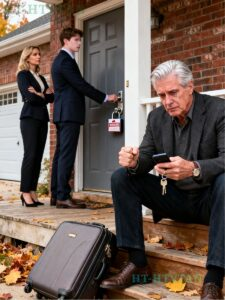
The key slid in, but the lock didn’t turn. I stood there on my own front porch in Sudbury, Ontario. On a Tuesday afternoon in late October, my suitcase beside me, the smell of wood smoke in the air, the way it always is up here when the seasons change. I’d been gone 11 days. A fishing trip up near Chaplau with my old friend Gerald.
Something we’d done every fall for the better part of 20 years. I tried the key again. Nothing. I stepped back and looked at the door. Same door I’d hung myself in 1987. Same brass handle I’d replaced the summer my wife Margaret. No, not Margaret. The summer my wife Patricia passed 3 years ago now. I pulled out my phone and called my son.
He picked up on the second ring. Dad, he said, you’re back early. I’m standing on my porch. Ryan, my key doesn’t work. There was a pause. Not a long one, just long enough. Dad, we need to talk. Can you Are you okay to drive? Can you come to our place? I’m not going anywhere. Whose lock is on my door? Another pause. Then my daughter-in-law’s voice in the background, low and urgent.
And Ryan said, “Dad, just just stay there. We’ll come to you.” They arrived 22 minutes later. I know because I sat on the porch steps and watched the clock on my phone. I didn’t call a locksmith. I didn’t call the police. I just sat there in the cold with my hands folded in my lap and I breathed and I waited because I already knew. I had known for 6 weeks.
I had been waiting for this exact moment. What I hadn’t expected was how calm I would feel. My name is Walter Kowalsski. I’m 67 years old. I spent 31 years working as a structural engineer for the same firm in Sudbury. retired at 62 and have lived in the same house on Martenddale Road for 38 years. It’s not a mansion.
It’s a four-bedroom brick house on a corner lot with a double garage in a workshop out back where I spend most of my time building furniture, tables, chairs, bookshelves. Nothing fancy, just things that are solid and made to last. Patricia and I bought that house in 1986 for $94,000. When she passed in the fall 3 years ago, I had it appraised.
The number came back at just over $720,000. That surprised me. It shouldn’t have. That’s what houses in Ontario do. But it was the first time I thought of my home as a number rather than a place. And I didn’t like the feeling. I have one son. Ryan is 41 and he lives about 15 minutes from me with his wife Diane and their two kids.
For most of his life, Ryan was a good son. Not a close one. He got busy the way people do, but he called on birthdays. Showed up at Christmas, helped me move some lumber once. When I threw my back out after Patricia died, he started coming around more. I thought it was grief. I thought he was checking in. Looking back, I think he was assessing. It started small.
The way these things always do. Dad, are you eating properly? You’ve lost some weight. Dad, have you been to the doctor lately? You should get a checkup. Dad, the driveway needs resurfacing. Why don’t you let me handle that? I didn’t think much of it at first. I appreciated it actually. It felt like concern. It felt like my son stepping up.
But then it started to shift. The questions got more pointed. The concern started to sound like something else. Dad, this house is a lot for one person. Four bedrooms, all these stairs. Have you thought about whether it still makes sense? Dad. Diane’s mother moved into a place in Barry last year and she loves it.
She has her own apartment, meals included, activities every day. You might actually enjoy it. Dad, I’m just saying you could take the equity out of this house and live very comfortably for the rest of your life without worrying about maintenance, taxes, the furnace going, any of it. I told him I wasn’t interested.
I told him this house was where I’d raised him, where his mother had her garden, where I had my workshop. I told him I was 65 years old at the time and perfectly capable of managing my own affairs. He nodded. He backed off and then about two months later, he started up again. The pattern repeated maybe four or five times over the course of a year. Each time I said no.
Each time he waited a while and came back with a slightly different angle. Once he brought Diane with him, which I now understand was a tactical decision. She’s warmer than Ryan, easier to talk to, and I’ve always liked her. Once he showed up with printouts from three different retirement communities. Once he started talking about what would happen if I fell in the workshop and nobody found me for days.
That one landed differently than he intended. Because 2 weeks before that conversation, I had fallen in the workshop. I was moving a piece of hardwood off the top shelf of the lumber rack, misjudged the weight, and went down hard on my left side. Nothing broken. Bruised ribs, bruised ego, but I was on the floor for about 20 minutes before I could get myself up.
I didn’t tell anyone. I didn’t call 911. I lay there on the concrete and I thought about Patricia and then I thought about what I was going to do and then I got up. When Ryan mentioned falling in the workshop, I thought, “How does he know?” He didn’t, of course. It was a general concern, not a specific one. But the coincidence shook me and I started paying more attention to things I’d been half noticing, like the fact that Ryan had asked me casually to add him to my bank account in case of an emergency.
I’d done it without much thought he’d helped me with a few online transfers after Patricia passed, and it seemed practical, like the fact that Diane had asked me equally casually where I kept my important documents, my will, my property deed, my insurance papers. I’d shown her the filing cabinet in the second bedroom.
I’d even given her a key to the house a year earlier so she could water the plants when I was away. Like the fact that Ryan had mentioned twice now that he knew a real estate agent, a friend of a friend who specialized in estate transitions and had helped a lot of families in similar situations. None of it seemed alarming on its own.
Together looking back, it told a very clear story. The thing that finally opened my eyes happened on a Thursday evening in late August. I was at my kitchen table going through my mail, physical mail, the old-fashioned kind, because I’ve never fully trusted paperless billing. And there was an envelope from a law office in Toronto I’d never heard of.
Inside was a single page. It was a summary of a power of attorney document. My name was on it. Ryan’s name was on it as the designated attorney. The effective date was listed as 2 weeks prior. I had not signed any power of attorney. I sat at that table for a long time. I read the page four times. I turned it over as if there might be an explanation on the back.
There wasn’t. I got up, made a pot of tea, sat back down, and read it again. Then I called my own lawyer. Her name is Beverly Tanaka. She’s been my lawyer for 20 years, handled Patricia’s estate, drafted my will, dealt with a property dispute with a neighbor back in 2011. She’s sharp and she’s direct, and she doesn’t waste time.
I called her at home, which I’d never done before, and she picked up because she recognized my number, and I read her the letter. She was quiet for a moment. Then she said, “Walter, don’t touch anything in that house. Don’t move those documents, and don’t say anything to Ryan yet. Come see me first thing tomorrow morning.
” I didn’t sleep that night. I lay in the dark in the bed I’d shared with Patricia for 35 years, and I looked at the ceiling, and I thought about my son. I thought about the boy I’d coached in hockey, the teenager I’d driven to university in London, the young man I’d danced with at his wedding. I thought about what it means to love someone and be betrayed by them.
I thought about whether I was wrong, whether there was an explanation. By morning, I had decided there wasn’t. Beverly confirmed what I already suspected. The power of attorney had been filed with forged documentation. whoever had prepared it. And she suspected the friend of a friend real estate lawyer had used a copy of my signature, likely from some document I’d signed years earlier.
She told me this was more common than people realized, particularly with elderly homeowners, and particularly after the death of a spouse, when one partner suddenly becomes the sole owner of a valuable property. She also told me something that made my stomach drop. A conditional agreement of purchase and sale had been filed on my house 3 weeks earlier.
The closing date was set for mid- November. The sale price was $695,000, about $25,000 below market value, which Beverly said was typical in these cases. Fast sale, cooperative buyer, everyone looking the other way. My son had sold my house. I was still living in it. Beverly laid out my options. I could go to the police immediately.
I could confront Ryan. I could file an injunction to halt the sale. All of those things were on the table. But she also said something else. She said, “Walter, if you move too fast, Ryan’s lawyer and he will have one. We’ll claim the POA is legitimate and tie this up for a year. If you give me 6 weeks, I can build something he can’t argue his way out of.” 6 weeks.
I went home and I kept my mouth shut. That was the hardest thing I’ve ever done. Harder than watching Patricia in the hospital those last two weeks. harder than emptying her closet. Because at least then I knew who I was grieving and why. Sitting across from my son at his kitchen table the following Sunday, eating Diane’s roast chicken and watching his kids do homework at the island, knowing what I knew that required a kind of discipline I didn’t know I had. I acted normal.
I asked Ryan about work. I let Diane refill my coffee. I helped my grandson with a math problem. And when Ryan said casually, “Dad, I’ve been thinking with winter coming. maybe we should talk again about your living situation. I said, “You know what, Ryan? Maybe you’re right. Let’s talk soon.” He looked surprised, then pleased.
That was the moment I understood what had been happening, because his pleasure was not a son’s relief that his father was finally seeing reason. It was something else. It was anticipation. While I was having Sunday dinners and pretending everything was fine, Beverly was working. She obtained a court order to freeze any transactions related to my property.
She filed a formal complaint with the Law Society of Ontario regarding the lawyer who had filed the fraudulent POA. She gathered phone records which she obtained legally through the civil process that showed multiple calls between Ryan, the buyer’s agent, and that Toronto law office going back nearly 8 months. She also helped me set up a legitimate ironclad living trust with my property and assets, naming Beverly herself as trustee with specific instructions.
I also did one thing on my own. I installed a small camera in the workshop, the kind that connects to my phone and stores footage in the cloud. I told Beverly about it. She said it was fine since it was my property. What that camera captured over the following 5 weeks was Ryan entering my workshop twice without telling me.
The first time he spent about 15 minutes going through my filing boxes, the ones where I keep older documents, warranties, that kind of thing. The second time he brought someone with him, a man I didn’t recognize. They walked through the workshop, the garage, the backyard. The man took photographs on his phone.
I watched this footage sitting in my truck in the Canadian Tire parking lot so Ryan wouldn’t see my face if he happened to drive by. On the day I left for my fishing trip with Gerald, I made a point of telling Ryan I’d be gone 11 days. I mentioned specifically that I was leaving my truck at home and getting a ride to the bus station, which was true.
Gerald picked me up because the long-term lot at the bus station was always full and parking downtown was impossible. I said this once at dinner at their place the Thursday before I left in front of both Ryan and Diane. I also called Beverly from Chaplo and told her the timeline. She told me she was ready. On the ninth day, Beverly’s assistant sent me a message.
The locks had been changed. The new buyer’s agent had done it without waiting for the actual closing date, probably to start the possession process early. Beverly had anticipated this. She had already filed the injunction the previous afternoon. I cut the trip short by 2 days. Gerald understood. He’s known me for 40 years and he’d known something was wrong from the moment I showed up at his truck that morning carrying this particular kind of silence.
I didn’t tell him everything, just enough. So when I stood on my porch on that Tuesday afternoon and the key didn’t turn, I was not surprised. I was not panicking. I was waiting. Ryan and Diane arrived together. They looked nervous in the way people look nervous when they’ve rehearsed what they’re going to say, but aren’t sure the other person is going to follow the script.
Ryan got out of the car first. He had his hands in his jacket pockets and he was already talking before he reached the porch. Dad, listen. I know this looks. I know it’s confusing, but this is for your own good. This is what Diane and I have been worried about for years. The house is too much. The workshop is a hazard. We found a great place in Ryan, I said.
He stopped. Who is the buyer? Something moved across his face just for a second. Dad, that’s not Is it someone you know? Diane touched his arm. He looked at her. Ryan, I said again, I want you to think very carefully before you answer me. I want you to think about whether you want to have this conversation here on the porch or whether you want to have it in front of a judge.
The silence that followed was the longest of my life, longer than the 20 minutes I spent on the workshop floor, longer than the drive to the hospital the morning Patricia had her first episode. The kind of silence that contains everything that’s about to change. Diane started to cry, not loudly, just quietly with her hand over her mouth, which I hadn’t expected and which made it harder, Ryan said very quietly.
Dad, I didn’t we were going to tell you. After the closing, we were going to set you up somewhere, take care of everything. With my money, he didn’t answer. With my house, my money, the house your mother and I built our life in. He sat down on the porch steps. He looked in that moment less like a 41-year-old man and more like the boy who used to sit on those same steps after getting in trouble at school waiting for me to come outside.
I had sat next to him then and talked it through. I wasn’t going to do that now. Beverly has filed everything. I said the fraudulent POA, the unauthorized sale agreement, the evidence of you entering this property without my knowledge. The sale has been legally halted. The buyer has been notified.
There will be an investigation and depending on what that investigation finds, there may be criminal charges. Diane sat down next to Ryan. She was crying steadily now. Ryan was looking at the ground. I want you to go home, I said. I want you to call a lawyer, a real one, not whoever helped you with this. And I want you to understand that whatever happens next is a consequence of a choice you made, not something that was done to you.
They left without another word. I called Beverly from the porch. She answered immediately. They were here, I said. How do you feel? Like I need a cup of tea and about 3 days of silence. Get inside first. I’ll send a locksmith within the hour. The investigation took 4 months. The fraudulent POA was traced back to the Toronto law firm, which was found to have prepared similar documents for three other families in the past 2 years.
The lawyer involved surrendered his license. The buyer, who turned out to be a real estate investor, Ryan had met through a mutual contact, cooperated with the investigation in exchange for immunity and provided testimony that confirmed Ryan had initiated the arrangement. Ryan was charged with fraud over $5,000 and breach of trust.
He took a plea agreement. He did not go to prison. The crown accepted a conditional sentence with two years of community service, restitution, and a permanent prohibition from acting as a power of attorney or estate trustee in Ontario. It wasn’t the outcome I would have written, but it was the outcome the law produced, and I’ve made my peace with it. My house is still mine.
The trust Beverly set up means it will remain mine for as long as I choose to live here. And when I’m gone, it goes to a land trust that Patricia and I had always talked about supporting a conservation organization that protects wetlands in Northern Ontario. That was her idea originally, something she mentioned once and I never forgot.
I finally did something about it. I don’t have a relationship with Ryan anymore. Not right now. His children still send me drawings sometimes. slipped through the mail slot, which I think Diane allows because she is a better person than the situation she found herself in. I keep the drawings on the workbench in the workshop.
I look at them sometimes when I’m sanding. There are things I wish I’d done differently over the years. I wish I’d talked to Ryan more openly about money after Patricia died about the house, the will, what I was planning. I think the silence left room for assumptions that turned into something uglier than they needed to. I’m not taking responsibility for his choices, but I understand that grief and money together can do things to people that surprise them and that some of those things could have been interrupted earlier if we’d talked more honestly.
What I want people to hear, and I say this as someone who spent a year watching it happen and 6 weeks quietly building the wall that stopped it, is this. Your home is not a problem to be managed by the people around you. Your age is not a medical condition. Your desire to stay in a place that holds your life is not stubbornness and it is not a burden on your family.
It is a right. If you are over 60 and you have property and the people in your life are starting to have conversations about your living situation, ask yourself who is benefiting from those conversations. Ask yourself whether the concern is for you or for what you own. And then if something feels wrong, don’t wait.
Call a lawyer. Not your son’s lawyer, not a family friend, your lawyer. Sign nothing you haven’t read completely. Add no one to your accounts without understanding exactly what access that gives them. And if someone ever files a document with your name on it that you didn’t sign, that is not a misunderstanding.
That is a crime. I’m still in my house on Martenddale Road. The furnace is fine. The stairs don’t bother me. Last week, I finished building a blanket chest from a piece of white ash I’ve had drying in the workshop for 4 years. Solid as a rock. Dovetail joints. Hand cut. The kind of thing that lasts longer than the person who made it.
Patricia would have liked it. I know what I know now, and I’m still standing. That’s enough.