The first thing I noticed was not the suitcases.
It was the way my son was sitting.
Nathan had always been a straight-backed man, even as a boy. He sat like someone who expected to be called on, someone ready to stand and explain himself, ready to do the hard thing without complaint. But that afternoon in Bryant Park, under a pale October sky and the brittle gold of late leaves, he was folded inward on himself as though the day had taught him that taking up space was a privilege he no longer possessed.
The three suitcases came second. One navy, one black, one brown leather with a scuff at the corner. Everything he owned, stacked beside a green-painted bench in the middle of Midtown Manhattan like luggage abandoned by a traveler who had missed the last train out.
The third thing I noticed was Mason.
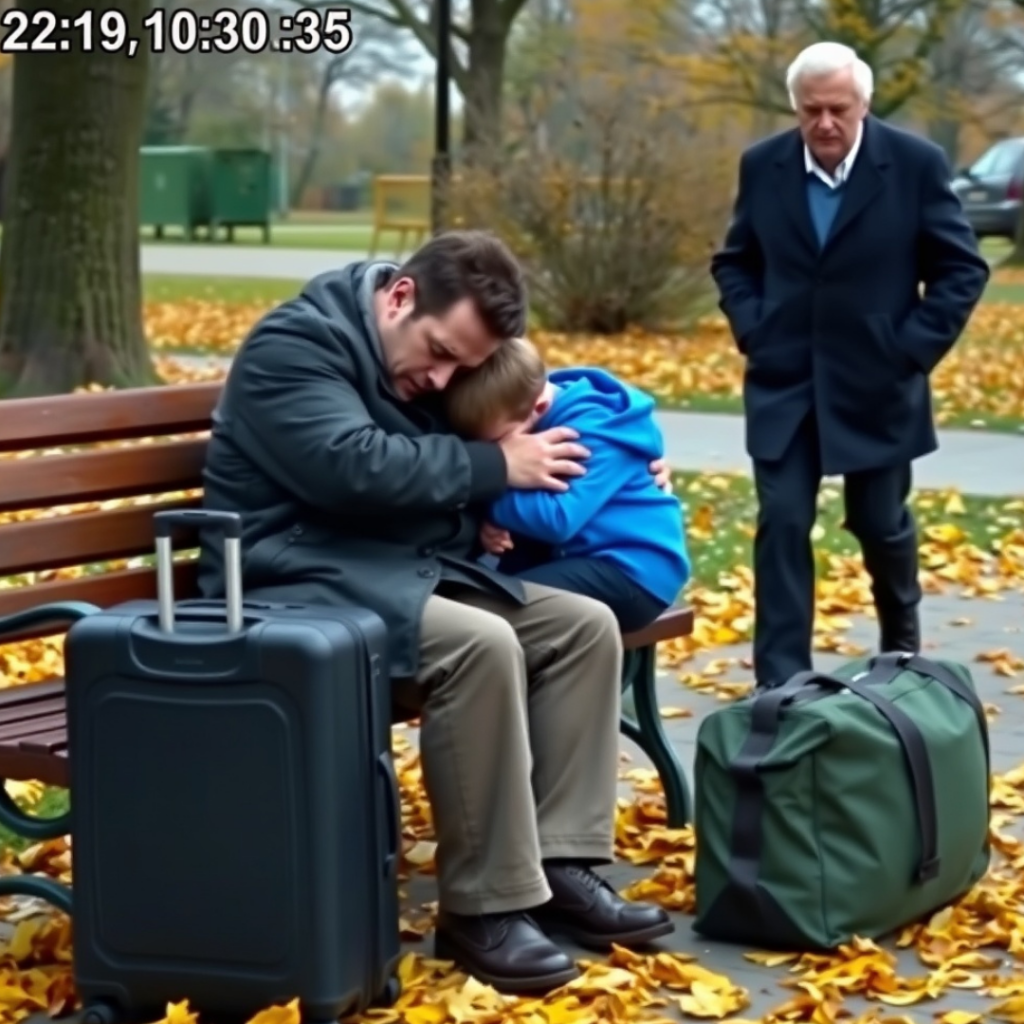
My grandson was four years old and wearing a tiny puffer jacket the color of wet cherries. His sneakers flashed blue and red every time he kicked through a pile of leaves. To anyone passing by, he might have looked like any other child amusing himself while his father waited for a ride. But children don’t hide worry well, not when it’s fresh. Every few seconds Mason glanced back at Nathan, as if making sure he was still there, as if he had learned that day that adults could disappear.
I pulled the car over too hard.
Frank, who was driving, looked at me in the rearview mirror but said nothing. He had worked for me long enough to recognize the silence that comes before violence. Not the crude kind with fists and broken teeth. The cleaner kind. The expensive kind. The kind that ends with signatures, warrants, and ruined legacies.
I opened the car door and stepped out into the cold.
Nathan didn’t look up right away. Only when my shadow crossed his shoes did his eyes lift to mine. They were bloodshot and hollow with exhaustion. Not the exhaustion of a long week. Not the kind sleep fixes. This was the exhaustion of humiliation, of a man who has spent all day trying not to collapse because a little boy is watching him.
“Dad,” he said.
Mason saw me and ran over so fast he nearly slipped on the pavement. He crashed into my legs, wrapped his arms around my knee, and looked up at me with the simple certainty only children and fools possess.
“Grandpa,” he said, “can you fix this?”
There are questions a man should never have to answer with a child looking at him.
I put my hand on Mason’s head and forced my voice steady. “I can fix anything that involves you.”
Then I looked at Nathan.
“Why aren’t you at the office?”
His jaw moved once before the words came. “I was fired.”
There are ways men say that sentence. Angry, embarrassed, defensive, ashamed. Nathan said it like he was reporting weather.
“By who?”
He gave a humorless little laugh and looked away, past me, toward the library lions two avenues over, toward the city that was too busy to care.
“Charles did it himself,” he said. “Brought me into the boardroom at nine-thirty. Said there had been concerns about judgment, about temperament, about culture.” He swallowed. “Then, when I asked him what that really meant, he said, ‘Our blood doesn’t belong with people like them.’”
The air turned colder around us.
New York was still moving. Taxis hissed along Sixth Avenue. A siren somewhere downtown rose and fell. Office workers hurried past with phones to their ears and coffee in hand. No one knew that the axis of my world had just tilted.
Three years.
For three years I had listened to Charles Pennington talk about blood as though he’d invented it. Old money. Proper families. Breeding. Institutions. The right schools, the right clubs, the right surnames spoken in the right rooms. He dressed prejudice in etiquette and called it tradition. I had watched. I had cataloged. I had said nothing, because Nathan had asked me for silence and a man should keep his word to his son.
But there are promises that survive only until they collide with cruelty.
I looked at the suitcases again. “Where’s Victoria?”
Nathan’s face hardened in a way I had not seen before, not even when he was a teenager and thought hardness was the same as manhood.
“She changed the locks while I was at the office,” he said. “Packed my clothes. Put them outside. Told the doorman not to let me in. She said her father finally did what should have been done from the start.” He glanced toward Mason and lowered his voice. “She said maybe now Mason has a chance to be raised properly.”
Frank got out of the car behind me, but he kept his distance.
I crouched so I was eye level with Mason. “Buddy, go sit in the car with Frank for one minute, all right? I need to talk to your dad.”
Mason frowned. “Are you mad?”
“No.” I smiled, though it cost me something. “But somebody’s going to be.”
Frank offered his hand. Mason took it and trotted toward the car. When he was out of earshot, I turned back to Nathan.
“Did she put her hands on you?”
He blinked at me. “What?”
“Did she hit you? Did Charles?”
“No.”
“Did anyone threaten Mason?”
His expression changed then. It was small, almost invisible, but I saw it. A tightening around the eyes. A pause too long to be harmless.
“Nathan.”
He looked down at his shoes. “Not directly.”
I waited.
He let out a breath. “Last night Victoria said I should think carefully before making things ugly. She said judges in New York always notice instability in fathers who don’t understand their place. She said if I pushed back, I’d be lucky to see Mason on supervised weekends.”
My hands closed at my sides.
“She said that,” I repeated.
He nodded.
I stood up.
“Get in the car.”
He looked at the suitcases, then at me, and something like shame flickered through him. “Dad, I don’t have anywhere to—”
“I didn’t ask whether you had somewhere to go.”
He stared at me.
I could see the boy beneath the man for a second. The same boy who used to stand in the doorway of my study waiting for me to finish a call so he could show me a drawing or ask me to come outside. The same boy who had eventually stopped asking.
“I said,” I told him, “get in the car.”
That was the voice I used when storms were coming and ships needed moving. The voice that did not leave room for debate.
Nathan reached for the suitcase handles. Frank stepped in front of him.
“I’ve got those, Mr. Nathan.”
My son’s eyes moved from Frank to me. “You already know?”
“Enough,” I said. “Get in.”
He did.
Mason had curled up in the back seat by the time we pulled away, small and warm and trusting, one hand still clutching a plastic dinosaur. Nathan sat beside him, staring out the window as Bryant Park slid away behind us and the city rose up in mirrored glass and stone.
I told Frank to take the FDR north.
For the first ten minutes, no one spoke.
I watched Manhattan flicker past—the shoulders of skyscrapers, the flash of scaffolding, the dirty elegance of old brick against new steel. I built half my life in this city. Built it in warehouses that smelled of salt and diesel, in shipping offices where the heat worked only when it pleased, in deals made over bad coffee and better lies. I knew every kind of ambition New York could produce. But there is a special ugliness in the kind that wraps itself in civility and then uses family as a weapon.
“Nathan,” I said at last.
He didn’t turn. “Yeah?”
“How long?”
He knew what I meant. “Which part?”
“All of it.”
His reflection moved faintly in the tinted glass. “The comments? Since before the wedding. The company stuff? A while.” He rubbed one hand over his mouth. “The financial pressure got bad around six months ago. Victoria started changing after that.”
“Changing how?”
“She stopped pretending.” His laugh this time sounded tired, broken at the edges. “I guess that’s the simplest way to put it. Before, she’d defend me in private and say we just had to be patient with her father, that Charles was from a different generation, that he’d come around once he saw results. Then she stopped doing even that. Started repeating him. Started correcting the way I talked, the way I dressed, the way I held a wine glass.” He shook his head. “It’s stupid when I say it out loud.”
“No,” I said. “It isn’t.”
“You know what the worst part is?” he asked.
I waited.
He finally looked at me, and in his face I saw something harder than humiliation. I saw betrayal stripped to the bone.
“For a while,” he said quietly, “I thought if I just worked harder, if I proved myself enough, they would stop. Not because I cared about their approval. I kept telling myself it was for Mason. For stability. For the marriage. But really…” He glanced at the sleeping child beside him. “Really, I think some part of me wanted to win. Wanted to walk into those rooms and have them see me. Wanted them to admit I belonged there even if I didn’t have their schools or their friends or their ridiculous bloodline garbage.”
He looked back out the window.
“And they knew it,” he said. “That’s what makes me sick. They knew exactly which hunger to feed and which wound to press.”
The car went silent again.
Outside, the city loosened into bridges and broader roads, into the clean-lined wealth of Westchester and stone walls tucked behind trees turning copper and rust. Our home in Bedford wasn’t really a home in the sentimental sense. It was an estate, large enough to deserve the word and cold enough, in some seasons of my life, to earn it. I had bought it after Nathan’s mother died because I thought land and privacy and good schools were the kind of things a man was supposed to provide his family. I did not understand then that grief doesn’t care how many acres you own.
“Dad,” Nathan said.
“Yes.”
“You asked me once if I wanted your help. Three years ago.”
“I remember.”
“I said no.”
“You did.”
He nodded, still looking forward. “I told you I didn’t want to be your son in that company. I wanted to be a man on my own feet. I wanted respect I’d earned without your name carrying me.” He swallowed. “You kept your word. You stayed out.”
“I did.”
“Why?”
I considered him a long moment before answering. “Because you were right to want it.”
He laughed softly without humor. “Doesn’t feel like I was.”
“It will,” I said.
His eyes came back to mine. “How?”
I leaned back and watched the tree shadows move across the glass.
“Because Charles Pennington made a mistake,” I told him.
Nathan frowned. “What mistake?”
“He forgot who he was talking to.”
He said nothing.
I let the silence gather a little weight, then added, “There’s something you should know before we get home.”
His shoulders stiffened.
“Three years ago,” I said, “when Hudson Freight came on the market, the company was bleeding. The books were a mess, the ownership structure was unstable, and their debt exposure would have scared off anyone with common sense.”
Nathan stared at me now.
“I bought it anyway.”
He blinked. “What?”
“Not in my name. Through holding companies. Layered offshore. Quietly. I put new capital into it, cleaned up the debt, and installed Charles as chief executive because he had the industry pedigree and the social sheen the board wanted.” I paused. “And because you had just married his daughter and told me you wanted a chance to stand on your own without anyone saying your father handed you a throne.”
He kept staring.
“I gave you that chance. I told no one. Not even you.”
The words seemed to move through him slowly, as though they had to break through shock before they could become understanding.
“You own Hudson Freight,” he said at last.
“I own every chair in the boardroom where he fired you.”
His mouth opened, closed, then opened again. “You let him—”
“I let you try,” I said. “I let you build. I let you learn who you were away from me and my shadow.” My voice hardened. “What I did not permit, and what ends now, is this.”
Nathan looked down at Mason, then back at me. “Why are you telling me now?”
“Because the agreement died when I saw you on that bench.”
I watched the truth settle in his face, watched anger and relief and disbelief try to coexist. He leaned back slowly and covered his eyes with one hand.
“Jesus,” he whispered.
“No,” I said. “Just me.”
That got half a laugh out of him, weak and brief, but real.
We rode the rest of the way in silence.
By the time the gates opened and the house rose ahead of us through the trees, dusk had begun laying its blue hands over the grounds. The lamps along the drive clicked on one by one. Warm light glowed from the windows. Somewhere inside, the kitchen staff would be setting dinner. Somewhere in the back hall, the old grandfather clock would be preparing to strike the hour. Everything about the place suggested order, permanence, safety.
Sometimes houses lie.
I got out first and opened Mason’s door myself. He woke halfway, confused and soft with sleep, and leaned into my shoulder when I lifted him.
“Home?” he murmured.
“Yes.”
“Can Daddy come too?”
My throat tightened unexpectedly. “Daddy’s coming too.”
Nathan stood on the gravel with his face turned toward the house as though he wasn’t sure it was real. Frank and another guard carried in the suitcases. No one asked questions.
Inside, Mrs. Alvarez, who had been keeping my household from collapsing into masculine incompetence for nineteen years, took one look at Nathan and abandoned all protocol.
“Oh, honey,” she said, and pulled him into a hug before he could stop her.
He nearly came apart right there.
I handed Mason to her. “Can you get him fed and upstairs?”
“Of course.”
Mason lifted his head from her shoulder. “Grandpa?”
“Yes?”
“I knew you’d fix it.”
Then he was gone up the stairs, and I was left standing in the front hall with my son.
Nathan looked ashamed of the tears in his eyes.
“Don’t,” I said.
“I’m not crying.”
“You are.”
He laughed once, wiped at his face, and nodded. “Yeah.”
I put a hand on the back of his neck the way I used to when he was a boy and couldn’t sleep after thunderstorms. “Go shower. Eat something. Sit with your son. Then come to my study.”
He looked at me for a second longer, as if trying to decide whether he was allowed to trust the steadiness in my voice. Then he nodded and went upstairs.
I waited until I heard his footsteps fade before turning to Frank.
“Now,” I said.
He followed me down the corridor.
My study had always been the room that told the truth about me. The rest of the house had been decorated by experts with excellent taste and no moral authority. The study was mine. Walnut shelves. Brass lamps. Framed port maps. Two old maritime paintings I’d bought when I couldn’t really afford them because they reminded me that men had crossed oceans long before I ever learned how to survive a boardroom. Everything smelled faintly of leather, paper, and the single-malt whiskey I rarely drank and often poured.
Frank closed the door behind us.
He was a broad man with iron-gray hair and the face of someone who had no illusions left but kept going anyway. We had met twenty-two years earlier when he was NYPD and I needed private security after a labor dispute got ugly at the Newark docks. He retired from the force and came to work for me not because the money was better, though it was, but because he liked clear loyalties. He had a gift for seeing danger before it announced itself.
“What do you have?” I asked.
He set a black folder on my desk.
Black was his color for immediate threat.
“I started with the company audit you asked for last week,” he said. “Then expanded after what happened today.”
I sat down and opened the folder.
The first page was a police report.
Complainant: Charles Pennington.
Accusation: theft of family heirlooms.
Estimated value: 2.8 million dollars.
Filed that afternoon.
I read it twice, not because I needed clarity but because repetition helps anger ripen.
“He filed before noon,” Frank said. “Timing suggests he wanted the report in the system before Nathan had counsel.”
“Of course he did.”
The second section held loan documents. A dozen of them. Different banks. Different terms. One pattern.
All in Nathan’s name.
“Tell me these are fake.”
“They are,” Frank said. “Every signature digitally lifted. Our handwriting analyst is certain.”
I flipped through them. Eighteen million dollars in personal exposure layered against Hudson Freight guarantees and Nathan’s alleged assets. Enough debt to bury a man. Enough default risk to trigger cross-collateral clauses, force seizures, and leave my son appearing not merely incompetent but criminal.
“It gets worse,” Frank said.
That is not a phrase a man of my age enjoys hearing.
He slid a tablet across the desk and hit play.
The first video showed Nathan and Victoria in what looked like their bedroom. The angle was wrong for any legitimate camera. Hidden. Deliberate. I watched my son loosen his tie while Victoria stood with crossed arms and a face of practiced concern.
“You’re tense again,” she said.
“I’m fine.”
“You scared Mason this morning.”
“I was late to work.”
“That’s not an answer.”
He pinched the bridge of his nose. “Victoria, not now.”
“See?” she said softly. “That tone. That’s what I mean.”
The clip ended.
Frank loaded another.
A lamp shattered on the floor. Nathan wasn’t even in frame when it happened. Then he entered, startled, and Victoria’s voice rose instantly into frightened outrage.
“Why would you do that?”
Nathan stared at her. “I didn’t.”
“Mason, baby, go to your room. Daddy’s upset.”
The video stopped.
My study went very quiet.
“She was building a record,” Frank said. “A pattern of instability. Enough clips like this, edited properly, supported by statements from her father and maybe one or two household staff, and she files for sole custody with a narrative ready to go.”
I put the tablet down very carefully.
“Anything else?”
Frank nodded. “One more thing. This may be the center of it.”
He handed me another document. I recognized the number before I finished the first line.
My international shipping license.
The authorization under which Sullivan Maritime held access to a web of contracts up and down the Eastern Seaboard. Ports, bonded operations, restricted cargo channels, the sort of institutional permission that takes years to earn and can be destroyed by a single scandal.
It had been listed as collateral in a seven-and-a-half-million-dollar transaction routed through a Cayman fund.
My voice went flat. “How.”
“We think a corrupt notary and an insider at a records office. They forged a duplicate chain and pledged it as security for a private loan. Funds were scheduled to move tomorrow at noon.”
I sat back.
So that was the architecture. Strip Nathan personally. Collapse Hudson. Poison his custody case. Leverage my own assets if necessary. Pin enough financial chaos on my son that he would drown in allegations before he ever reached clean air.
They hadn’t just wanted him gone.
They had wanted him ruined.
Some men destroy impulsively. Charles Pennington preferred tailoring. He wanted the ruin to appear inevitable, tasteful, and deserved.
I closed the folder.
“Stop the Cayman transfer.”
“We’re already moving on it.”
“I don’t care what you need to call in. Federal Reserve, Treasury, financial crime task force, private pressure. I want that money frozen before it leaves domestic reach.”
Frank nodded.
“And get me every communication between Charles and Victoria for the last six months. Emails, texts, board messages, social channels. I want his accounts, his debts, his offshore entities, his affairs if he has them, and the names of every person he thinks will stand between him and consequence.”
“Yes, sir.”
I rose and walked to the window.
The lawn beyond the glass was washed in evening. Somewhere upstairs, Mason laughed at something Nathan had said. The sound traveled faintly through the old house, and it landed in me with more force than any threat in the folder.
I thought of all the years I had told myself I was building something for my son. A company, a foundation, the kind of durable wealth that could shield a family from the vulgarity of need. It is one of the great vanities of successful men to mistake provision for presence.
I had fed Nathan, educated him, housed him, secured him, and left him lonely often enough that he learned not to expect rescue.
Maybe that was why he had married into the Penningtons in the first place.
Charles offered the illusion of belonging through approval. Victoria offered admiration polished to a shine. They had met at a charity auction six years earlier, and from the outside it had looked absurdly suitable: my son, handsome and earnest, with a woman from one of those families that seemed to have been born already framed in a museum. They fell in love, or something adjacent to it. Nathan said she made him feel chosen. I heard that and understood too late what accusation was buried in the compliment.
“You know what he wants most?” Nathan had once said about Charles, back in the early days when condescension still masqueraded as a challenge. “He wants me to hate him.”
“And do you?” I had asked.
“No. I want him to be wrong.”
That was the wound they had fed. Not greed. Not social hunger. Something far more dangerous. The desire to be judged fairly by people committed to unfairness.
I turned back to Frank.
“Call James Thornton at Manhattan Capital. Wake him if he’s asleep. Tell him I’m buying Pennington debt at market plus ten percent for immediate transfer.”
Frank’s eyebrow moved a fraction. “All of it?”
“All of it.”
“That will be expensive.”
“Yes.”
He started for the door, then paused. “Nathan?”
“Keep him out of the details tonight,” I said. “He needs one night under a safe roof with his son before I tell him how ugly it really is.”
Frank nodded and left.
I remained in the study a long time after he was gone.
At some point I poured whiskey and forgot to drink it.
My mind moved backward, which it often did in moments when forward required too much patience. Back to the first Sunday dinner after Nathan married Victoria. Back to the Pennington estate in Greenwich, where every room looked curated for the benefit of dead ancestors and living insecurity.
Charles had corrected my son’s hand placement on a wine glass that night.
“By the stem, Nathan,” he had said, smiling the way men smile when they want cruelty mistaken for polish. “A proper Bordeaux deserves respect. Details reveal breeding.”
Victoria had looked down at her plate as if the pattern there required study. Nathan had apologized. I had cut my duck and said nothing.
Then came the next dinner and the next. Corrections about schools, about posture, about tie knots, about literature, about summering properly, about the vulgarity of talking money too directly, though Charles himself never seemed troubled by the income statements of other people. It was death by a thousand polished cuts.
I let it happen because Nathan asked me to. Because he was thirty and proud and desperate to prove that the Sullivan name was not the source of every door in his life. Because I thought suffering might harden him into something self-sufficient.
I see now that too many fathers confuse hardness with strength because hardness resembles the face we wear in the world.
Strength is something else.
Strength is what my son had shown by protecting Mason with almost nothing left in him.
Strength is what he had shown by not calling me until there was nowhere else to go.
Strength is what I would need to show now, not in patience but in action.
A soft knock came at the door.
Nathan stepped in wearing one of my old sweaters, sleeves pushed up, hair still damp from the shower. He looked younger that way and older at once.
“You wanted to see me.”
I motioned to the chair across from my desk. “Sit.”
He did, with the caution of a man entering a conversation he isn’t sure he deserves.
“How’s Mason?”
“Asleep. Mrs. Alvarez fed him and read to him. He asked if we live here now.”
I folded my hands. “And what did you say?”
“That I don’t know yet.”
“Fair.”
He looked at the folder on the desk. “This is bad, isn’t it?”
“Yes.”
He nodded once. “Tell me.”
So I did.
Not every document, not every mechanism, but enough. The false loans. The hidden cameras. The police report. The attempted pledge of my shipping license. As I spoke, his face passed through disbelief and anger and something beyond both, something close to mourning. By the time I finished, he was sitting very still.
“I didn’t know about the loans,” he said quietly.
“I know.”
“I knew Charles had been moving things around. Delaying reports. Taking private meetings. I thought maybe he was lining up a buyout or trying to force me out strategically. I didn’t realize—” He stopped. “Victoria knew?”
“Yes.”
His eyes shut.
Not for long. Just long enough to let the truth cut where it needed to.
“When did it start?” he asked.
“Probably before you realized.”
He laughed under his breath. “That could mean anything.”
“Did you love her?” I asked.
He looked startled by the question.
Then his shoulders dropped.
“Yes,” he said. “At first. I think she loved the version of me that made her feel rebellious. The man from outside her world who was still polished enough to bring home. The one with just enough rough edges to be interesting, not enough to be threatening.” He rubbed his palm over his knee. “But love that depends on curation isn’t love. It’s branding.”
I studied him. “When did you know it was over?”
“The day Mason got a cold and had a fever. He wanted me, not the nanny. He wouldn’t stop crying until I held him, so I stayed up with him most of the night.” Nathan smiled faintly at the memory. “At about three in the morning, I was in the rocking chair with him sleeping on my chest, and Victoria came in wearing silk pajamas and looked at us like we’d done something embarrassing. She said, ‘This is why children get attached in unhealthy ways. You need boundaries.’” He shook his head. “He was two years old. Sick. I remember looking at her and realizing she thought tenderness was bad breeding.”
He looked away.
“I think that was the beginning of the end.”
I let the silence hold that for a moment.
“Listen to me,” I said.
He raised his eyes.
“You are not responsible for being deceived by people who practiced deception long before they met you.”
His mouth tightened. “I should have seen it.”
“Maybe. But seeing rot inside charm is harder when you were raised hungry for approval.”
He flinched very slightly.
Good. Truth should sting when it lands close enough.
“I’m not insulting you,” I said. “I’m indicting myself.”
He stared at me.
I took a breath I did not enjoy taking.
“When you were seven, you came to my office in your little league uniform and asked if I’d come watch you pitch. I told you not today. When you were twelve, you won a school history prize and I sent flowers instead of showing up. When you were sixteen and your mother had been dead less than a year, I doubled down on work because I didn’t know how to sit with grief unless it was itemized into tasks.” My voice stayed level only by force. “You learned from me that love can exist beside absence. That men prove devotion through infrastructure and timing and tuition, through the machinery of support, rather than the vulgar simplicity of being there. So yes, maybe you were vulnerable to people who made belonging seem conditional. You came by that vulnerability honestly.”
Nathan did not speak.
There are conversations in which a father hopes to be forgiven before he finishes confessing. This was not one of them. I said what needed saying and let it stand.
Finally he leaned back and exhaled slowly.
“I spent years blaming Mom for marrying you,” he said with a tired smile. “Then after she died, I spent years wanting to become you. Then I spent even more years trying not to become you.” He shook his head. “Turns out families are efficient factories for contradiction.”
“That,” I said, “is true.”
A tiny laugh escaped him.
Then he sobered.
“What are you going to do?”
The answer rose in me calm and fully formed.
“I’m going to dismantle Charles Pennington in the language he respects most,” I said. “Assets, reputation, access, consequence.”
“Nathan—”
“I don’t want blood,” he said quickly. “I don’t want anything illegal.”
I almost smiled. “You think very little of me.”
“I think a lot of your imagination.”
“Fair enough.” I leaned forward. “No one is getting hurt. Not physically. But your father-in-law built his life on three assumptions. First, that wealth grants immunity. Second, that civility can disguise predation. Third, that men like me remain useful so long as we remain silent. I intend to correct all three misunderstandings.”
He held my gaze.
“Will I have to testify?”
“Possibly.”
“Will Mason be dragged through this?”
“Not if I can help it.”
His jaw tightened. “And Victoria?”
The name carried no softness now.
“She will face what she earned.”
He nodded once.
Then, to my surprise, he asked, “Can I sit here for a while?”
I glanced around the room. “It’s my study.”
“I know.”
“Then why are you asking?”
A ghost of the boy again. “Because for most of my life it felt like I needed permission.”
That one landed deep.
I stood, walked around the desk, and set a hand on his shoulder.
“Sit as long as you like,” I said.
I left him there and went upstairs.
Sleep did not come easily, though at some point I must have fallen into a thin, strategic version of it because I woke before dawn with the next moves already ordered in my head.
By seven, Frank was back in the study with coffee and updates.
“James Thornton is on board,” he said. “Pennington debt transfers can be initiated today. We’ve identified primary holdings through shell structures in Connecticut, Delaware, and a family trust with exposure through two private banks.”
“Good.”
“The Cayman transaction has been flagged. We used a compliance contact to trigger a money-laundering review. Funds won’t clear on schedule.”
“Excellent.”
He handed me another file. “And there’s more. Charles met someone last night at Christie’s.”
I looked up.
“Who?”
“A man named Anthony Russo. Cargo theft background. Some sealed cases. Current federal interest. We’ve got photographs and partial audio. Looks like ten stolen trucks moving through Port Newark this morning under cover of one of Hudson’s vendor channels.”
I took the photos.
There was Charles in a tuxedo jacket among high art and expensive nonsense, accepting a small USB drive from a man who smiled like a knife.
“What time is the delivery?”
“Tomorrow if they stay on schedule. But we can take them at the port today if you want. Customs and federal contacts are standing by.”
I thought about that.
“No.”
Frank watched me.
“Let them think the deal is intact,” I said. “If we intercept now, Charles gets one embarrassment and a plausible story. If we let him move forward while we strip his leverage everywhere else, he loses his footing before he understands he’s fallen.”
Frank nodded. “Understood.”
At breakfast, Mason sat between Nathan and me, solemnly spreading too much jam on toast.
“Are we on vacation?” he asked.
“No,” Nathan said.
Mason considered that. “Then why are you not in your office?”
Nathan looked at me.
“Because,” I said before he could answer, “sometimes grown-ups discover they’ve been working in the wrong place.”
Mason accepted this without difficulty. Children are generous with ambiguity when breakfast is involved.
“Can I stay here?” he asked.
“As long as you need,” I said.
He nodded as if granting me permission to keep him.
After breakfast Nathan took Mason out to the back lawn with a soccer ball. I watched from the terrace for a minute. My son’s face still held strain, but when Mason laughed and darted away from him, something in Nathan’s body loosened. That alone was worth every dollar I would spend before the week was over.
The first strike came at lunch.
I met Victoria at The Modern because she chose it, and because people like Victoria prefer cruelty in rooms with good lighting.
She arrived in cashmere and sunglasses too large for the day, carrying herself with the brittle grace of a woman who mistakes composure for innocence. When she saw me rise to greet her, she gave a small, sad smile meant for spectators. It would have worked on many men. I have spent too much of my life around actresses of finance and matrimony to be moved by curation.
“Thank you for meeting me,” she said.
Her voice held strain in exactly the right measure. Not enough to seem theatrical. Just enough to suggest burden.
“Sit,” I said.
She did.
A server approached. She ordered sparkling water and a salad she had no intention of eating. I ordered coffee.
For a moment she looked almost relieved, as if she thought I had come there to negotiate from weakness. That was one of her father’s flaws as well. Penningtons always assumed silence indicated uncertainty, when often it merely indicated attention.
“This is all very painful,” she began.
“I imagine it is.”
She dipped her head, fingers resting lightly on the stem of her glass. “Nathan has become difficult. Unpredictable. My father tried to mentor him for years, but there are cultural differences that no one wanted to address honestly.”
There it was. Culture. The coward’s word.
I said nothing.
“He’s been unstable,” she went on. “I’m worried about Mason. I’m worried about what happens if Nathan lashes out. Of course, I don’t want anything ugly. I’d like to handle this quietly.”
“What do you want, Victoria?”
Her eyes flicked up, surprised by the bluntness.
Then the sadness thinned.
She reached into her bag and produced a folder.
“The Tribeca penthouse,” she said. “Transfer it to me and I’ll encourage everyone to resolve things privately.”
I looked at the folder but didn’t touch it.
“My understanding,” I said, “is that the penthouse belongs to me.”
“It does.”
“Then why would I give it to you?”
She leaned in slightly. “Because your son is facing serious allegations. Theft. Financial misconduct. Possible volatility around a minor child. Things can spiral, and very publicly. I’m giving you an opportunity to protect him.”
“By donating my property to you.”
“Yes,” she said softly. “Call it whatever helps you sleep.”
I let a little fear into my expression, just enough to invite overconfidence.
“This is all I have left of certain memories,” I said.
She didn’t even blink.
“Then choose,” she replied. “The apartment, or your son’s peace.”
There are moments when the soul of a person reveals itself not in what they say, but in how quickly they stop pretending. I saw her then with perfect clarity. Not tragic. Not confused. Not a woman twisted by her father’s influence into things she couldn’t fully understand. No. She was an adult who had discovered that greed could hide inside elegance so long as the room stayed expensive enough.
I opened the folder. It was framed as a voluntary property donation, dressed in legal language elegant enough to make extortion look charitable.
“You have until tomorrow morning,” she said. “There’s a notary waiting.”
I closed the folder and slid it back.
“I’ll think about it.”
“You should think quickly.”
Then she stood, touched my arm as if we were sharing a sorrow, and walked away.
Frank’s voice came through the earpiece buried neatly under my collar. “We got everything.”
“Good.”
I stayed for another ten minutes, finished my coffee, and called James Thornton from the table.
James answered on the second ring. He had the careful voice of a man who’d grown rich handling other people’s crises without ever appearing to enjoy them.
“James.”
“Good afternoon.”
“I’m buying every debt Charles Pennington has exposure to.”
A pause. “That’s a broad instruction.”
“Then broaden yourself.”
He cleared his throat. “Residential?”
“Yes.”
“Vehicles?”
“Yes.”
“Business lines?”
“Yes.”
“Personal credit?”
“Yes.”
“Do you want direct control or layered entities?”
“Both. Quiet where useful, visible where necessary.”
Another pause. “That will cost you.”
“It will cost him more.”
James had known me long enough not to moralize. “I’ll start with the Greenwich mortgage and corporate lines. Expect initial papers this evening.”
“By tomorrow morning.”
“I’ll do my best.”
“James,” I said, “your best is what people say when they want me to prepare for disappointment.”
He sighed very softly. “Tomorrow morning.”
That night I did not go to bed at all.
Some wars are won by sleep and patience. Others require a man to remain awake long enough to become inevitable.
By dawn, the first debt purchases were complete. The Greenwich estate mortgage, their vehicle loans, several credit facilities, two private bank exposures, and the most significant of all: the distressed business lines tied to Hudson Freight and Charles’s personal guarantees.
By noon, I owned his pressure points.
At one o’clock, I told James to freeze them.
“Effective immediately,” I said.
“It will trigger panic.”
“That is the point.”
“Shall I cite internal review?”
“No. Cite creditor intervention. I want him to know this came from someone.”
When James called back twenty-three minutes later, his tone had changed by a degree.
“It’s done. Accounts restricted pending creditor action. Cards will decline.”
I thanked him and hung up.
At two, Frank confirmed the Cayman transfer was formally under financial-crime review. Seven and a half million dollars suspended in bureaucratic amber.
At three, one of my tech consultants delivered the final edit of the audio and document package for the gala.
At four, Nathan came into the study carrying Mason, who had fallen asleep on his shoulder.
“You’ve barely left this room,” he said quietly.
“I’m working.”
“I know.”
He shifted Mason a little higher against him. “He asked if you were making bad people go away.”
“And what did you say?”
“I told him you were making sure the truth had somewhere to sit.”
That surprised me.
“It’s a good line,” I admitted.
Nathan looked down at his son. “I’ve had time to think.”
“That can be dangerous.”
He almost smiled. “Dad.”
“Yes?”
“I don’t want mercy for them.”
I stood very still.
“I don’t mean revenge for revenge’s sake,” he said. “I mean I don’t want them shielded by manners or money or the fact that they know how to pronounce everything correctly.” He met my eyes. “I spent years telling myself decency meant endurance. That if I just held steady long enough, I’d be the better man. But Mason almost grows up thinking his father was weak or unstable or disposable because I kept trying to be noble in a room full of predators.”
His voice thickened, but he kept it under control.
“I won’t do that again.”
I stepped closer and touched Mason’s small back.
“You’re not asking me for permission, are you?”
“No.”
“Good.”
He nodded.
Then, quieter: “Bring the house down.”
I looked at him for a long moment and saw something new. Not cruelty. Not even vengeance, exactly. Clarity. The kind pain sometimes burns into a person when all the softer illusions have gone.
“I intend to,” I said.
The gala at The Plaza was scheduled for seven-thirty that evening.
By six forty-five, the ballroom was filling with the sort of people who spend their lives believing they are the final draft of civilization. Silk gowns, cuff links, discreet old diamonds, men who had gone to the right schools and women who had learned to laugh three tones lower than real delight. They moved beneath chandeliers as if history itself had invited them.
Charles Pennington was near the front with Victoria, receiving congratulations for an award celebrating his leadership and philanthropic vision. The phrasing alone made me tired.
I watched from a private balcony while Frank stood behind me with a tablet and two backup plans.
“His first card declined at six fifty-eight,” Frank said quietly.
“Reaction?”
“He tried a second. Same result. Then stepped aside and called someone. Probably James’s office.”
“Good.”
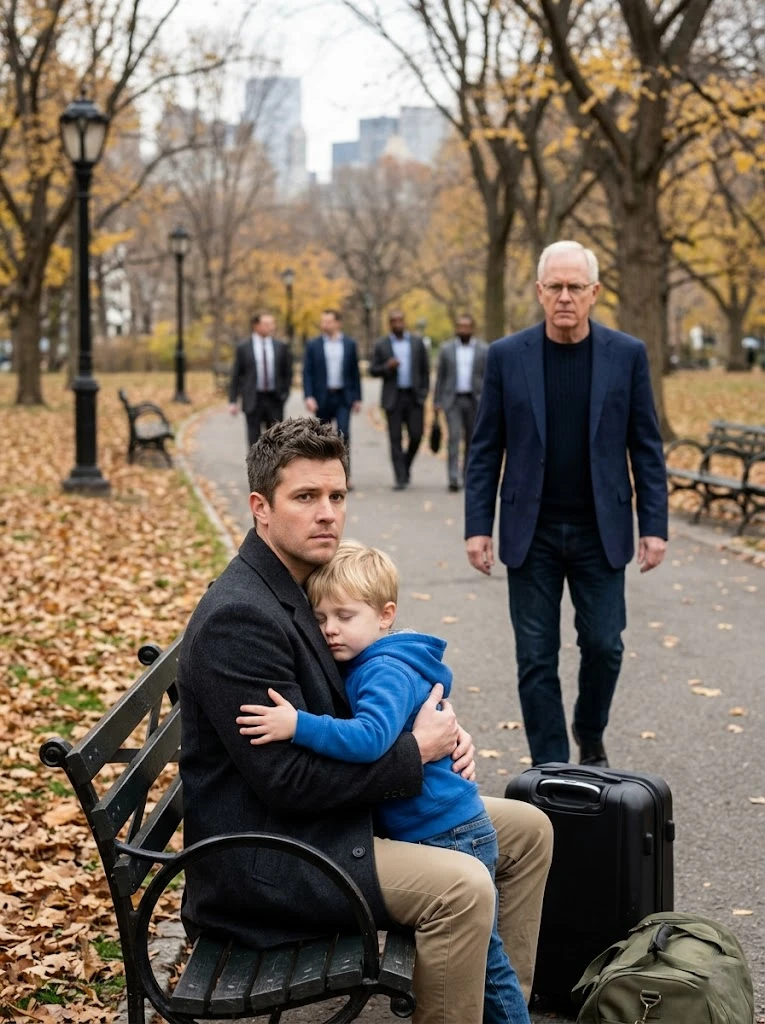
On the ballroom floor, Charles’s composure remained mostly intact, but I could see the first cracks. A stiffness at the jaw. The smile that arrives half a second late. Victoria, meanwhile, was checking her own phone with increasingly controlled movements. She knew something was wrong. People like her can smell instability the way horses smell weather.
I straightened my cuff and waited.
At seven twenty-five, the master of ceremonies stepped onto the stage.
The room settled.
At seven twenty-eight, Charles’s phone buzzed again. He looked at it and went pale.
I didn’t need to see the screen to know the content. One of his private banks would have informed him that facilities were under review due to creditor action. Another would have flagged a compliance hold. The mortgage officer likely would have left a message urgent enough to make his throat dry.
Victoria leaned toward him. He showed her the screen. Her hand flew to her mouth.
Beautiful.
At seven thirty, the speech began. Applause. Introductory praise. A slideshow of charitable initiatives no doubt funded more by tax strategy than compassion. Charles’s name echoed through the ballroom in reverent tones.
He rose and walked toward the stage.
I felt, not triumph, but a hard settling certainty. The moment had become unavoidable. That is one of the few reliable pleasures in life: watching inevitability arrive on time.
Charles took the podium.
He smiled.
“Thank you,” he began, voice smooth enough to convince a stranger. “It is an honor—”
The giant screen behind him changed.
At first the audience thought it was part of the program. A transition. A video tribute.
Then Victoria’s recorded voice rang through the ballroom.
“The older man will cave. He always does when it’s about family.”
Charles froze.
On the screen appeared a message thread. Victoria and Charles. Cleanly enlarged. Time-stamped.
What if Nathan fights?
Then we break him before he understands the game.
The ballroom shifted, a ripple of confusion moving through three hundred well-dressed bodies.
Another clip began.
Charles’s voice this time.
“Keep pressure on him. Once the loans trigger, he’ll be too busy drowning to contest custody.”
A sharp intake of breath moved through the room.
Phones appeared. Quietly at first, then openly. Wealthy people pretend to disdain scandal while recording it from optimal angles.
Charles turned toward the screen in horror. “What is this?”
The answer came in the form of documents. Loan applications. Signature comparisons. Transfer orders. The false police report. Still images from the hidden-camera footage. Then the extortion draft Victoria had placed in front of me at lunch, highlighted where it mattered.
FRAUD.
FORGERY.
EXTORTION.
Each word stamped across the screen in severe red.
The master of ceremonies backed away from the podium so quickly he nearly tripped.
Victoria stood up in the front row.
“This is fake!” she shouted.
Excellent. Public panic rarely helps the innocent or the guilty, but it does reveal which one you are.
I stepped out from the balcony into the light.
At first only a few heads turned. Then more. Then all of them.
The silence that followed was not absolute, but it was close enough to feel holy.
I descended the stairs slowly.
There are men who enjoy entrances. I am not one of them. But I understand their utility. If you are going to end someone’s world in public, you owe the moment enough shape that no one mistakes what happened for an accident.
I crossed the ballroom floor while the screen behind Charles continued feeding the room truth in expensive resolution.
His eyes found me halfway down the aisle.
Recognition hit him first.
Then understanding.
Then fear.
I mounted the stage and took the second microphone from its stand.
“Good evening,” I said.
No one moved.
“I apologize for interrupting your celebration,” I continued, “but I felt it was important that the award committee receive complete information before honoring a man for leadership.”
A nervous titter came from somewhere in the room and died almost instantly.
Charles found his voice. “This is slander.”
“No,” I said. “Slander requires falsehood. What you’re hearing is documentation.”
He looked around, searching for support. The crowd gave him what all social predators eventually earn: distance.
“You have no right,” he snapped.
I turned to face him fully. “I have every right. You’ve spent three years insulting my son inside a company I own.”
The words landed like dropped steel.
He stared at me.
The room stared at both of us.
I let the sentence breathe before continuing.
“Harrison Shipping Holdings,” I said, naming the entity no one there had ever connected to me, “acquired Hudson Freight three years ago through layered structures because the company required rescue capital and disciplined management.” I smiled without warmth. “You mistook your appointment for ownership.”
Victoria was white now, gripping the edge of her chair.
Charles licked his lips. “That’s absurd.”
“Is it?” I reached for the first folder Frank had placed beside the podium. “This is the ownership chain. Verified. Signed. Filed. Auditable.” I set it down. “This second folder contains notice of immediate internal review, pending criminal referral, regarding the fraudulent loans issued in Nathan Sullivan’s name.” I placed another beside it. “The third holds preliminary evidence packages already delivered to the Manhattan District Attorney, federal financial-crimes investigators, and two regulatory bodies with a strong interest in forged port-related collateral.”
A murmur spread through the ballroom like a fuse.
“You tried to destroy my son,” I said. “You used your daughter, your board position, and the manners of your class as camouflage.” My voice remained calm; calm is always more frightening than shouting when the facts are on your side. “You believed civility would protect you while you laid traps for a man you considered beneath you.”
Charles’s face was no longer pale. It had gone a strange mottled gray.
Victoria rose and took a step toward the stage. Frank appeared as if conjured, intercepting her with a politeness so complete it was almost obscene.
“Ma’am,” he said, “I wouldn’t.”
She recoiled as if slapped.
Charles grabbed the microphone stand. “You don’t understand what you’re doing.”
I looked at him for a second and felt the old anger pass through me without owning me. Strange thing about revenge: people imagine it’s hot. The good kind is cold enough to preserve evidence.
“No,” I said. “You don’t understand what you’ve already done.”
I gestured to the screen.
More documents appeared. The attempted collateralization of my shipping license. The scheduled Cayman transfer. The audio from Christie’s with Anthony Russo discussing stolen vehicles moving through Port Newark.
At that, the room truly changed. Financial impropriety can still be rationalized among the rich as an unfortunate complexity. Cargo theft tied to organized crime has a different odor.
A woman in diamonds covered her mouth.
A hedge-fund manager I recognized took two careful steps away from a banker standing too close to Charles’s wife.
The award committee chair, who had once spent forty-five minutes lecturing me about ethical legacy during a fundraiser, sank into his seat like a man wishing furniture could become a grave.
Charles tried to speak again, but this time his voice broke.
“This is a misunderstanding.”
I shook my head.
“No. A misunderstanding is believing the tide is coming in at noon when it comes at ten. This is exposure.”
He swayed slightly.
For a flicker of a second, I saw not a monster, not even a villain, but simply an old man realizing the story he had told himself about his permanence was over.
Then I remembered Nathan on a park bench.
I remembered Mason asking if I could fix this.
Compassion retreated.
“You told my son your blood didn’t belong with people like us,” I said into the microphone, and now the ballroom held absolutely still. “Let me explain something you should have learned before tonight. Blood means very little to me. The docks taught me that. Storms taught me that. Markets taught me that. Character matters. Loyalty matters. Whether a man protects the weak when it costs him something matters. Everything else is upholstery.”
No one breathed.
“You are not powerful because your grandfather joined the right club in 1954. You are powerful only for as long as reality agrees to cooperate with your performance.”
I stepped closer to him.
“And reality has withdrawn its support.”
He collapsed then.
Not theatrically. No clutching his chest, no operatic stumble. Just a visible loss of structure. His knees gave and he folded sideways onto the polished stage floor, one hand still brushing the podium as if he could hold on to furniture when reputation failed him.
Gasps moved through the room.
Victoria screamed, “Dad!”
She surged forward again and Frank stopped her again, this time with two uniformed security men at his side.
“Please remain where you are,” one of them said.
“This is illegal!”
“No,” Frank replied mildly. “What your family did is illegal.”
I handed the microphone back to the speechless master of ceremonies, who accepted it as though I had passed him a live animal.
Then I turned and walked offstage.
Halfway down the aisle, the ballroom doors opened.
Two detectives from the NYPD Financial Crimes Task Force entered with federal agents behind them. Their timing was exact, which pleased me. There are few things as satisfying as choreography in service of consequence.
One of the detectives approached the stage and identified himself.
Charles, still on the floor, looked up with blank eyes as he was informed of the charges pending and the need to come with them immediately.
Victoria began crying in great bright animal sounds.
No one comforted her.
That, I think, may have hurt her more than the legal reality beginning to close in. Women like Victoria grow up believing the room will always bend itself around their distress. But distress without status is merely noise.
I reached the lobby before Nathan joined me.
He had been waiting just beyond the ballroom doors, at my request. I did not want him inside for the spectacle. Exposure is useful; reliving humiliation in front of three hundred strangers is not.
He looked at my face and understood enough.
“It’s done?” he asked.
“Yes.”
“Was it ugly?”
“Very.”
He nodded once.
“Good,” he said.
Outside, the October air met us like cold water. Fifth Avenue gleamed with traffic and reflected light. Tourists moved past the hotel entrance unaware that an empire of veneers had just split open a few feet behind them.
Nathan stood beside me with his hands in his coat pockets and stared up at the night.
“I thought I would feel better,” he said after a moment.
“And?”
“I feel…” He searched for it. “Not empty. Not satisfied. Just tired. Like something I’d been bracing against for years finally hit the ground, and now my body doesn’t know how to stand without the impact.”
“That’s normal.”
He laughed a little. “You say that like you’ve done this before.”
I looked at the moving lights of the city. “Not exactly this.”
Then I put a hand on his shoulder.
“But I know what it is to survive a war and be disappointed that peace isn’t louder.”
He turned to me.
For a second we just stood there, father and son in the wash of hotel light and city noise, connected not by power or inheritance or any of the other things people mistake for family, but by the simple fact of having come through something together.
He said, very quietly, “Thank you.”
I nodded.
We went home.
The aftermath was slower, messier, and more human than the spectacle.
That is another thing people get wrong about justice. They imagine a climax and then a clean moral horizon. In reality, consequences arrive in installments. Paperwork. Depositions. Statements. Quiet panic behind closed doors. Shame that settles into bones more deeply at breakfast than at midnight.
Charles Pennington was not handcuffed in front of cameras the way the tabloids later implied, but he was escorted out under warrant authority and processed before sunrise. The charges evolved as investigators dug. Financial fraud. Identity theft. Conspiracy. Forgery. Exposure tied to stolen cargo channels. Enough to keep his attorneys awake and his old friends newly unreachable.
The first twenty-four hours after public disgrace are when social ecosystems reveal their true architecture.
Board members resigned with tender regret and sharp legal counsel. Charity committees removed his name from event materials citing administrative review. Clubs where he had spent forty years perfecting the art of selective contempt suddenly discovered bylaws on reputational risk. Men who had once repeated his jokes now returned his calls through assistants who sounded professionally appalled.
He had spent a lifetime believing access was solid. He learned instead that elite society is merely a prettier version of the docks: everyone scatters fastest when they smell liability.
Victoria was not arrested that night. Her path into consequence ran through a different corridor. Civil exposure first. Then cooperation pressures. Then the slow collapse of every surface that had once supported her identity.
She called me twice in the week that followed.
I did not answer.
She left one voicemail, voice trembling.
“You don’t understand,” she said. “He controlled everything. I was trying to survive.”
Maybe part of that was even true. Many damaged people become willing accomplices long before they become independent architects. But survival is not a blanket defense when you start using children as leverage and men as bait.
Nathan listened to the message once and deleted it.
“She always says controlled,” he murmured afterward. “Never chose.”
That sentence stayed with me.
The custody matter, which I had dreaded most for Mason’s sake, resolved faster than I expected once the evidentiary weight turned. Judges, contrary to popular myth, are not uniformly blind to class performance. The hidden-camera footage, the extortion pressure, and the documented financial conspiracy stripped much of Victoria’s credibility. Interim custody favored Nathan. Supervised contact for her. Evaluations. Restrictions. A long legal road, yes, but no abyss.
When Nathan walked out of the courthouse that first day with temporary primary custody papers in his hand, he did not smile. He sat in the back seat of the car and cried so quietly I almost pretended not to notice.
Almost.
I handed him a handkerchief and looked straight ahead.
“Use that,” I said. “I’m too old to witness performative toughness.”
He took it, laughed through tears, and shook his head.
“I hate that you make good one-liners at times like this.”
“It’s a gift.”
Mason adapted in the strange resilient way children do when love stays present enough to bridge change. He asked difficult questions in simple language.
“Why can’t Mommy come here?”
“Because grown-ups are figuring things out.”
“Did Daddy do something bad?”
“No.”
“Did Mommy?”
A child’s eyes on your face while you answer that is a courtroom of its own.
“Mommy made some very poor choices,” I told him carefully. “And poor choices have consequences.”
He absorbed this while chewing an apple slice.
“Like when I color on the wall?”
“Yes.”
He considered it. “Is her consequence bigger?”
“Yes.”
“Because she’s a grown-up.”
“Exactly.”
He nodded, apparently satisfied by the internal elegance of justice measured according to wall-coloring plus adulthood.
Nathan moved into the east wing with Mason “temporarily,” which in wealthy households is a word that can mean anything from three days to permanent rearrangement. I had not shared this house properly with family in years. Its routines bent around us. Breakfast became noisier. Toys appeared under chairs. Crayon drawings began turning up propped against silver frames and tucked into ledges where no decorator would ever have allowed them.
I found one on my desk three weeks after Bryant Park.
It showed three figures in stick form. One tall. One medium. One small. All holding hands beside what was either a house or an unusually optimistic boat.
At the top, in violent red marker, Mason had written with help: OUR TEAM.
I stared at that drawing for a long time.
Then I put it in a frame.
Nathan returned to Hudson Freight sooner than many advised.
“You should take time,” his lawyer told him.
“For what?” Nathan asked.
“To recover.”
Nathan looked at him with a calm I had come to admire. “I’ll recover faster if I stop letting other men sit in my chair.”
So back he went.
The first day he entered the headquarters again, I stayed in the observation room above the board level, watching through tinted glass like the meddling god I had spent three years pretending not to be.
Staff went still when he walked in.
He was wearing a charcoal suit, a plain navy tie, no wedding ring, and the face of a man who had learned exactly how much he had survived.
No flourish. No theatrical revenge. He simply called the leadership team into the conference room and took his seat at the head of the table.
“I’m going to be concise,” he said.
No one interrupted.
“The company was used as cover for fraud, theft, and deliberate sabotage. That ends now. Anyone who participated should resign before noon. Anyone who thinks loyalty to Charles Pennington buys silence will discover quickly that I am not him.”
He slid three envelopes across the table.
“Purchasing, legal operations, and vendor compliance are under immediate outside audit. If your name appears where it shouldn’t, you will not enjoy the next phase.”
One of the senior managers, a man named Keller who had spent years laughing too hard at Charles’s jokes, cleared his throat. “Nathan, I’m sure we all want transparency, but this tone—”
Nathan turned to him. “Pack your office.”
Keller blinked. “Excuse me?”
“You took personal payments from Atlantic Equipment and approved inflated invoices during two quarters when the company was being positioned for internal damage.” Nathan tapped one of the folders. “The supporting records are already with counsel. Security will walk you out in ten minutes.”
Keller went gray.
No one else spoke.
I watched from above with my hands in my pockets and something dangerously close to pride pressing at the inside of my ribs.
This was not hardness.
This was strength.
He was not cruel. That was the key difference. Cruel men enjoy domination. Strong men restore order.
By the end of that week, Hudson Freight felt like a company waking from sedation. Processes tightened. External auditors crawled through the books. Vendor channels were cleaned. Five employees resigned. Two were escorted out. One tried to threaten a wrongful termination suit and discovered quickly that the company now belonged to someone who knew where every receipt slept.
Nathan worked twelve-hour days and still came home in time to read to Mason.
That was the part that impressed me most.
At six thirty each evening, no matter how ugly the day had been, he walked through the front door, loosened his tie, scooped up his son, and disappeared for an hour into the small universe of bedtime. Dinosaur books. Baths. Pajamas. Questions about whether sharks sleep and if grandpas get time-outs and why the moon follows the car. Ordinary things. Sacred things.
One night I passed Mason’s room and heard Nathan reading in voices so ridiculous I had to stop in the hall to smile.
After a moment, I knocked softly on the open doorframe.
Mason saw me first. “Grandpa! We’re at the volcano part.”
“Are you now?”
Nathan looked over his shoulder. “He’s requested my worst dramatic performance.”
“Then you were born for it.”
Mason bounced on the bed. “Come sit!”
I hesitated.
I am ashamed, even now, to admit that it took me a second to step into a child’s room in my own house as though I were the visitor.
Nathan saw the hesitation. So did I.
Then he moved over and made space.
I sat.
Mason shoved the book into my hands and commanded, “You be the bad dinosaur.”
So I did.
My bad-dinosaur voice was apparently magnificent because Mason laughed so hard he snorted and Nathan had to turn away to hide his own laughter.
It was a tiny thing. Ten minutes. Fifteen at most.
But afterward, when I went back to my study, the room felt different.
All my life I had thought legacy was a structure you built and then invited your descendants to inherit. Company shares. Property trusts. Tax-efficient vehicles. Governance frameworks.
Sitting on that child’s carpet making a fool of myself as a volcano dinosaur, I realized legacy might be far less architectural and far more embarrassingly simple.
Maybe legacy is the set of rooms your children feel welcome entering without permission.
Charles went to trial months later.
By then his face had thinned and aged in ways expensive skincare never anticipates. He still wore tailored suits. Men like him cling to tailoring as though it can discipline reality. But the sheen had gone. He looked like a version of himself printed on poorer paper.
I attended only part of the proceedings. Not out of squeamishness. Out of practicality. Trials are engines of tedium interrupted by occasional meaning. I had the evidence I cared about. The rest belonged to prosecutors and procedure.
Nathan testified once.
He prepared meticulously. I offered help. He refused with a small smile.
“I know,” he said. “You own the air everyone breathes. But I can do this.”
So I sat in the gallery and watched my son answer questions with devastating calm.
Yes, that was his signature used without permission.
Yes, those were hidden recordings from his home.
Yes, his wife had pressured him regarding custody.
Yes, his father-in-law had made repeated remarks about blood, class, breeding, and belonging.
When defense counsel tried to imply that Nathan had been overreactive because of insecurity around elite social settings, he did something I will remember until I die.
He smiled.
Not bitterly. Not angrily. Simply with the ease of a man who had stopped granting authority to the wrong standards.
“I’m insecure around incompetence dressed as pedigree,” he said. “That may have created some confusion.”
Even the judge had to hide a reaction.
Victoria never fully became a sympathetic witness, no matter how her attorneys polished the narrative. The problem with using fear as retroactive defense is that recordings exist, and recordings are rude. Her own voice undercut her too often. Her cooperation spared her incarceration, but not consequence. She lost access to trust distributions, forfeited assets tied to the schemes, and spent a long season in a world where no one cared who her father had once been.
I saw her exactly one more time.
It was outside a courthouse annex on a rainy afternoon. She was standing under an awning in a coat that had once been exquisite and now looked merely expensive. No driver. No assistant. No buffer. Just a woman with wet hair and a face stripped of its old certainty.
She saw me and stepped forward.
“For what it’s worth,” she said, “I did love him once.”
Rain hissed off the curb between us.
I studied her.
“For what it’s worth,” I replied, “once was not enough.”
Then I got into the car.
Winter came.
The first snow that year fell early, soft and theatrical across the Bedford grounds. Mason lost his mind with joy. Nathan, despite carrying a company on his shoulders, went outside in boots and gloves and built a lopsided snow fort under my grandson’s uncompromising supervision.
Mrs. Alvarez made cocoa. I stood at the window in my study and watched them until Mason spotted me and began pounding on the glass from outside.
“Grandpa! Come be the monster!”
I pointed at myself. “In this coat?”
He nodded violently.
So I went.
The snow was colder than I remembered from younger years, or perhaps my bones had become more honest. Mason decreed that I was the ice giant trying to destroy the kingdom. Nathan handed me a crooked branch and informed me this was my staff of doom.
“Seems underfunded,” I muttered.
“Budget cuts,” he said.
We spent an hour in the snow while the sky darkened and the fort collapsed twice and was rebuilt three times. Mason declared victory over me with the absolute tyranny children bring to games. By the time we went inside, my knees hurt, my ears were numb, and I had not felt so unguarded in decades.
That night, after Mason fell asleep on the couch halfway through a holiday cartoon, Nathan carried him upstairs and came back down alone.
He found me in the kitchen, of all places, making terrible tea because I didn’t want whiskey and didn’t trust sleep.
“You’ve changed,” he said.
I looked at the kettle. “That obvious?”
“You made tea.”
“That is not evidence of personal growth. It may just be confusion.”
He smiled and leaned against the counter.
After a moment he said, “You know, when I was a kid, I used to think you loved the company more than me.”
I waited.
Then he surprised me again.
“I don’t think that anymore.”
The kettle clicked softly as it cooled.
“What do you think now?” I asked.
“I think you were a man who knew how to win in one arena and got lost trying to bring the same skills home.”
I looked at him.
He shrugged. “I’m not saying that to excuse it. Some of it hurt. A lot. But I get it better now. Running Hudson these past months, trying to be there for Mason at the same time… I understand something I didn’t before. Work gives you scoreboards. Family gives you mirrors.”
I said nothing.
He pushed on.
“It’s easier to stay where the numbers move.”
The tea steamed between us.
“That may be the wisest thing you’ve ever said in my kitchen,” I replied.
He laughed. Then the laughter faded and he grew serious.
“I used to resent you for letting Charles treat me that way,” he admitted. “Even before I knew what he was really doing. Part of me thought, if Dad cared enough, he’d end it. If he were really paying attention, he’d see what this does to me.”
My fingers tightened around the mug.
“I know.”
“But if you’d stepped in too soon,” he said, “I probably would have hated you for that too.”
“That,” I said dryly, “sounds like my son.”
He nodded. “I needed to find out what I was made of. I just wish it hadn’t cost Mason so much uncertainty.”
I looked toward the ceiling as if I could see the sleeping child above us.
“He seems all right,” I said.
“He does.” Nathan’s voice softened. “Because he had you when it mattered.”
I almost corrected him. Almost told him I should have been there long before “when it mattered” arrived with enough drama to make itself undeniable.
But perhaps this is one of the quieter forms of grace available to men like me: not absolution, but another chance to participate while time remains.
Spring arrived with mud, daffodils, and the slow administrative closure of legal matters.
Charles took a plea when the weight became unsustainable. Pride survives many things, but prison calculations tend to sober it. He did not confess in the grand moral sense. Men like him rarely do. He admitted enough to reduce exposure and preserve whatever fantasy of self could still be housed inside the language of legal compromise.
He would not die in prison.
Neither would he return to the world as he had known it.
That seemed proportionate.
Victoria moved into a small rental in Queens and began the difficult work of becoming a person without servants, curated settings, or inherited momentum. I was told by someone who monitors such things for me that she sold jewelry discreetly, then less discreetly. I do not know whether she learned anything. Suffering does not guarantee reflection. Sometimes it simply teaches resentment new vocabulary.
Nathan, meanwhile, grew into the company the way some men grow into weathered leather—under pressure, with use, more comfortably than anyone expected.
By summer Hudson Freight had stabilized beyond forecast. One hundred and twenty million in contracts retained, two new port agreements signed, internal compliance strengthened, reputational damage contained. Investors who had circled warily returned. Employees began saying “Mr. Sullivan” with something approaching respect rather than reflexive calculation.
He came to my office one Friday afternoon carrying a quarterly report and set it on my desk.
“I know you’ve seen the numbers,” he said.
“Of course.”
“But I wanted to bring them myself.”
I opened the report though I already knew every line.
Strong. Cleaner than before. Honest.
“I’m proud of you,” I said.
He glanced away, almost embarrassed.
Then he said, “You should be. You built one company. I had to rebuild two.”
I stared at him.
His face broke into a grin.
I laughed harder than I had in months.
That evening we grilled on the terrace while Mason chased fireflies with an enthusiasm that made actual capture secondary to the holiness of pursuit. The sky deepened. The lawn smelled of cut grass and charcoal. Somewhere in the trees a late bird kept insisting on its own importance.
Mason ran up holding a jar with exactly one blinking captive star inside.
“Look!”
I crouched. “Very impressive.”
“Can I keep him?”
“No.”
“Why?”
“Because some beautiful things stop being beautiful when you trap them.”
He thought about that seriously, then opened the jar.
The firefly drifted out and vanished into the dusk.
Nathan looked at me over the grill.
“That was annoyingly profound.”
“I’m full of surprises.”
He snorted. “At your age?”
“At my age especially.”
Later, after Mason was asleep and the house had settled into the old soft noises of summer night, I walked alone down the path behind the garden and stood for a long time where the property sloped toward the trees.
I thought about money.
Men pretend not to worship it when they’ve had enough of it for too long. I have no patience for that hypocrisy. Money matters. It buys safety, treatment, time, options, privacy, leverage, and distance from a thousand vulgar humiliations. It can rescue. It can shield. It can also rot the instincts of those who mistake its presence for proof of virtue.
Charles worshipped money as lineage sanctified.
I worshipped it as a tool sharpened by labor.
Both positions contained their own blindness.
Because the thing money cannot do, no matter how much of it sits obediently under your signature, is force your children to feel held.
That requires something far more difficult.
Attention.
Attention is expensive in ways balance sheets can’t measure. It costs ego. It costs habit. It costs the soothing fiction that you are too important to be interrupted by small voices asking if you can come outside, read one more page, look at this drawing, watch this throw, answer this fear.
I had spent decades giving my attention where returns were obvious.
A market rewards presence quickly.
A child does not. A child asks and asks and asks, and half the time the thing they want is absurd or repetitive or badly timed. It feels inefficient. Until one day they stop asking. And by then you’ve trained them beautifully for adulthood among conditional people.
I wish I had learned that sooner.
But regret, if used properly, can become instruction instead of merely punishment.
By the time autumn returned, almost a full year after Bryant Park, the bench had become more than a memory. It had become a private landmark in my mind. The place where one life ended and another, if not began, then at least turned in the right direction.
So one bright Saturday I told Nathan I needed the city.
“For business?” he asked.
“No.”
He studied me a moment. “You want company?”
There are old versions of myself that would have lied out of reflex. I am grateful that man has been dying slowly.
“Yes,” I said.
So we went together.
Bryant Park in October has a particular kind of beauty, one sharpened by the surrounding severity of Midtown. The leaves fall against glass towers. Children run where bankers cut through between meetings. The city reveals, just for a few weeks, that even it cannot fully suppress season.
We found the bench.
Not the same one exactly. That one was occupied by two tourists and a stroller full of shopping bags. But near enough. Mason ran toward the lawn with a rubber ball under one arm, calling that he was going to practice “big throws.”
Nathan sat beside me.
For a while we said nothing.
The park moved around us. Chess players leaned over their games. A busker tuned a guitar near the fountain. Office workers carried lunch in careful biodegradable bowls as though sustainability could be consumed between calls.
“I hate this place a little,” Nathan admitted.
“Understandable.”
“But I’m glad we came.”
I nodded.
“I keep thinking,” he said after a minute, “about how fast a life can be rearranged. One afternoon. One conversation. One bench.”
“Yes.”
“And how long it took to understand what that afternoon really meant.”
I looked at him. “What do you think it meant?”
He watched Mason winding up far too hard before hurling the ball in a direction only loosely related to aim.
“I think,” Nathan said slowly, “it was the first day I stopped waiting for other people to tell me who I was.”
Children laughed somewhere behind us.
The city breathed.
“That’s worth a bench,” I said.
He smiled.
Mason ran back over. “Did you see that?”
“I saw something,” Nathan said.
“It was a fastball.”
“Was it.”
“Grandpa said I’m powerful.”
I raised an eyebrow. “Did I?”
“You should,” Mason said, as if correcting an administrative oversight.
So I did. “You’re powerful.”
He beamed.
Then he tugged my sleeve. “Come throw with me.”
I stood.
My knees protested. I ignored them.
We walked out onto the grass together, Nathan beside me, Mason between us, the ball warm from his hands.
I showed him how to place his fingers on the seams. Nathan demonstrated how to step into the throw. Mason listened with the grave concentration children reserve for tasks they regard as central to civilization. Then he launched the ball and it arced wildly off target and we all laughed.
We threw until the light softened.
At one point Mason missed badly and the ball rolled toward a stranger’s shoes. The man picked it up, smiled, and tossed it back. An ordinary kindness. Brief. Unremarkable. Somehow it moved me more than I expected.
Maybe because ordinary kindness is what the grand dramas are supposed to protect.
Not prestige. Not victory speeches. Not the satisfaction of seeing a rival kneel. Those things are intoxicants at best and ash by morning. No. The point of fighting, if you must fight at all, is to preserve the small safe ordinary moments where love can behave without fear.
A child with a baseball.
A father laughing.
A grandfather staying long enough to see the throw.
When the sun dropped lower, we sat again on the bench with coffee and juice boxes and the kind of peaceful fatigue that follows honest play.
Mason leaned against me and announced, “This is our spot now.”
Nathan looked at me.
I thought about everything that bench had held. Humiliation. Rage. Revelation. Decision. The sight of my son reduced in public and my grandson trying to make sense of adult cruelty with shoes that lit up when he ran.
Then I looked at the present. The same city. The same season. The same people, remade by survival.
“Yes,” I said. “It is.”
Mason sipped his juice and kicked his feet.
“Grandpa?”
“Yes?”
“Are you still fixing things?”
I glanced at Nathan.
Then I looked down at the boy.
“No,” I said. “Now I’m learning how to keep them.”
He seemed to accept that.
Children are merciful. They do not require polished philosophies. They only want enough truth to feel where the floor is.
On the drive home, Mason fell asleep in the back seat, his head tipped against the window, one hand still curled around the baseball. Nathan sat in the front beside me because he does that now sometimes, choosing the seat near me rather than disappearing into privacy. I do not make a ceremony of it. Some gifts lose texture when named too loudly.
The traffic eased as we headed north.
Streetlights came on.
For a while the only sound was the road.
Then Nathan said, “Do you ever think about calling him?”
I knew who he meant.
Charles.
I kept my eyes on the highway. “No.”
“Never?”
“Not productively.”
Nathan folded his hands in his lap. “I had a dream about him last week. Nothing dramatic. We were just sitting at that long dining table in Greenwich. He was carving meat, correcting my posture, talking about institutions. Same as always. Then in the dream I realized he couldn’t actually see me. Not because he was refusing to. Because he literally couldn’t.” Nathan turned toward the dark windshield. “It was like talking to a blind man who thought he was an art critic.”
I considered that.
“That sounds right,” I said.
He nodded.
“I’m glad he’s gone from our lives.”
“So am I.”
After another silence, he asked, “Do you think people like that ever understand what they’ve done?”
“No.”
“Why?”
“Because understanding requires humility, and humility feels to them like annihilation.”
He let that sit.
Then he said, “That’s bleak.”
“It’s efficient.”
He laughed softly.
When we reached home, Mrs. Alvarez met us at the door, took one look at the sleeping child, and shooed us all toward food as if hunger were a moral failure. Nathan carried Mason upstairs. I went to my study, then stopped halfway down the corridor.
The door was open.
On the corner of my desk sat another drawing.
This one showed three figures again, but with a fourth in a strange blue blob that I eventually realized was probably Mrs. Alvarez. Above them, in uncertain letters, Mason had written: FAMILY IS PEOPLE WHO STAY.
I stood there in the doorway and felt, quite unexpectedly, my eyes sting.
No one saw. That is not the point. The point is that it happened at all.
I framed that drawing too.
Years from now, perhaps after I’m gone, Nathan may sort through my things and find those frames among the brass and paper and maritime relics. He may smile. He may cry. He may be irritated that I left too many old contracts in the wrong drawers and too many cuff links without mates.
If that day comes, I hope he understands something.
I hope he understands that I did love him, even when I loved him clumsily, even when I offered him structures instead of shelter, even when I mistook silence for respect and distance for strength.
I hope he knows that men can fail their children badly and still choose, while time remains, to become less dangerous to love.
And I hope Mason grows up never once doubting that he belongs wherever our name is spoken, not because blood is sacred, but because he was cherished there.
That is the legacy I was too foolish to build first and wise enough, finally, to recognize.
If I have any authority left after all these years of money and ships and strategy and storms, it is this:
Do not wait for a park bench.
Do not wait for the day your child sits in public with everything he owns beside him before deciding that your attention belongs at home.
Do not confuse provision with presence. Do not imagine character develops best when starved of tenderness. Do not send the people you love into wolves’ dens to prove they can stand alone. The world will test them soon enough without your assistance.
Show up.
Show up when the game is boring and the recital is too long and the school ceremony interrupts a good workday. Show up when your teenager pretends not to care whether you’re there. Show up when your grown child says they don’t need help and what they really mean is they don’t want pity. Show up before the collapse, not merely after it. Especially then.
Justice matters. I will never pretend otherwise. The world is full of elegant predators who count on decent people mistaking passivity for nobility. If someone threatens your family, answer. If someone tries to destroy your child, stop them. If someone uses class or money or institutional polish as cover for cruelty, tear the cover off.
But once the fight is over, remember what the fight was for.
Not dominance.
Not spectacle.
Not even the satisfaction of seeing the guilty brought low, though I confess there is a certain stern beauty in that.
No. Fight so that a child can laugh without glancing over his shoulder. Fight so that a father can sleep without fear of losing his son to a manufactured lie. Fight so that a family can sit at dinner without the room feeling borrowed from people who despise them. Fight so that ordinary tenderness may continue unmolested.
That is worth more than any award Charles Pennington ever stood beneath.
That is worth more than eight hundred million in annual revenue, more than summer houses and trust structures and the flattering obedience of bankers.
That is worth, if necessary, bringing down the whole ballroom.
Tonight Mason is asleep upstairs. Nathan is finishing tomorrow’s numbers because the company still needs him and likely always will. Mrs. Alvarez is humming somewhere in the kitchen. The house is alive in the modest ways that matter most. A lamp left on. A hallway runner slightly crooked because small feet have been charging down it all week. One baseball on the console table where it does not belong and where I intend to leave it.
I am an old man now by any honest standard.
I know how markets move, how fear enters debt, how reputation can be dismantled in under an hour if the documents are clean enough.
More importantly, I now know this:
A strong man is not the one who wins every room.
A strong man is the one whose children can still walk into his study without knocking.
And tomorrow morning, when Mason bursts through that door to ask whether I’m too busy to practice throws before breakfast, I already know my answer.