The screen flickered on. The tablet’s battery was low, but it was alive.
I opened the audio app. One file, time-stamped just a week ago, sat at the top: “DINOTAPE_3”
With trembling fingers, I hit play.
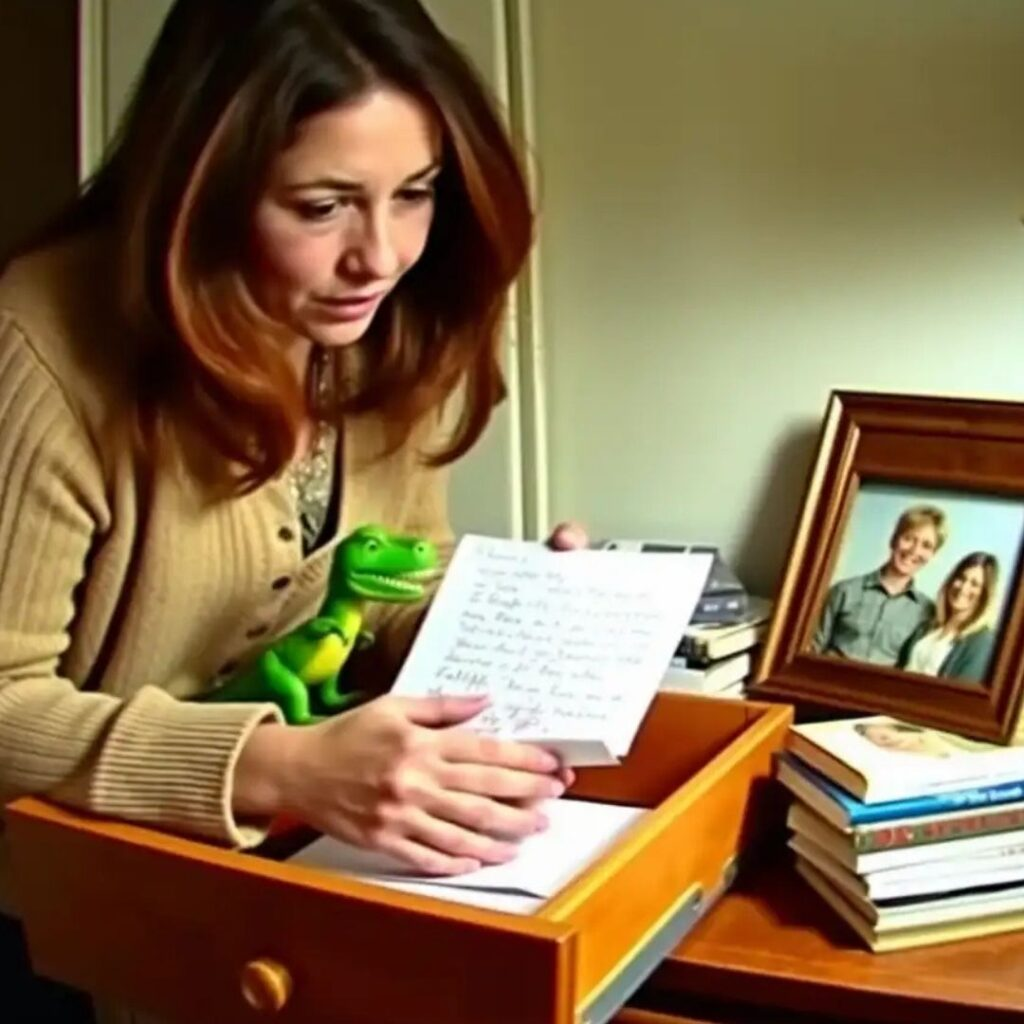
At first, just static. Then, Caleb’s small voice: “It’s recording… okay…”
There was a shuffling sound. Then voices—two men, speaking low.
The first voice I recognized immediately: Mark.
“She’s got no clue. Hell, she even thanked me for helping while Caleb’s been sick.”
The second voice—smooth, clinical. Dr. Reynolds. “We keep the doses subtle. Too much attention and we lose control. Just enough to keep the kid weak. He was getting suspicious. He’s smart.”
“He’s a damn kid,” Mark muttered. “He won’t last much longer anyway.”
“I’m monitoring him closely. When it happens, it’ll look like natural complications. No flags.”
There was a pause.
Then Reynolds added, coldly: “We’re almost done. Once she signs the insurance papers, it’s over.”
I dropped the tablet.
Insurance papers.
A week ago, I had signed an update to Caleb’s life insurance through the hospital. Dr. Reynolds had brought the documents, explained it was routine.
And Mark…
Mark had insisted I take extra shifts at work. “He’s family,” he said. “Let me take care of Caleb.”
I thought it was kindness.
My stomach turned.
I stared at the device on the floor. My son had recorded them. He’d been watching, listening. Dying slowly, terrified, but still trying to protect me.
And they thought he didn’t matter.
I called the police.
But as the line rang, I stopped.
What if they were already listening?
Mark had keys to my house. He stayed here. Ate here.
I hung up.
Instead, I drove. Straight to the local precinct. In person.
I played the audio. Gave them Caleb’s letter. Gave them the tablet. The officer’s face turned stone-cold the moment he heard the words “adjusted the dosage.”
They asked me if I felt safe.
“No,” I said. “Not anymore.”
Within hours, a warrant was issued.
But when they arrived at Mark’s apartment, he was gone.
And Dr. Reynolds?
Arrested at his clinic before his shift started.
The funeral was quiet. Just me, a few friends, and the detective who handled the case.
Caleb’s favorite toy dinosaur sat on his casket.
The media would eventually catch wind of it. “Local pediatrician and family member conspired in slow poisoning of child for insurance money.” But I didn’t care what headlines they wrote.
Because my son was gone.
And justice didn’t bring him back.
The investigation confirmed what I feared. Mark had gambling debts. Big ones. He’d approached Dr. Reynolds about “a solution.” Reynolds had a history—malpractice settlements buried under legal hush. They saw my son as leverage. A number. A policy payout.
But they didn’t see him.
They didn’t see the sharp boy who loved dinosaurs, who read books beyond his age, who saw more than anyone knew.
He caught them.
And he paid for it.
I moved out of the house. I couldn’t stay in the room where he recorded his last words. I kept the tablet, though. I backed it up. I listen to that last message sometimes—not the one of the men. The one at the end.
“I love you, Mom. I hope this helps. I’m not scared anymore.”
They never found Mark. He vanished. Maybe he fled the country. Maybe he changed his name. The police kept the case open, but I knew better.
People like him don’t stop. They just hide.
So I stopped waiting for closure.
Instead, I focused on honoring Caleb.
I helped write legislation in his name—Caleb’s Law—requiring stricter oversight of in-home care by medical professionals. I gave talks. I spoke at schools.
But some nights, when the house is quiet and the lights are off, I feel that cold air again. The moment Caleb said, “Please run away.”
I didn’t understand it then.
But now I do.
He wasn’t just warning me.
He was saving me.
The legal process moved with the cold, mechanical efficiency of a clock, but for me, time had frozen the moment I heard my son’s voice on that tablet. Dr. Reynolds was eventually sentenced to life without parole, his medical license stripped away in a courtroom filled with the families of other children he had “treated.” The insurance money—the blood money—was never paid out; instead, it became the foundation for a search that would consume my life.
Because while Reynolds was behind bars, Mark was still out there. And I knew that as long as my brother was free, Caleb’s mission wasn’t finished.
Part 2: The Silent Guardian
Two years passed. I lived in a state of permanent, quiet alertness. I had moved to a different city, changed my last name back to my maiden name, and worked as an advocate for child safety. My house was a fortress—cameras at every angle, reinforced locks, and a dog that barked at the slightest rustle of wind.
I thought I was hiding. I didn’t realize I was being hunted.
On the anniversary of Caleb’s passing, a small, brown envelope appeared on my doorstep. There was no stamp, no return address. Inside was a single polaroid photo.
It was a picture of me, taken from a distance, sitting on a park bench three days earlier. On the back, in handwriting I had known since childhood, were three words:
Insurance pays eventually.
My blood turned to ice. Mark wasn’t just hiding; he was waiting. He knew that if I died, the original policy—which was still tied to the estate—would theoretically default to him as the next of kin, or so he believed in his twisted, desperate mind.
I didn’t call the police this time. I knew from experience that “vague threats” and “stalking” were hard to prove with a single photo. Instead, I went back to the only person who truly knew the depths of this darkness.
I visited Dr. Reynolds in prison. He looked older, his clinical arrogance replaced by the gray pallor of the incarcerated.
“Where is he, Reynolds?” I asked, staring at him through the reinforced glass.
He chuckled, a dry, raspy sound. “Mark was always the weak link. He didn’t have the stomach for the science, only the greed. He’s in the ‘Lowlands,’ Sarah. That’s what he called the gambling dens near the border. But you didn’t come here for him. You came here because you’re still scared.”
“I’m not scared,” I lied. “I’m finishing what my son started.”
Reynolds leaned in, his eyes gleaming. “Caleb was a marvel. Even when I increased the sedative, his brain wouldn’t quiet down. Did you know he used to stare at me? Not crying. Just… watching. He knew he was dying, and he spent his last breaths making sure I’d end up here. If I were you, I’d watch the shadows. Mark isn’t smart, but he’s hungry.”
I knew Mark would come for me. He was broke, desperate, and convinced that I was the only thing standing between him and a payday.
I returned home and did something Caleb would have been proud of. I didn’t hide; I made myself a target. I purposefully left my kitchen light on. I sat in view of the window. And I waited.
At 3:00 AM, the back door clicked. Mark didn’t know I had replaced the old tumblers with a high-end silent alarm. He slipped into the kitchen, a shadow of the brother I once loved. He looked haggard, his clothes filthy, a knife glinting in the dim light of the stove clock.
“I just need the money, Sarah,” he whispered to the empty room, heading toward my bedroom. “It’s not personal. You’re just… the last hurdle.”
He stepped into the hallway, and that’s when I turned on the lights.
I wasn’t in the bedroom. I was standing at the end of the hall, holding the old tablet.
“Caleb is still watching you, Mark,” I said, my voice echoing in the small space.
Mark lunged, but he didn’t reach me. Two plainclothes officers, who had been stationed in the guest room for forty-eight hours, tackled him to the floor. As they cuffed him, the tablet in my hand began to play. It was the recording Caleb had made—the sound of Mark’s own voice conspiring to kill a child.
Mark screamed, a raw, jagged sound of defeat, as he was dragged out of the house.
A week after Mark’s arrest, I finally sat down to delete the files on the tablet. I wanted the darkness to be gone. But as I scrolled to the very end of the “DINOTAPE” folder, I found a hidden file I had never seen before. It was titled: “MOM_READ_LAST.mp3”
I hit play.
“Hi Mom. It’s me again. If you’re hearing this, it means the police did their job and you’re safe. I’m sorry I had to be a spy. It was kind of scary, but I pretended I was a secret agent on a mission to save the Queen. That’s you.”
I sobbed, clutching the tablet to my chest.
“Don’t stay sad forever, okay? When you look at the stars, find the one that looks like a Triceratops. That’s me. I’m not in pain anymore. I’m just waiting for the next mission. I love you, Mom. Mission accomplished.”
I didn’t sell the tablet. I kept it in the top drawer of my own desk, a reminder that courage doesn’t have a minimum age.
Mark and Reynolds are gone, buried in the legal system they tried to exploit. The insurance money was eventually released, and I used every penny of it to build “Caleb’s Haven”—a hospice for terminally ill children that focuses on advocacy and protection, ensuring no other child ever has to be a “secret agent” in their own home.
Every night, before I close my eyes, I look out the window. I find that one bright star, the one that stands a little apart from the rest.
I’m not running anymore.
I’m home. And my son is the reason why.
The move to the new house had been a necessity for my safety, but I had never fully let go of the old one. It stood empty for months, a silent monument to the life we had shared and the horror that had ended it. Before the final sale papers were signed, I knew I had to go back one last time. I told myself it was for a final sweep of the closets, but my heart knew better.
I was looking for Caleb. Not the ghost of him, but the physical proof that his love was stronger than the poison they had fed him.
The Loose Floorboard
I walked through the empty rooms, my footsteps echoing against the bare hardwood. The house felt smaller without furniture, stripped of its warmth. I ended up in his bedroom. The dinosaur posters were gone, leaving faint rectangular outlines on the faded blue paint.
I sat in the middle of the floor, right where his bed used to be. My hand brushed against the transition strip between the bedroom and the closet. It felt… loose.
Caleb had always been a “collector.” He hid smooth stones, shiny bottle caps, and secret drawings. I grabbed a flat-head screwdriver from my bag and gently pried at the edge of the wood. With a dry creak, the board lifted.
Tucked into the dusty space between the joists was a small, metal lunchbox—one with a faded picture of an astronaut on the front. My breath hitched. I hadn’t seen this since he was six.
I pulled it out and clicked the rusty latches open.
Inside wasn’t just “treasure.” It was a roadmap of his final months. There was a polaroid of the two of us at the zoo, the edges curled. There was a pressed wildflower I remembered him picking for me when he “tripped” in the backyard—though I now realized he had likely been dizzy from the medication.
But at the very bottom was a small, hand-drawn comic book made of stapled construction paper.
I flipped through the pages. The drawings were shaky, done with a hand that was losing its grip on the world, but the story was clear.
It featured a superhero named “Mighty Mom” and her sidekick, “Dino-Boy.” In the story, villains—drawn as shadowy figures with stethoscopes and dark glasses—tried to trap the Queen in a tower. Dino-Boy’s job wasn’t to fight them; he was too small for that. His job was to build a bridge so the Queen could escape.
On the very last page, there was a drawing of me flying away into a sky full of stars. Beneath it, in his careful, labored print, he had written:
I gave the Queen the map. She is going to the stars. I have to stay behind to guard the bridge, but I’m not lonely. I have my cape.
Beneath the comic book sat a small piece of fabric. It was a scrap of my old blue scarf—the one I thought I’d lost a year ago. He had kept a piece of me with him the whole time. It was his “cape.”
I held the fabric to my face. It didn’t smell like the hospital. It didn’t smell like chemicals. It smelled like home. Like the laundry detergent I used to use. Like the life we had before the “villains” arrived.
I realized then that Caleb hadn’t just died. He had completed a mission. He had stood at the bridge and held the line until I was across.
I put the lunchbox back together, but I kept the scrap of blue fabric and the comic book. I stood up and walked out of the room, and for the first time, I didn’t feel the need to look back. I didn’t need the house to remember him.
He wasn’t in the walls. He was in the “map” he gave me—the life I was now living.
Epilogue: The New Mission
I donated the house to a local non-profit that helps families in crisis. I told them I wanted it to be a place where “Queens and Kings” could find their way to the stars.
I kept the comic book framed on my desk at Caleb’s Haven. Whenever a parent comes to me, overwhelmed by the darkness they’ve discovered in their own lives, I show them the last page.
“He saved me,” I tell them. “And he’d want me to help you find your bridge, too.”
The beeping of the hospital monitors no longer haunts my dreams. Instead, I hear the rustle of construction paper and the whisper of a boy who was far more than a victim. He was a hero. And his story didn’t end in a drawer—it began there.