At a family dinner, I said, “I’m about to give birth.” My parents sneered, “Call a cab. We’re busy.” I drove myself to the ER in unbearable pain. A week later, my mom showed up at my door and said, “Let me see the baby.” I looked at her and replied, “What baby?”
“I’m about to give birth,” I gasped, clutching the edge of my parents’ dining table as another contraction tore through me.
My mother didn’t even rise. She lifted her wineglass and said, “Then call a cab. We’re eating.”
My father barely glanced up. “You’re thirty, Ava. Figure it out.”
Pain bent me in half. I dropped to one knee on the floor, breathless, shaking, humiliated. No one moved. My brother kept staring at his plate. My mother reached for the bread basket like I was interrupting a show.
I drove myself to St. Mary’s Regional with my vision swimming and my hands slick on the wheel. By the time I staggered into the ER, blood was trailing down my legs. A nurse caught me before I collapsed.
“How far along?”
“Thirty-eight weeks,” I whispered. “Please—something’s wrong.”
Then everything dissolved into noise and light. Hands. Commands. A doctor saying fetal distress. Another voice telling me not to push. Someone asking where the father was. I tried to say my husband’s name, but it came out fractured. He had vanished three months ago without a trace, and that was the last thought I had before darkness took me.
When I woke up, there was no baby beside me.
No cry. No bassinet. No pink hospital blanket.
Only a woman from administration sitting next to a state trooper.
The woman leaned forward gently. “Ms. Carter, before we discuss your child, there’s something you need to know about the man you listed as the father.”
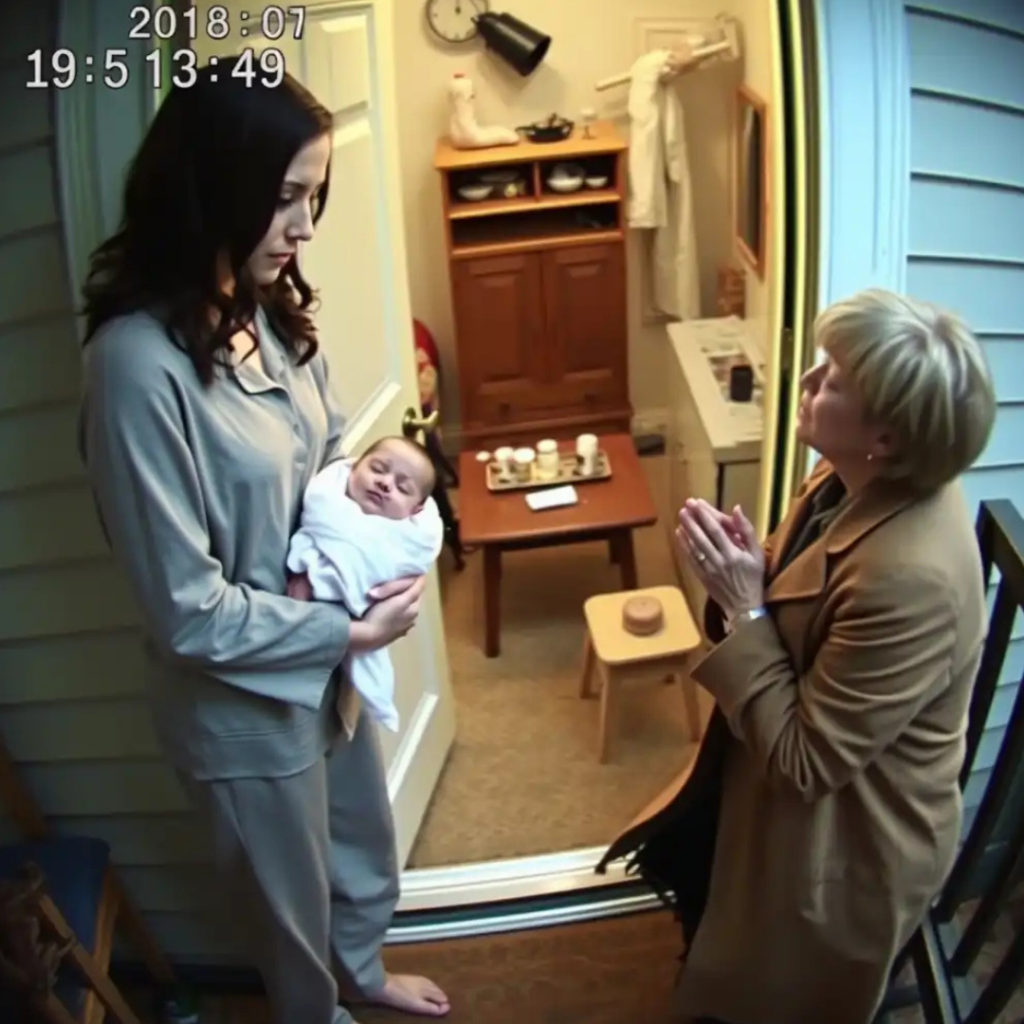
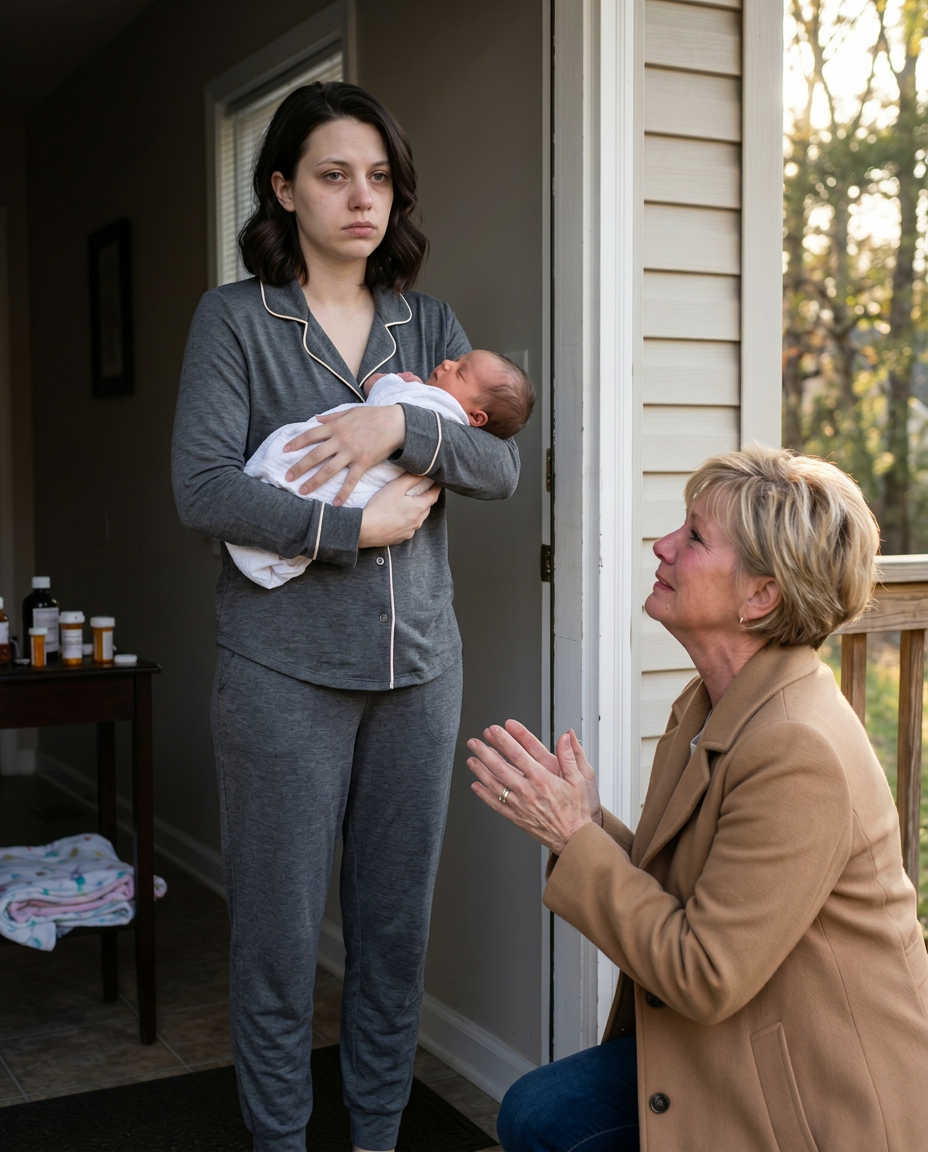
A week later, my mother came to my front door and said, “Let me see the baby.”
I looked straight at her and said, “What baby?”
Then a man’s voice came from the shadows behind her.
“Ava,” he said, “don’t make this harder. We know what you took.”
I had thought waking up without my baby was the worst thing imaginable. I was wrong. The truth waiting outside my door was darker still, and the first person I should have feared wasn’t a stranger.
My heart pounded against my ribs.
A man stepped into the porch light, and for a sickening second I thought I was hallucinating. It was Noah—my husband, the father of my baby, the man who had disappeared three months before my due date. He looked thinner, colder, like someone had stripped away the version of him I loved and left behind a stranger wearing his face.
My mother folded her arms. “Enough games, Ava.”
I let out a sharp, hollow laugh. “Games? I woke up in a hospital bed with no child and a state trooper questioning me about my husband. Then both of you vanished. Now you show up demanding a baby I never even got to hold?”
Noah’s eyes flicked toward the street. “Keep your voice down.”
That scared me more than anything.
“What did they tell you at the hospital?” he asked.
“Nothing,” I snapped. “A woman said there was something I needed to know about you, and then my room was cleared. My chart disappeared. By morning, I was discharged with stitches, an empty car seat, and no answers.”
My mother stepped closer. “Ava, please. Just hand him over.”
Every muscle in my body went rigid. “Him?”
Noah shut his eyes.
“They never told me it was a boy,” I whispered.
Silence.
I stepped backward into the house. “You knew.”
“Ava, listen to me,” Noah said, moving quickly now. “Your son is alive.”
The room spun.
Alive.
I grabbed the doorknob to steady myself. “Where is he?”
Noah glanced at my mother, and I understood something horrifying: he was afraid of her.
“He was never meant to stay in that hospital,” he said. “The delivery wasn’t an emergency. It was arranged.”
My mother lunged for the door. I slammed it, catching her hand in the frame hard enough to make her scream. Noah pounded on the wood from outside.
“Ava! Open the door if you want the truth!”
I locked it and backed away, shaking. Then my phone buzzed on the kitchen counter.
Unknown number.
A woman whispered, “If they found you first, you’re already out of time. Check the lining of the diaper bag they sent home with you. Do not trust your mother.”
The line went dead.
I tore open the diaper bag. Hidden in the lining was a burner phone, a key, and a folded birth certificate.
Mother: Ava Carter.
Father: Unknown.
Where my son’s name should have been, there was only one handwritten word: Hide.
The burner phone lit up in my hand.
YOUR MOTHER SOLD ACCESS TO YOUR DELIVERY. YOUR HUSBAND HELPED US UNTIL HE SWITCHED SIDES. IF YOU WANT YOUR SON, GO TO UNION STATION LOCKER 214. COME ALONE.
Then another message came through.
THE POLICE ARE COMPROMISED.
I glanced toward the front door as my mother pounded on it, screaming my name.
For the first time in my life, I realized the most dangerous person I knew might be the woman who raised me.
I didn’t call the police.
I drove across downtown Denver and reached Union Station late. Locker 214 opened with the key from the diaper bag.
Inside, there was no baby.
Only cash, a flash drive, and a note in Noah’s handwriting.
I’m sorry. If you’re reading this, I failed to get to you first. Trust Lena Morales at St. Mary’s. She saved our son. Your mother is working with Benton.
Richard Benton. My father’s law partner. Hospital donor. The man who had been sitting at my parents’ dinner table the night I went into labor.
The burner phone rang.
“Go to the address in the bag,” a woman said. “Now. They know you left.”
It was Lena.
She opened the door of a small house outside Aurora before I could knock. In her arms was a blue blanket.
My knees nearly buckled.
She pulled it back, and I saw him—tiny, asleep, alive. My son.
Inside, Lena told me everything. Benton ran a private adoption ring through St. Mary’s, using forged records to steal newborns and sell them to wealthy clients. My mother recruited women through charity programs. My father cleaned up the legal trail. When Benton learned my son might inherit money from Noah’s estranged grandfather, he selected him for a buyer who had already paid.
“And Noah?” I asked.
“He helped Benton at first,” Lena said. “He was being blackmailed over old debts. But when he found out they were targeting you, he switched sides. He helped me move the baby before the paperwork cleared.”
Headlights swept across the living room window.
Lena froze. “They found us.”
Glass shattered inward. My mother’s voice followed.
“Ava! Don’t be stupid. He belongs with the family who paid for him!”
Noah burst through the back door, blood on his forehead. “Benton’s here,” he said. “So is your father.”
I placed the baby in Lena’s arms. Noah shoved the flash drive into her laptop. Ledgers, fake birth records, payments, signatures.
“You sent it?” I asked.
He nodded. “Three reporters and a federal investigator. Delayed release.”
Benton stepped into the hall with a gun. My father stood behind him. My mother looked unhinged.
“You ruined everything,” she hissed.
I finally understood. None of this had ever been about family. It was greed wearing my mother’s face.
Benton raised the gun toward Noah.
Then sirens wailed outside.
Noah tackled Benton. The gun skidded across the floor. Officers stormed in. My father dropped to his knees. My mother tried to run and was cuffed in the kitchen.
An hour later, wrapped in a blanket at the back of an ambulance, I held my son against my chest as agents led my parents and Benton away.
Noah sat across from me, bruised and quiet. “I don’t deserve forgiveness,” he said. “But I’m done running.”
“What’s his name?” Lena asked.
For the first time, no one answered for me.
I kissed his forehead and said, “Gabriel. Because he came back to me.”
And this time, no one took him away.
The silence that followed Gabriel’s naming was the first true peace I had known in years. But as the sirens faded into the distance and the clinical chill of the ambulance settled in, I realized that “happily ever after” doesn’t exist for people like us. It only exists for people who have families they can trust.
Noah sat on the edge of the gurney, his head buried in his hands. The federal agents were still bagging evidence inside Lena’s house—the house that had been my son’s first sanctuary.
“They won’t get out on bail,” Noah whispered, his voice cracking. “Benton’s reach is long, but the flash drive… it has the offshore accounts. Your father’s signatures are all over the wire transfers.”
I looked at him, really looked at him. The man I had married was a stranger, then a ghost, then a traitor, and now—what? A whistleblower? “You knew, Noah. When we were sitting in that nursery we painted together, you knew they were planning to sell him.”
“I thought I could stop it from the inside,” he said, finally looking up. His eyes were rimmed with red. “I thought if I played along, I could divert the ‘buyer’ to another case, stall the paperwork. But your mother… Ava, she isn’t human. She saw Gabriel as a windfall. She told Benton you were ‘unstable’ and that a forced adoption was an act of mercy.”
I tightened my grip on the sleeping bundle in my arms. My mother’s sneer at the dinner table—“Call a cab. We’re busy”—wasn’t just cruelty. It was a calculated move to ensure I arrived at the hospital alone, vulnerable, and without a witness.
Two days later, I sat in a sterile room at the Federal Building. Gabriel was in a carrier at my feet, his tiny fist curled around his blanket. Across from me sat a woman named Agent Miller.
“We’ve processed your mother’s statement,” Miller said, sliding a file across the desk. “She’s not even trying to deny it. She’s claiming she did it for your own good. She says you have a history of ‘psychological fragility’ and she was merely securing a future for the child with a ‘stable’ family.”
“And the money?” I asked, my voice cold.
“Two million dollars,” Miller replied. “Deposited into a trust in her name the day you went into labor. Your father was the one who drew up the ‘abandonment’ papers you were supposed to sign while you were drugged after the C-section.”
The room felt like it was shrinking. My own father had used his legal expertise to erase his grandson from existence.
“What happens to Noah?”
“He’s a co-conspirator,” Miller said bluntly. “But his cooperation is the only reason we have the ledger. He’ll likely serve time, though it’ll be reduced. He wants to see you.”
“No,” I said, standing up. “He can see the lawyers. Gabriel and I are leaving.”
I moved into a small apartment three towns over, under a name my parents didn’t know. Lena stayed in touch, a guardian angel who checked in every week.
One evening, a thick envelope arrived. It was from the county jail. I almost threw it away, thinking it was a plea from Noah. But the handwriting was elegant, sharp, and unmistakably my mother’s.
Ava,
I hope you’re enjoying your little victory. You always were dramatic. You think you’ve saved that boy, but look at what you’ve given him: a life of struggle, a father in a cell, and a mother who can’t even look at her own parents without shaking. We offered him a legacy. We offered you a clean slate. You were never meant for motherhood, dear. You’re too soft. Eventually, you’ll realize that the world doesn’t care about ‘love.’ It cares about power. And you just threw ours away.
Don’t bother visiting. We have nothing more to say to a daughter who chooses a stranger’s child over her own blood.
I stared at the words ‘stranger’s child.’ To her, Gabriel wasn’t a person. He was a commodity. A “stranger” because he didn’t yet serve her interests.
I didn’t cry. Instead, I walked to the kitchen and held the letter over the stove. I watched the blue flame catch the corner of the paper. I watched her insults and her greed curl into black ash and vanish into the sink.
Months passed. Gabriel grew, his eyes turning a bright, inquisitive amber—Noah’s eyes.
One night, I sat at my small kitchen table. It wasn’t the heavy mahogany monster of my childhood home. It was a cheap, pine thing I’d assembled myself. There was no wine, no sneering, and no silence.
There was only the sound of Gabriel babbling at a stuffed bear and the soft hum of the radio.
Noah had been sentenced to four years. He sent letters, but I didn’t open them. Maybe one day Gabriel would want to know his father, and I would give him the box of unopened envelopes then. But for now, the air in our home was clean.
I looked at the empty chair across from me. For years, I had begged for a seat at my parents’ table, begging for a crumb of their approval. I realized now that the table was poisoned from the start.
I picked up Gabriel, feeling the warmth of his small body against mine. He was the only legacy I cared about.
“We’re not calling a cab, Gabriel,” I whispered into his hair. “We’re already home.”
The scars on my stomach from that frantic, lonely night at St. Mary’s would never fully fade. They were a map of where I had been. But as I looked out the window at the quiet street, I knew they were also a reminder: I was the one who drove through the pain. I was the one who survived. And I was the only one who got to keep the prize.
The dinner was finally over. And for the first time, I wasn’t hungry for their love anymore.