The sun over São Paulo–Guarulhos had that hard white glare that made the runway look almost unreal.
Ricardo pressed a hand to the airplane window and let himself breathe for what felt like the first time in months.
Five years of expansion had turned him into the kind of man other people described with numbers before they described with feelings.
Thirty-five years old.
Seven restaurants.
Real estate in Dubai.
Constant growth.
Constant absence.
But on that afternoon, stepping back onto Brazilian soil, he was not thinking about profits or meetings or investors.
He was thinking about Camila.
He had not told anyone he was coming.
He had arranged the trip in silence because he wanted one clean moment that belonged only to him and the people he loved.
He imagined Camila’s expression when she saw him standing in the doorway.
He imagined his mother crying.
He imagined his brother slapping his back and his sister talking too loudly as always.
For once, he wanted to arrive as a husband and a son, not as an account number.
In the van from the airport to Campinas, he turned a velvet box over in his hand until the edges felt warm.
Inside was a diamond necklace, simple and elegant, chosen after an hour of rejecting things that looked too cold, too flashy, too impersonal.
Camila had never cared about expensive jewelry.
That was part of why he wanted to give it to her.
Camila had known him before there was anything to admire from a distance.
When Ricardo met her, he was running a failing snack bar with a broken freezer and two chipped tables.
He slept in the storage room more than once because he could not afford rent and food and payroll all at the same time.
Camila had come in one rainy afternoon, ordered coffee, and ended up staying to help him close because the place was flooding.
After that she kept coming back.
She stayed when the business nearly collapsed.
She stayed when his pride was bad and his temper worse.
She stayed when everybody else called him unrealistic.
When success finally arrived, it came like a dam breaking.
One restaurant became three.
Three became seven.
Investors called.
Real estate opportunities opened.
Dubai wanted a concept that looked like luxury but sold nostalgia, and Ricardo, who had once counted coins in the dark, became an international success story almost overnight.
That was when his family began to talk about management.
Dona Lourdes said wealth attracted opportunists.
Patrícia said Camila was too trusting to handle large accounts.
Marcelo laughed and said no woman with a soft heart should be left in charge of property, staff, and contracts.
They framed it as concern.
They framed it as protection.
Ricardo, exhausted and flattered by the idea that his family would help keep everything running, let his mother and sister take over the household budget and operations.
He told himself it was temporary.
He told himself Camila would be relieved to avoid the pressure.
He never asked enough questions to learn whether that was true.
The gates of the Campinas mansion slid open just before sunset.
Ricardo leaned forward as the van rolled in, and pride
touched him before suspicion did.
The property looked polished in a way he had never seen before.
The front gate had fresh paint.
The gardens were trimmed hard and symmetrical.
In the driveway sat a shiny black SUV and a low sports car he did not recognize.
He assumed Marcelo had bought the vehicles with the generous allowance Ricardo transferred each month for family expenses.
The thought annoyed him a little, but not enough to ruin his mood.
He was still holding the necklace box in his palm like it contained a future.
Then he heard the music.
Not background music.
Party music.
Loud enough to vibrate the front windows.
A new security guard met him near the entrance and tried to stop him, his hand lifting automatically.
Ricardo gave his name, then his ID, and watched the man go pale in a way that was too sudden to miss.
The guard opened the gate at once and murmured an apology that sounded more like fear than courtesy.
Ricardo noticed it, frowned, and kept walking.
He expected laughter when he entered.
Surprise.
A cry from Camila somewhere in the hall.
Instead he stepped into a scene that looked less like family warmth and more like a performance of wealth.
A massive dining table stretched nearly the length of the room, crowded with roasted meat, seafood, imported wine, heavy desserts, floral arrangements, and the kind of excess that wanted witnesses.
Guests filled the space in silk, cologne, loud perfume, polished shoes.
Hired servers moved with trays as if this had all been planned for days.
At the center of it, Dona Lourdes wore layered gold necklaces against a shining dress.
Patrícia stood with one hand on her hip in designer fabric Ricardo had never seen before.
Marcelo, already red from drink, slapped the table and raised his glass.
“A toast to Ricardo’s transfers!” he shouted.
The room burst into laughter.
Ricardo did not move at first.
He had stopped near the entrance, partly obscured by a decorative vase taller than his shoulder, and it bought him a few seconds no one noticed him.
In those seconds, the phrase kept striking him from the inside.
Ricardo’s transfers.
Not his return.
Not his success.
Not gratitude.
Money.
Then a sharper problem rose above all the others.
Camila was not there.
He scanned the room once, then again.
She was not at the table, not beside his mother, not helping host, not descending the staircase, not visible through the open doors to the patio.
He crossed the living room and went upstairs, his heartbeat changing shape in his chest.
The master bedroom was empty.
Her closet door stood open.
The bed was made too neatly, as if nobody had rested there in peace.
He went back down and cut toward the main kitchen, where catering staff were moving quickly between stoves and warming trays.
One waiter looked up, clearly assuming Ricardo was another guest.
“Excuse me,” Ricardo said, keeping his voice level.
“Where is Mrs.
Camila?”
The waiter answered without thinking.
“Oh, Camilinha? I think she’s in the back service area.
Dona Patrícia had her washing the big pots.”
There are sentences that land slowly, and there are sentences that rearrange a person in an instant.
Ricardo barely remembered moving after that.
He crossed
the corridor, pushed through the back doors, and walked toward the outdoor kitchen behind the mansion.
Heat hit him first.
Then the smell of grease, detergent, and smoke.
The space was dim and cramped, the exact opposite of the bright luxury in the dining room.
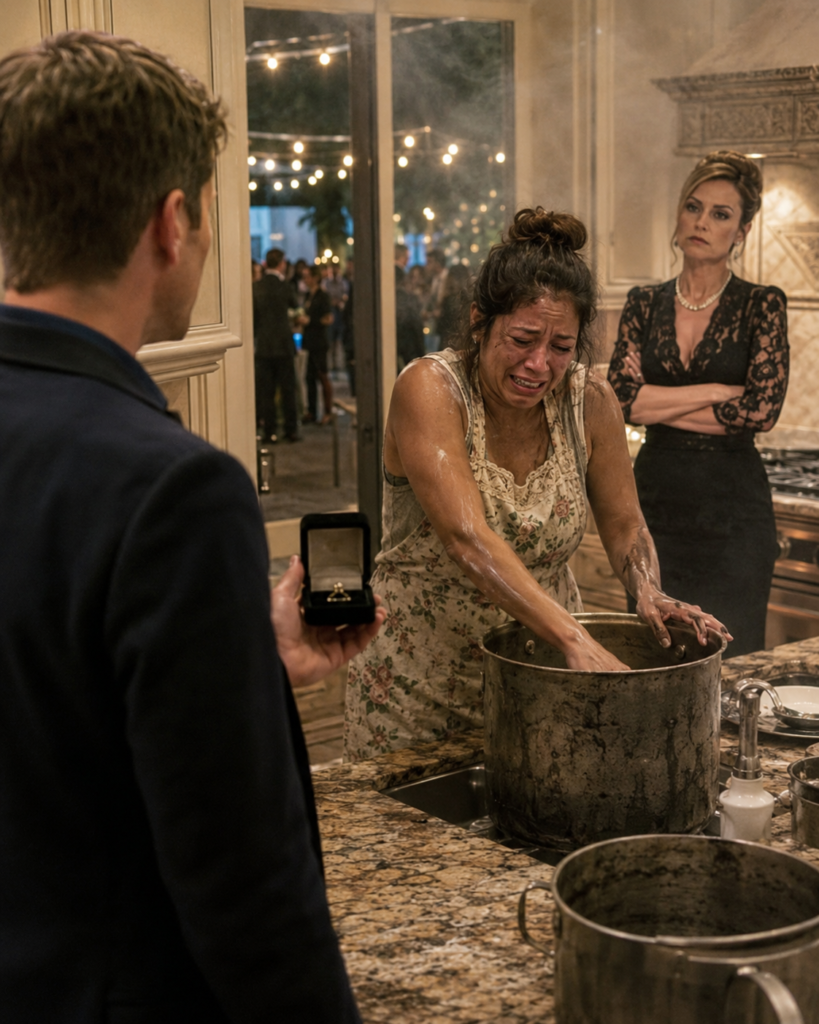
Camila stood at an industrial sink with her sleeves rolled up.
Her hair was tied back carelessly.
Her cheeks were wet with sweat.
Her hands were red from soap and hot water as she scrubbed blackened roasting pans big enough to serve a wedding.
Patrícia stood three feet away in high heels, holding a wineglass and giving instructions.
Ricardo stopped in the doorway.
Camila looked up first.
The sponge fell from her hand.
For a fraction of a second, everything in her face was visible at once: relief, disbelief, shame, love, fear.
Not fear of him.
Fear of being seen like that.
Patrícia turned next, and what flashed across her face was not surprise but irritation, as if he had arrived early to an event she had carefully choreographed.
“Ricardo,” she said, recovering fast.
“You should have called.
We were just—”
“Camila,” he said.
He never raised his voice, but the way he said her name cut the air in half.
Camila straightened slowly.
“You’re home.”
Ricardo looked at her hands, at the apron, at the blackened pans, at the damp hair pasted to her neck.
Then he looked at his sister.
“Why is my wife washing dishes while you drink wine in my backyard?”
Patrícia laughed once, brittle and offended.
“Don’t be dramatic.
The staff got overwhelmed.
She said she would help.”
Camila opened her mouth, then closed it.
That silence told Ricardo more than any explanation could have.
He stepped closer to Camila and took the towel from the counter.
Without speaking, he dried her hands one by one.
The skin along her fingers was chapped and raw.
He had not even been home ten minutes, and already he felt the sick pressure of realization building under his ribs.
“Come with me,” he said.
Patrícia moved in front of them.
“Ricardo, the guests are inside.
Don’t make a scene.”
He looked at her with a calm she did not understand yet.
“You should have thought about that before you built one.”
He took Camila’s hand and led her through the corridor, back into the bright dining room, where the music was still playing and nobody had any idea what was coming.
Ricardo walked to the sound system and turned it off.
Conversation broke apart.
Forks paused in midair.
Marcelo lowered his glass.
Dona Lourdes smiled at first, then froze.
“Ricardo!” his mother cried, pressing a hand to her chest.
“My son! You should have told us!”
He did not answer her immediately.
He guided Camila to the head of the table and pulled out the chair that should have belonged to her all along.
She hesitated.
He waited.
Then she sat.
Only then did he speak.
“Someone explain to me,” he said, “why my wife was in the service area washing pots while you people were toasting my bank transfers.”
Silence moved through the room like smoke.
Marcelo snorted first, making the oldest mistake in the family.
“Oh, come on.
It’s not what it looks like.”
Ricardo turned to him.
“Then this is
your chance to make it look better.”
Dona Lourdes rose from her chair, already arranging her face into maternal injury.
“Camila likes to help in the house.
You know how she is.
Simple.
Humble.
We’re family here.”
Ricardo stared at the gold on her neck.
“Family does not hide my wife in the back while guests drink in the front.”
Patrícia folded her arms.
“She has never known how to manage a large home.
We’ve had to teach her.
You’re always away, Ricardo.
Things have to function.”
“By putting her to work while you spend my money?”
Patrícia’s jaw tightened.
“That is an ugly way to say it.”
Ricardo placed the velvet necklace box on the table.
It landed between crystal glasses and silverware with a small sharp sound.
“I flew across the world to put this around my wife’s neck,” he said.
“Instead I found her scrubbing grease off your party dishes.”
No one answered.
He told the guests to leave.
Some tried to pretend they had not heard.
He repeated himself once, and the authority in his tone emptied the room faster than anger would have.
Within minutes, shoes clicked toward the exit.
Chairs scraped.
Servers disappeared into the kitchen.
Marcelo muttered under his breath.
Patrícia whispered furiously to her husband.
Dona Lourdes began crying on command.
Ricardo let none of it touch him yet.
He took Camila upstairs to the bedroom and closed the door.
For several seconds they simply stood there, two people in a room that had once been theirs and now felt borrowed.
“I’m sorry,” he said.
Camila sat on the edge of the bed and looked at her hands.
“You don’t even know what for yet.”
“Then tell me.”
She was quiet for so long that he almost spoke again.
When she finally lifted her eyes, the exhaustion in them was worse than tears.
“It started small,” she said.
“Your mother said she and Patrícia would help while you were traveling.
Then they started changing staff.
They moved into the main rooms.
They took over the office.
Every decision had to go through them.
If I questioned anything, they said I was ungrateful.
If I wanted to buy something, they said it was wasteful.
If I tried to call you during meetings, they said I was distracting you from work.”
Ricardo sat opposite her and listened without interruption.
“After a while,” she continued, “they stopped treating me like your wife and started treating me like I was lucky to be tolerated.
They told staff not to take instructions from me.
They told guests I didn’t understand money.
They said you had asked them to protect everything because I was too naive.” She swallowed.
“They made me believe that if I complained, you would think I was trying to turn you against your own family.”
“Why didn’t you tell me everything?”
Camila laughed without humor.
“How? In the three minutes between flights? In the messages your sister kept answering for you? In the calls your mother always seemed to be listening to?”
The shame that moved through Ricardo then had nothing to do with money.
He had prided himself on providing, yet he had built an entire system in which the most important person in his life had no safe way to reach him.
“The worst part,” Camila said softly, “wasn’t washing pots.
It was realizing everyone in this house had more access to you than I did.”
He closed his eyes.
That night Ricardo did not sleep.
He went through the office himself.
In locked drawers he found canceled cards, household ledgers, invoices for jewelry, fake maintenance bills, vehicle contracts, and a list of monthly transfers that told a story uglier than he had imagined.
Enormous sums had been flowing into the house for years under the excuse of staffing, upkeep, security, hospitality, and extended family support.
Meanwhile Camila had been given a controlled allowance and treated as though she were irresponsible with money that should have been hers to spend without permission.
At six in the morning he called three people: his attorney Helena, his private banker, and the head of security for his business group.
By eight, they were in the study.
Ricardo did not shout.
He did not throw things.
He became, in a way his family had never respected before, terrifyingly organized.
All household authorizations in Dona Lourdes’s and Patrícia’s names were revoked.
The accounts connected to the property were frozen for review.
The vehicles in the driveway were flagged for ownership verification.
Cameras from the house and grounds were pulled.
Staff contracts were audited.
Temporary access codes were changed.
Security was instructed that no item left the property without written approval from Ricardo or Camila.
At nine-thirty he asked his mother, brother, sister, and brother-in-law to come to the breakfast room.
They arrived angry, red-eyed, and certain that tears, guilt, or family history would rescue them.
Dona Lourdes opened with offense.
“I raised you.
After everything I sacrificed, this is how you repay me? By humiliating me in my own son’s home?”
Ricardo looked at her steadily.
“That is not your home.
And what you did to Camila was humiliation.”
Marcelo leaned forward.
“You’re choosing a wife over blood.”
Ricardo answered him without blinking.
“The woman I married is my family.
The rest is a privilege you just abused.”
Patrícia tried logic next.
She always had.
“You were absent.
Someone had to keep that house running.
We made decisions because you left us no choice.”
Helena, the attorney, slid a folder across the table.
“These were not household decisions,” she said.
“These were personal expenditures disguised as management costs.
There are also irregular cash withdrawals and false vendor invoices.
You may want to choose your next words carefully.”
For the first time, real fear entered the room.
Ricardo placed copies of written notices in front of them.
They were to leave the property that day.
Security would supervise the packing of personal belongings only.
The vehicles purchased with misused household funds would remain.
An audit would determine civil liability.
Criminal complaints would be filed where appropriate.
Dona Lourdes began to sob in earnest.
Marcelo cursed.
Patrícia turned to Camila, who sat quietly at Ricardo’s side, and tried one last line of attack.
“You’re really doing this?” she said.
“After everything we did for you?”
Camila looked at her for a long moment.
When she finally spoke, her voice was calm enough to make the words land harder.
“You did not do things for me,” she said.
“You did things to me.
And you called it care.”
That ended it.
By late afternoon, suitcases were lined in the hall.
Security escorted the family out while staff watched from a distance with the tense stillness of people who had seen far more than they had ever said.
Marcelo turned once at the door as if expecting Ricardo to break.
He did not.
Dona Lourdes tried to bless the house as she left, weeping.
Patrícia kept insisting there had been a misunderstanding even while she demanded to take bracelets the auditor had already identified as purchased with household funds.
When the doors closed behind them, the mansion went quiet in a way Ricardo had never heard before.
It should have felt like victory.
It did not.
It felt like an empty room after a flood.
The following weeks were filled with consequences.
The audit confirmed years of manipulation.
Cars were repossessed.
Jewelry was recovered.
False invoices led to a broader financial review.
Ricardo’s mother and siblings hired lawyers who quickly discovered there was little to defend once documentation, camera footage, staff testimony, and banking records were assembled in one place.
Ricardo paid every legitimate worker in the house what they were owed and let go of the ones who had willingly participated in Camila’s humiliation.
The remaining staff answered to Camila alone until she decided what she wanted.
That was the part Ricardo understood he could not rush.
He could remove parasites in a day.
Rebuilding trust would take longer.
Camila did not fold into his arms and act as if one dramatic confrontation had repaired everything.
She accepted his apology, but she did not let him mistake apology for healing.
Some nights she slept in the guest room.
Some days she barely spoke.
Once, when he tried to promise that he would never let anything like that happen again, she looked at him and said, “That matters.
But it does not erase that it already did.”
So Ricardo did something success had never really taught him to do.
He stopped trying to solve pain like a business problem.
He listened.
He stayed in Brazil.
He canceled trips.
He moved meetings online or delegated them entirely.
He sat with Camila at the first tiny restaurant they had ever built together and spent afternoons in the kitchen, chopping vegetables and cleaning counters beside her like the version of himself that existed before status made him careless.
He gave her full and direct access to every account that affected their lives.
He transferred ownership interests to her name not as a gift to impress her, but as a correction of something that should never have been taken from her in the first place.
Months passed.
The legal matters settled in stages.
Some money was recovered.
Some was not.
Ricardo’s family moved into a smaller apartment on the other side of the city and discovered, for the first time in many years, what life looked like without his transfers padding every desire.
There were no reconciliations.
There were messages, then demands, then insults, then silence.
Ricardo answered none of them.
One evening, standing in the master bedroom of the mansion, Camila looked around at the polished floors, the oversized windows, the furniture chosen more for display than comfort, and said what Ricardo had slowly come to feel himself.
“This house was never really ours
after a while,” she said.
“It became a stage.”
He nodded.
“Do you want to leave?”
She looked at him with relief so immediate that it almost hurt.
“Yes.”
They sold the mansion the next season.
With part of the proceeds and part of the money recovered from the audit, they bought a smaller home near the original restaurant where their story had started.
It had a wide porch, a kitchen full of morning light, and no rooms hidden behind status.
Camila chose every detail herself.
No one approved her decisions.
No one controlled the budget.
No one told her what role she was allowed to occupy in her own life.
The rest of the money went somewhere that made both of them feel, for the first time, that something good had been wrestled out of what had happened.
Camila opened a culinary training program for women returning to the workforce after abuse, abandonment, or financial control.
She wanted a place where labor would never be confused with humiliation, where service would be paid, respected, and chosen.
Ricardo backed the project, but he did not place himself at the center of it.
He knew exactly whose vision it was.
On opening day, the room buzzed with nervous hope.
Stainless steel counters shone under bright lights.
Fresh aprons were folded in stacks.
Women who had spent years being ignored stood straighter when Camila welcomed them.
Ricardo stayed near the back, watching her move through the space with quiet authority.
She was not hidden in a service area anymore.
She was leading the room.
That night, after the guests were gone and the last tray had been put away by people who were paid and proud to be there, Ricardo and Camila sat on the porch of their new house.
The air smelled like rain and herbs from the garden she had planted herself.
He took the velvet box from his pocket.
“I should have given this to you that first day,” he said.
Camila smiled faintly.
“That first day, I needed something else more.”
“I know.”
He opened the box anyway, not as a grand gesture, not as compensation, but as a marker of how far they had come.
Under the soft porch light, he fastened the necklace around her neck.
She touched it once, then looked at him.
“Do you know what mattered more than this?”
“What?”
“Being seen.”
Ricardo reached for her hand, the same hand he had dried in the backyard of the mansion months before, when he finally understood the cost of his blind trust.
“I see you now,” he said.
“And I will spend the rest of my life proving it.”
This time, there was no audience.
No toast.
No performance.
No hidden room where the truth was waiting in the dark.
Only a husband, a wife, and a home that belonged to both of them.
That was how the story actually ended: not with the mansion, not with the money, not with the family who mistook access for entitlement, but with Camila stepping fully back into her own life and Ricardo learning that love without attention is not protection at all.
He never sent his mother or siblings another cent.
Camila never again asked permission to exist in her own home.
And whenever people later
asked Ricardo what had changed him, he gave the same answer every time.
“The day I came home,” he said, “and finally saw my wife.”