
Sophia’s Devastating Fate: A Tragic Suicide or a Carefully Concealed Mystery? | Days of Our Lives Spoilers
For decades, the unpredictable world of Days of Our Lives has captivated audiences with stories of passionate romance, devastating betrayals, unexpected second chances, and unbearable losses. Yet one unwritten rule has always governed life in Salem: nobody disappears without leaving a trail of secrets, sorrow, and lingering uncertainty. Now, Sophia’s deeply unsettling apparent departure has sent shockwaves throughout the fictional town, leaving viewers struggling to understand what truly happened. Her final scenes delivered far more than an emotional farewell. They introduced a disturbing mystery, one filled with painful revelations and unsettling possibilities that could dramatically reshape everything audiences believe they witnessed.
The heartbreaking sequence opens inside a familiar setting that once represented safety and happiness: Sophia’s bedroom. This was where countless private conversations took place, where she and her former best friend Holly once exchanged secrets, laughed together, and imagined brighter futures. But the welcoming atmosphere has vanished. Instead, the bedroom is wrapped in oppressive silence, while faint light stretches eerie shadows across the walls. Longtime soap opera fans know this kind of visual storytelling rarely appears without a reason. Something life-changing, perhaps even irreversible, appears dangerously close.
Sophia remains seated at her writing desk, barely moving as tension overwhelms her body. Her fingers shake when she picks up a pen, and the camera stays close enough to reveal the anguish hidden behind her exhausted expression. Every glance reflects emotional wounds that have accumulated over time. She has survived painful betrayals, relationships that collapsed under unbearable pressure, and the exhausting struggle to earn forgiveness from people unwilling to overlook her past. Salem has repeatedly reminded her of every mistake, no matter how desperately she has tried to move forward. Now, the emotional burden seems heavier than she can bear.
When Sophia finally begins putting her thoughts onto paper, the result is an intensely personal confession. Her message contains no carefully constructed sentences or graceful declarations. Instead, it reveals someone overwhelmed by loneliness, shame, and emotional exhaustion. She admits that she can no longer endure the constant cycle of saying sorry, defending herself, and searching for acceptance that always seems just beyond her reach. She desperately wanted others to recognize her pain rather than define her entirely by her failures. Above everything else, she longed to experience affection without criticism or conditions. Tragically, she has convinced herself that such happiness is no longer possible.
Then, one devastating reference gives the entire message an even darker meaning.
Sophia recalls something Holly once told her during the collapse of their friendship: that she was “already dead inside.” What may have been spoken in anger has apparently remained lodged deep within Sophia’s thoughts. Those words inflicted damage far beyond what Holly could have anticipated. Over time, Sophia seemingly began accepting the cruel accusation as an accurate description of herself. Instead of dismissing it as an expression of frustration, she allowed it to shape how she understood her own existence. Now, in an especially painful development, the statement appears connected to her apparent decision to end her life.
The emotional significance of this revelation is overwhelming. Sophia and Holly were once inseparable, providing each other with companionship and understanding in a community where danger and deception seemed unavoidable. Their friendship endured difficult revelations, personal disagreements, and experiences that might have destroyed less meaningful connections. Yet somewhere between those struggles, resentment began replacing trust. Arguments became increasingly damaging, and the emotional distance between them grew until reconciliation seemed impossible. Could the collapse of this once-cherished relationship have contributed to Sophia’s devastating state of mind?
The sequence continues with an unsettling stillness, allowing each small gesture to carry extraordinary emotional weight. Sophia carefully folds the letter, taking her time as though completing a deeply significant ritual. She then stops beside the mirror and looks silently at the face staring back at her. Is she searching for traces of the hopeful person she used to be? Is she reconsidering the decisions that brought her here? Or does that lingering glance represent a final farewell? There are no explosive confrontations, no dramatic pleas for help, and no sudden arrival to interrupt the scene. Instead, the atmosphere becomes increasingly disturbing because of its quietness.
The story appears to lead viewers toward one devastating interpretation: Sophia intends to die by suicide.
However, anyone familiar with Salem knows appearances can be dangerously misleading.
Dedicated followers of Days of Our Lives have learned to question nearly every seemingly definitive tragedy. Throughout the show’s history, characters declared dead have resurfaced after years of absence, sometimes under circumstances nobody could have predicted. Supposedly fatal incidents have been exposed as carefully organized schemes. Apparent deaths have concealed kidnapping plots, elaborate impersonations, and calculated criminal acts. Even situations initially presented as suicide have occasionally carried darker explanations. Salem has repeatedly demonstrated that a convincing scene does not necessarily reveal the entire truth.
That history raises an unavoidable question: have viewers really witnessed Sophia’s final chapter?
The suffering portrayed in these moments cannot simply be dismissed. Sophia’s despair appears deeply rooted in her experiences, and the emotional fatigue surrounding her is impossible to overlook. Her relationships have deteriorated, her reputation has suffered, and she has endured the painful realization that the people around her may never completely forgive what happened before. Every attempt at rebuilding her life has seemingly brought another reminder of the past. Her words reveal someone who believes she has exhausted every possible path toward acceptance. The resulting scene feels painfully intimate, as though audiences are watching a character reach an emotional crisis rather than simply witnessing another dramatic plot development.
Nevertheless, several details invite a different interpretation.
Sophia has never been portrayed as someone who gives up easily. Again and again, she has confronted situations that seemed impossible to overcome. Even after devastating setbacks, she has managed to find ways to continue, sometimes making questionable decisions but rarely surrendering without a struggle. Her determination has always been one of her defining characteristics. Could such a fiercely persistent person truly vanish without one final confrontation? Or are the writers deliberately hiding another explanation behind this apparently straightforward tragedy?
There is one particularly disturbing possibility that deserves consideration.
What if Sophia never actually carried out the decision described in her letter?
Consider how carefully the circumstances have been arranged. The emotional message already exists, her troubled relationships provide an apparent explanation, and the bedroom has become the setting for what looks like a heartbreaking ending. In Salem, however, such a convincing combination of evidence can sometimes become the perfect foundation for deception. The town’s history is filled with individuals who manipulate vulnerable people and exploit moments of emotional weakness to advance their own dangerous agendas.
Imagine an unidentified person entering Sophia’s bedroom after the letter has been written. Perhaps this individual has a personal grievance, a secret worth protecting, or a reason to silence her. The written confession could provide an ideal opportunity to disguise a crime. Investigators might interpret the circumstances as a suicide without immediately considering another person’s involvement. What initially appears to be the result of Sophia’s personal despair could instead conceal something far more sinister. If that theory proves accurate, then even the basic assumptions surrounding her reported death may be completely wrong.
Another detail that cannot be ignored concerns the timing of her apparent departure.
Reports and speculation surrounding the actress portraying Sophia suggest that her professional commitments outside Days of Our Lives may influence the character’s future. When performers move toward significant new opportunities, daytime dramas frequently respond by creating memorable exits. Sometimes those departures permanently close a character’s story. On other occasions, the writers intentionally leave important questions unanswered, preserving the possibility of an eventual comeback. And every so often, what initially resembles an ending becomes the first step toward a much larger and more complicated mystery.
After all, in Salem, the final page of one storyline can easily become the opening scene of another.
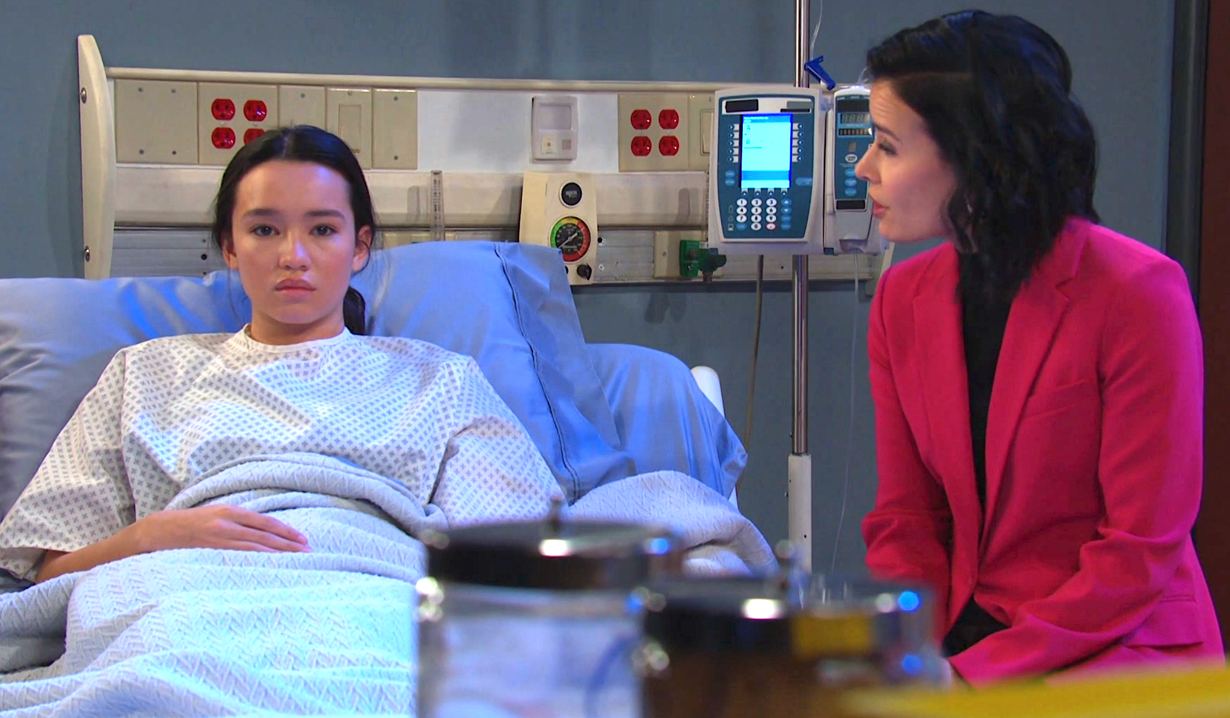
Picture an unexpected development: Sophia is found in critical condition, with doctors unable to determine whether she will survive. Friends and family are devastated, while rumors spread rapidly through Salem. Holly becomes overwhelmed by guilt, replaying their last arguments and remembering the terrible accusation she made. The words she once spoke in anger now seem impossible to escape. Yet while everyone focuses on Sophia’s medical condition, investigators begin noticing details that do not fit the original explanation. A suspicious discovery emerges, followed by conflicting accounts and unanswered questions.
Was Sophia really the only person inside that bedroom?
Or could someone else have intervened, preventing her from reconsidering her actions and turning a private emotional crisis into a calculated crime?
Another intriguing scenario involves Sophia surviving the ordeal, only to return under dramatically changed circumstances. Days of Our Lives has repeatedly embraced reinvention, introducing characters who experience memory problems, assume unfamiliar identities, or emerge from traumatic events with completely transformed personalities. If Sophia eventually reappears, the experience could alter her relationships, motivations, and understanding of everything that happened. She might remember a crucial detail that others overlooked. She could become determined to uncover the truth. Or she might return as someone who no longer recognizes the people and circumstances that once defined her world.
Such a transformation could provide the foundation for an entirely different future.
What gives this storyline its strongest emotional impact is not simply the uncertainty surrounding Sophia’s fate. Beneath the mystery lies a painful exploration of loneliness, remorse, rejection, and the human desire to feel understood. Sophia appears to believe that her mistakes have made her permanently unworthy of compassion. She has confused the judgments of others with the total value of her own life, allowing guilt and isolation to overshadow any possibility of healing. That distorted belief makes the sequence especially heartbreaking because her suffering is presented as real, even while the surrounding circumstances remain open to interpretation.
Still, whether her apparent departure truly represents the conclusion of her story is far from established.
The narrative contains enough uncertainty to encourage audiences to examine every moment more carefully. The camera’s attention to particular objects and movements inside the bedroom may eventually prove significant. Several complicated relationships remain unresolved, especially the damaged friendship between Sophia and Holly. Meanwhile, the apparent neatness of the circumstances surrounding her disappearance seems almost suspicious. Everything fits together so conveniently that experienced viewers may wonder whether they are being guided toward the wrong conclusion.
Perhaps that uncertainty is precisely what the writers intended to create.
Perhaps audiences are supposed to challenge the explanation placed directly in front of them.
Because in the unpredictable world of Salem, even the most convincing evidence can conceal a completely different reality.
Sophia may truly be gone, leaving behind painful memories and relationships forever marked by regret. But she could also be alive somewhere beyond the reach of those searching for answers, with an unfinished story waiting to emerge. Her emotional suffering was unmistakable. The despair expressed in her letter carried genuine significance within the narrative. Yet the circumstances surrounding her final appearance may contain secrets that have not been revealed. What seemed like a tragic conclusion could ultimately become the centerpiece of a dangerous investigation.
For the moment, viewers are left confronting troubling possibilities. Has Days of Our Lives delivered a devastating farewell to a young woman unable to find peace with her past? Will Holly be forced to live with the consequences of words she never imagined could cause such pain? Or is the supposed tragedy merely the beginning of a more sinister chain of events, one that will gradually expose unexpected betrayals and hidden motives in the coming weeks?
Whatever the ultimate explanation, Sophia’s apparent exit has already created emotional consequences that Salem will not easily forget.
And in a town famous for reversing the seemingly irreversible, what looks like a permanent goodbye may eventually prove to be anything but the end.